How to Increase Clubhead Speed After 50 in 30 Days

How to Increase Clubhead Speed After 50 in 30 Days
By Chris Ownbey | TPI Certified Golf Fitness Specialist | Dallas, Texas
Want to increase clubhead speed after 50? Start by understanding what your body is losing.
Are you losing distance off the tee? Are you swinging harder but watching your drives travel shorter than they did a few years ago?
Maybe two years ago, you were consistently driving the ball 240 yards. Today, you’re struggling to reach 210. Naturally, you start telling yourself, “I’m getting older, and I’m losing flexibility. I guess this is just part of aging.”
But what if age isn’t the biggest problem? What if the real issue is that you’re losing strength, speed, and power?
I have more than 30 years of experience in fitness and two decades of working with golfers. As a result, I’ve heard this frustration countless times. Almost every golfer who contacts me wants to improve one or more of three things:
- Clubhead speed
- Driving distance
- Consistency and accuracy
The good news? While we can’t stop chronological aging, we can influence many of the physical changes that affect golf performance. With the right system, you can begin making measurable progress in as little as 30 days.
Let’s look at why golfers lose distance and, more importantly, what you can do about it.
Why Do Golfers Lose Clubhead Speed After 50?
One of golf’s biggest misconceptions is that losing distance is simply a natural result of getting older. Aging certainly affects the body. However, the more useful question is this: what physical changes cause your swing speed to decline?
Several factors contribute, including reduced muscle mass, declining power production, changes in nervous system function, and restrictions in mobility. Fortunately, targeted training can improve many of them.
1. Sarcopenia: The Loss of Muscle Mass and Strength
Beginning in adulthood, we gradually lose muscle mass if we don’t take steps to preserve it. This age-related decline is called sarcopenia. It can become more significant through our 50s, 60s, and 70s.
Why does this matter for golf? Muscle produces the force that generates speed in your swing. Your legs, hips, torso, and upper body work together to transfer energy from the ground, through the club, and into the ball. When strength declines, your ability to generate and transfer force can decline too.
The solution isn’t necessarily to swing harder. Instead, it’s to build a stronger body that produces more force efficiently. For more on this, read why strength matters for golfers over 50.
2. Loss of Fast-Twitch Muscle Performance
Your muscles contain different types of fibers, including slow-twitch and fast-twitch fibers. Slow-twitch fibers mainly support endurance activities such as walking. Fast-twitch fibers, on the other hand, are especially important for rapid, powerful movements.
Think about the difference between walking up a hill and making an explosive golf swing. A powerful swing requires rapid muscle activation and coordinated force production. With age, however, fast-twitch fibers can shrink, and your ability to generate power can decline.
Properly designed resistance and speed training can help preserve and improve explosive performance. For this reason, walking, stretching, and recreational golf alone may not give your body everything it needs. You have to train your body to produce speed.
3. Changes in Neural Drive and Muscle Activation
Your nervous system plays an essential role in how quickly and effectively your muscles contract. Every movement starts with communication between your brain, nervous system, and muscles. Motor units, which consist of motor neurons and the muscle fibers they activate, carry out that communication.
As we age, changes in motor unit function can affect how efficiently we recruit muscles, particularly during fast, forceful movements. In golf, this can influence your ability to accelerate the club through the swing.
Therefore, the goal of golf-specific training isn’t simply to build bigger muscles. It’s to improve how well your nervous system and muscles work together. Strength gives you the capacity to produce force, while speed training teaches you to apply that force quickly. You need both.
4. Reduced Hip and Thoracic Mobility
Restricted mobility is another common reason golfers lose distance. During my golf fitness assessments, I frequently evaluate two areas:
- Hip internal and external rotation
- Thoracic spine rotation
Your hips and upper back need enough mobility for your body to rotate efficiently. When these areas become restricted, your body develops compensations. For example, you might notice early extension, an over-the-top swing pattern, a reduced shoulder turn, or difficulty holding your posture. These compensations can affect club delivery, consistency, and power.
I also teach golfers an important distinction. Flexibility generally refers to a muscle’s ability to lengthen. Mobility, in contrast, is your ability to actively move a joint through its available range. You need both, along with stability and control.
For golfers over 50, improving the right movement patterns helps you make better use of the strength and power you already have. To learn more, read about 5 physical limitations that can affect your golf swing.
The Good News: You Can Increase Clubhead Speed After 50
Here’s what I want every golfer to understand. You aren’t automatically destined to lose distance every year just because you’re getting older. You can’t change your age, but you can train your body to become stronger, more mobile, and more powerful.
No single workout is perfect for everyone. Still, there is a smarter way to train for your sport, your age, and your physical limitations. To increase clubhead speed after 50, I focus on three training components.
1. Resistance Training: Build the Strength Behind Your Swing
Resistance training is one of the most valuable investments you can make in your golf performance. I’m not talking about bodybuilding workouts or two hours of heavy lifting. Instead, I’m talking about targeted exercises that improve your ability to produce and control force.
Resistance bands are among my favorite tools. They let us challenge movement patterns while adjusting the resistance to each golfer. Examples include:
- Standing resistance-band rows
- Band-assisted rotational exercises
- Controlled band presses
- Hip strengthening movements
- Anti-rotation core exercises
I also use other resistance methods when appropriate. The objective is to strengthen your lower body, hips, torso, and upper body so they work together more effectively. Remember, your golf swing is a full-body athletic movement. A stronger body creates the foundation for a more powerful swing.
2. Speed Training: Teach Your Body to Move Faster
Strength is important, but strength alone doesn’t guarantee more clubhead speed. You must also train the ability to produce force quickly. That’s where golf-specific speed training becomes valuable.
Depending on your assessment, I may add controlled overspeed training, lightweight swing-speed drills, or other exercises that encourage rapid movement. If you’re curious about training aids, see my guide to golf swing trainers. The goal is to challenge your nervous system to coordinate faster movements without sacrificing control.
One of the biggest mistakes golfers make is trying to swing harder before building the physical capacity to support that speed. Instead, I prefer to build the foundation first and then introduce speed work progressively. Train for speed. Don’t just hope it returns.
3. Power Training: Improve Acceleration and Deceleration
Golf requires more than acceleration. Your body must also control and slow down movement effectively. The swing involves a coordinated sequence of force production, energy transfer, and muscular braking. Developing strength and control throughout that sequence supports better performance.
For golfers who are physically prepared, medicine-ball exercises can be effective power tools. Examples include:
- Medicine-ball slams
- Controlled rotational medicine-ball throws
- Standing explosive presses
- Fast resistance-band movements
Not every exercise suits every golfer. A 55-year-old with healthy joints may have very different needs from a 70-year-old with previous back or shoulder surgery. That’s why I assess each golfer before choosing exercises. The objective is to build power safely, not to perform explosive movements for the sake of intensity.
Your 30-Day Plan to Increase Clubhead Speed After 50
If you want to start improving over the next month, focus on consistency and progressive training. Here’s a general four-week framework.
Week 1: Establish your starting point. First, evaluate your current physical capabilities. Measure your clubhead speed if you have a launch monitor or speed-measuring device. Then assess your hip mobility, upper-back rotation, balance, and basic strength. This week’s goal is to identify limitations and set a baseline.
Week 2: Build strength and stability. Next, introduce structured resistance training two to three times per week. Focus on lower-body strength, hip stability, core control, and upper-body strength. Meanwhile, keep working on the mobility limitations you identified. Your objective is to improve your body’s ability to produce and control force.
Week 3: Introduce speed and power. Once you’ve built a foundation, add appropriate speed drills. Use controlled, high-quality repetitions with adequate recovery. Continue resistance training while you gradually introduce exercises designed to improve movement speed. Quality matters more than quantity.
Week 4: Retest and evaluate. Finally, reassess your clubhead speed and physical performance. Compare your results with your starting measurements. You may notice improvements in strength, mobility, swing confidence, or speed.
Not everyone will gain clubhead speed or distance within 30 days. Still, this period can give you a measurable starting point for continued progress. Meaningful physical development is a process, not a quick fix.
Why My 5-20-5 Golf Fitness System Works for Busy Golfers
Finding time to train consistently is one of the biggest challenges golfers face. Many of my clients are professionals, business owners, and executives. They want to stay competitive on the course without spending hours in the gym.
That’s why I developed my 5-20-5 Golf Fitness System™. Each private training session takes just 30 minutes:
- 5 minutes: Dynamic preparation. We prepare your body for movement, focusing on mobility, activation, and the areas that need attention.
- 20 minutes: Focused strength and performance. We train the physical qualities your assessment identified, including strength, stability, mobility, and appropriate speed or power work.
- 5 minutes: Recovery and mobility. We finish with targeted stretching, controlled movement, and recovery work.
There are no unnecessary exercises and no wasted time. Instead, you get focused training designed around your body and your golf performance. If you’re also interested in general fitness, see my page on personal training after 40 in Dallas.
Why a TPI Golf Fitness Assessment Matters
Before you try to increase clubhead speed after 50, you need to understand what’s limiting your performance. I’m a Titleist Performance Institute (TPI) Level 1 and Level 2 Certified Golf Fitness Specialist, so I evaluate the physical capabilities that influence your swing.
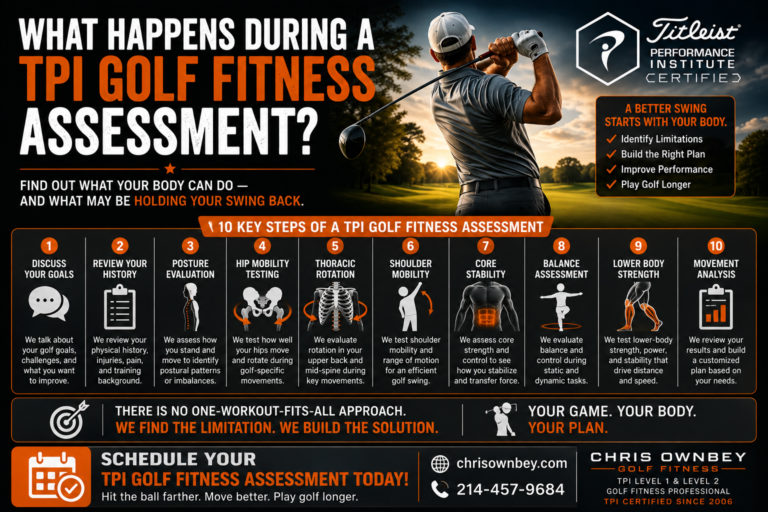
Your assessment may identify limitations in hip rotation, thoracic mobility, shoulder function, balance, strength, or stability. This information helps determine which exercises are right for you. For details, read what happens during a TPI golf fitness assessment.
Your golf instructor teaches you how to swing the club. My job is to help your body develop the physical capabilities needed to perform those movements. That’s an important distinction, and it’s the idea behind The 3 Inch Swing™.
Frequently Asked Questions: Increase Clubhead Speed After 50
Can you really increase clubhead speed after 50?
Yes. Many golfers over 50 can improve clubhead speed through properly designed resistance training, mobility work, and golf-specific speed training. Individual results depend on physical condition, training history, technique, and consistency.
How many days per week should golfers over 50 work out?
Two to three structured strength sessions per week can provide a useful foundation. Speed training and mobility work can then be added according to individual recovery and physical readiness.
Does lifting weights help increase golf driving distance?
Resistance training can improve the strength and power needed for an effective swing. When you combine it with speed training and efficient swing mechanics, it can contribute to more clubhead speed and driving distance.
Can I improve my golf swing without changing my swing mechanics?
Sometimes. Improving mobility, stability, strength, and power may help you execute your existing swing more effectively. However, technique and equipment also influence distance and accuracy.
How quickly can I expect to see results?
Some golfers notice early improvements in movement quality or performance within several weeks. Significant strength and power adaptations, however, generally require longer training. Results vary.
Ready to Increase Your Clubhead Speed After 50?
If you’re a golfer over 50 in Dallas, Carrollton, Plano, or the surrounding North Dallas area, I can help you find the physical limitations that may be holding back your game. I’ve spent decades helping athletes improve their physical performance, including more than 20 years specializing in golf fitness. For another angle on distance, read Golf Fitness Over 50: Are You Losing Distance Because of Your Body? or Losing Distance Off the Tee After 50? 7 Common Causes.
My approach is simple: assess your body, build the right system, train with purpose, and measure your progress.
You don’t need to train like a 25-year-old to become a better golfer at 55, 65, or 75. You need a system designed for your body, your goals, and the game you love.
Schedule your TPI Golf Fitness Assessment with Chris Ownbey today, or visit chrisownbey.com to learn more about private golf fitness training in Dallas, Texas.
Your body is your most important piece of golf equipment.
Stay Strong. Play Long.
Chris Ownbey
TPI Certified Golf Fitness Specialist
Founder, 5-20-5 Golf Fitness System™
Other related topics:
The Inner Game of Golf: How to Quiet Your Mind, Trust Your Swing, and Play Better Golf
The 3 Inch Swing™: A Simpler Approach to a Better Golf Swing
Personal Training After 40 in Dallas: Get Strong, Lean & Move Better
- What Happens During a TPI Golf Fitness Assessment?
- 5 Physical Limitations That Can Affect Your Golf Swing
- Is Your Body Limiting Your Golf Swing? Golf Fitness Dallas
- Why golfers lose distance after 50?
- How to Stop Slicing the Golf Ball
- Why Your Back Hurts After Playing Golf: The Hidden Cause Most Golfers Never Address
- Why Strength Matters for Golfers Over 50
- Straddle Stretch for Golfers | Dallas Golf Fitness
- Golf Fitness in Dallas – How to Increase Speed, power, and Distance While Preventing Injuries