Golf Fitness Over 50: Are You Losing Distance Because of Your Body?
Golf Fitness Over 50: Are You Losing Distance Because of Your Body?
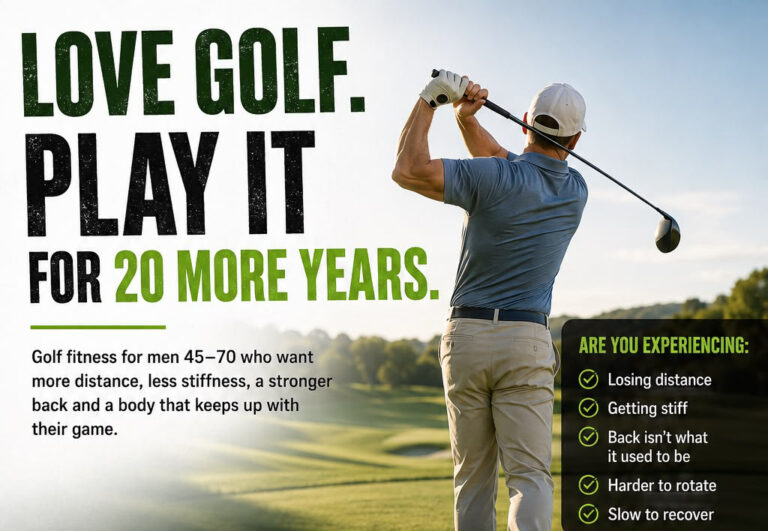
Golf fitness over 50 can play an important role in helping golfers maintain strength, mobility, balance, endurance, and distance as they get older.
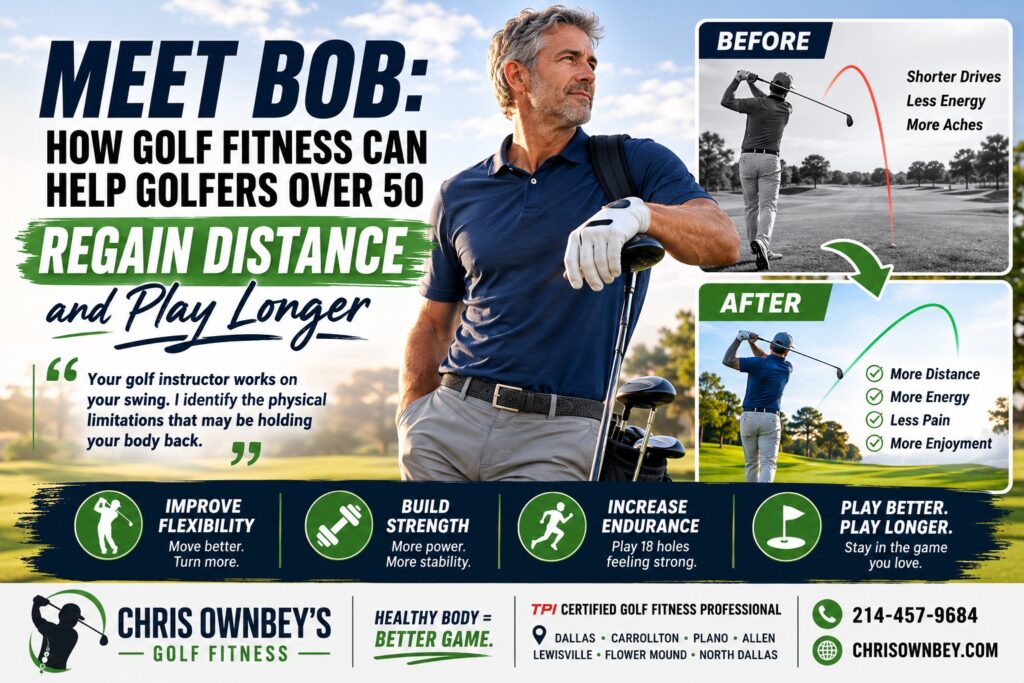
Fellow golfers, meet Bob.
Bob is a successful business executive who loves golf.
He reached a point in his life where he finally had more freedom to play. His career was established, his kids were older, and financially, he could enjoy more rounds of golf than he could 20 years ago.
There was just one problem.
His Body Wasn’t Cooperating
Bob had gradually gained about 10–15 pounds.
He wasn’t as flexible as he used to be. His back bothered him after playing, and he became tired toward the end of 18 holes.
Most importantly, Bob noticed something that many golfers over 50 understand immediately:
He Was Losing Distance Off the Tee
The frustrating part?
Bob had been playing golf for years.
He understood his swing, practiced regularly, and played often.
However, after turning 50, his driver simply wasn’t going as far as it once did.
At first, Bob assumed this was just part of getting older.
It isn’t necessarily.
Sometimes your golf swing isn’t the only thing that needs attention.
Instead, the problem may be the body performing the golf swing.
Why Golf Fitness Over 50 Matters
One of the biggest mistakes golfers make as they age is assuming that losing distance is purely a swing problem.
Sometimes it is.
That’s why working with a qualified golf instructor is important.
However, there is another side of the equation:
Your body.
Your golf instructor can teach you what the golf club needs to do.
My job as a golf fitness professional is different. I look for physical limitations that may prevent your body from doing what your instructor is asking you to do.
That’s exactly what Bob discovered.
He didn’t necessarily need to swing harder.
Instead, he needed to improve his body’s ability to make the golf swing.
For many golfers, golf fitness over 50 is about building the physical foundation needed to continue playing the game comfortably and efficiently.
Why Golf Changes After 50
Most golfers don’t wake up one morning and suddenly lose 20 yards.
Instead, these changes usually happen gradually.
Your shoulder turn may become slightly smaller.
Your hips may become tighter.
You may lose some strength.
Your balance can also change.
Meanwhile, your core may not be as strong as it once was.
You may also find that you don’t recover from 18 holes as quickly.
Eventually, you notice that you’re hitting one more club into the green.
Then another.
The par 5 you used to reach in two may no longer be reachable.
Your buddies may even start outdriving you.
What Do Many Golfers Do?
They swing harder.
Unfortunately, swinging harder isn’t necessarily the same as swinging faster.
If your body lacks mobility, stability, or strength, trying to create more speed can make your golf swing less efficient.
As a result, you may:
- Lose balance
- Change your swing sequence
- Create more tension
- Put extra stress on your lower back
- Place more stress on your shoulders, hips, or knees
That’s why I tell golfers:
You Don’t Necessarily Need to Swing Harder. You Need a Body That Allows You to Swing Better.
The Three Physical Qualities You Need for Golf Fitness Over 50
When Bob began his golf fitness training, we didn’t start by trying to rebuild his golf swing.
Instead, we focused on improving the physical foundation underneath it.
Several physical qualities are important for golf performance. However, three were particularly important for Bob:
1. Flexibility and Mobility
A good golf swing requires your body to move through a significant range of motion.
Your hips need to move freely.
Your shoulders also need to move well.
In addition, your upper back needs enough rotation.
When these areas become restricted, your body has to find another way to complete the golf swing.
That’s when compensations can occur.
For Bob, improving his ability to rotate allowed him to make a bigger and more comfortable shoulder turn without forcing the movement.
That’s important because a bigger backswing isn’t automatically better.
However, having the physical ability to rotate properly can give your golf instructor more options when working on your swing.
2. Golf-Specific Strength
When golfers hear the word “strength,” they sometimes think about bodybuilding or lifting extremely heavy weights.
That’s not what we’re talking about.
Golf-specific strength is about building the physical ability to support your golf swing.
Your legs help create force.
Your hips help transfer that force.
Meanwhile, your core helps stabilize and transfer energy between your lower and upper body.
Your upper body then helps control the club.
For Bob, additional core and lower-body strength helped create a better physical foundation.
Instead of trying to create everything with his arms and upper body, he became better able to use his entire body.
Golf Power Isn’t Just Upper-Body Strength
Golf power involves coordinated movement throughout the body.
Therefore, the goal isn’t simply to make one area stronger.
The goal is to help your entire body work together.
3. Muscular Endurance
Bob wasn’t only concerned about hitting longer drives.
He also wanted to feel better on holes 15, 16, 17, and 18.
That’s where muscular endurance becomes important.
Think about everything that happens during a round of golf.
You may be walking or riding for several hours.
You are repeatedly bending down, practicing swings, and hitting drives, irons, wedges, and putts.
In addition, you’re getting in and out of the cart and moving equipment.
Most importantly, you’re trying to reproduce an athletic movement dozens of times.
If your body becomes tired late in the round, your golf swing may change.
Your posture can change.
Balance may also become harder to maintain.
Rotation and timing can change as well.
Bob wanted to finish 18 holes feeling like the golfer who started the round.
For that reason, endurance became part of his golf fitness program.
What Happened When Bob Started Golf Fitness Training?
Bob began training approximately twice per week.
We weren’t trying to turn him into a bodybuilder.
We were trying to build a better body for golf.
After several weeks, Bob began noticing changes.
One of the first improvements was his ability to turn.
His improved upper-body mobility allowed him to create a more comfortable shoulder turn.
As a result, he could move more efficiently during the backswing.
Then something else happened.
His Distance Started Coming Back
However, that wasn’t even the biggest victory.
Bob noticed that he wasn’t nearly as tired after playing golf.
His body held up better throughout the round.
His back wasn’t bothering him in the same way after 18 holes.
He could also hit balls on the range without feeling as physically beaten up the following day.
For Bob, golf fitness wasn’t just helping his golf swing.
It was helping him enjoy golf again.
The Missing Piece: Golf Swing Sequencing
Bob had also been working on starting his downswing with his lower body.
His golf instruction made sense.
He understood what he was being asked to do.
However, understanding a movement and physically performing it are two different things.
This is where golf instruction and golf fitness should work together.
Bob’s improved upper-body mobility gave him more freedom to rotate during his backswing.
At the same time, his improved core strength gave him a better foundation for controlling that movement.
His improved lower-body strength and stability also helped him work on starting the downswing from the ground up.
The objective wasn’t to replace his golf instructor.
Instead, it was to make Bob’s body more capable of performing what his instructor wanted.
Golf Instructor + Golf Fitness Professional
I believe this is one of the most effective approaches for golfers.
Your Golf Instructor Works On:
- Clubface
- Club path
- Setup
- Ball position
- Swing mechanics
- Shot shape
- Technique
Your Golf Fitness Professional Evaluates:
- Mobility
- Flexibility
- Strength
- Balance
- Stability
- Posture
- Physical movement patterns
- Muscular endurance
The two roles should complement each other.
Your instructor teaches your swing.
We prepare your body to perform it.
Why Your Body Could Be Costing You Driving Distance
Let’s say your instructor wants more rotation in your backswing.
However, your thoracic spine is restricted.
You can understand the instruction perfectly and still struggle to perform it.
As a result, your body has to compensate somewhere.
Maybe you sway.
Perhaps you lift.
Your lower back may also try to create rotation that your upper back doesn’t have.
Alternatively, your arms may travel farther because your torso doesn’t.
Now imagine practicing that movement over and over.
You’re working hard.
You’re taking lessons.
You’re hitting hundreds of golf balls.
Yet you’re still fighting a physical limitation.
That’s why I use this phrase so often:
If You Don’t Test, It’s Just a Guess.
Before assuming everything is a swing problem, determine whether your body can physically perform the movement.
What Is a TPI Golf Fitness Assessment?
At Chris Ownbey’s Golf Fitness, we use a golf-specific physical assessment to look at the golfer behind the golf swing.
We’re trying to answer a simple question:
What Can Your Body Do—and What Is It Struggling to Do?
A golf fitness assessment may evaluate:
- Hip mobility
- Thoracic rotation
- Shoulder mobility
- Core stability
- Balance
- Posture
- Flexibility
- Strength
- Movement quality
This information helps us identify physical limitations that may influence how you move during the golf swing.
Instead of giving every golfer the same exercises, we can develop a system based on what that individual golfer needs.
That’s especially important when you’re considering golf fitness over 50.
You don’t have unlimited time.
You don’t need another generic workout.
Instead, you need to know which areas will give you the greatest return for the time you’re investing.
Golf Fitness Is Not the Same as Going to the Gym
This is another misconception I see with golfers.
You can be physically fit and still not be in golf shape.
For example, I’ve worked with strong golfers who couldn’t rotate well.
I’ve also seen flexible golfers who lacked stability.
In addition, I’ve seen people who could lift impressive weights but struggled to balance during golf-specific movements.
Golf has specific physical demands.
Therefore, the goal isn’t simply to become stronger.
Instead, it’s to develop the combination of mobility, strength, stability, balance, and endurance that supports your golf game.
Train With a Purpose
Every exercise should answer one simple question:
How Is This Helping My Body Perform Better for Golf?
If we can’t answer that question, we should reconsider why you’re doing the exercise.
A golf fitness program should have a purpose.
It should address your individual needs rather than simply copying exercises from social media.
Train for what your body needs, not just what looks like golf.
Golf Fitness for Dallas Golfers Over 50
Bob isn’t unusual.
I see golfers like him throughout Dallas, Carrollton, Plano, Allen, Lewisville, Flower Mound, and North Dallas.
They’ve spent decades building careers and businesses.
Now, they finally have more time to play the game they love.
However, physically, golf can become harder.
They tell me:
“I’ve lost 20 yards.”
“I can’t turn anymore.”
“My back hurts after I play.”
“I’m exhausted by the back nine.”
“My instructor wants me to make a movement I can’t seem to make.”
“I don’t want to stop playing golf.”
That’s exactly why golf fitness over 50 becomes increasingly important as we get older.
You aren’t training to become a professional athlete.
You’re training so you can continue enjoying your sport.
Can Golf Fitness Help Prevent Golf Injuries?
No exercise program can guarantee that you’ll never get injured.
However, improving the physical qualities required by your sport can help prepare your body for the demands you place on it.
Golf involves repeated rotation and force production.
If your hips aren’t moving well, another area may have to compensate.
Likewise, if your upper back lacks rotation, your body may search for movement somewhere else.
If your core lacks stability, maintaining posture and controlling force may become more difficult.
Therefore, the goal is to build a body that moves efficiently enough to handle golf.
For golfers over 50, that’s about much more than today’s score.
It’s About Longevity: Play Better Today. Keep Playing Tomorrow.
What is your real golf goal?
Maybe you want another 15 yards off the tee.
Perhaps you want to lower your handicap.
Maybe you simply want to beat your buddies.
There’s nothing wrong with any of those goals.
However, ask yourself another question:
Where Do You Want Your Golf Game to Be 10 Years From Now?
If you’re 50 today, do you want to play at 60?
If you’re 60, do you want to play at 70?
And if you’re 70, do you want to continue playing into your 80s?
Golf fitness isn’t only about improving performance.
It’s also about building a body that gives you the opportunity to continue doing something you love.
That’s why my philosophy is:
Healthy Body = Better Game.
Be Like Bob: Stop Accepting Lost Distance as “Getting Older”
Bob could have accepted that shorter drives, fatigue, and stiffness were simply the price of turning 50.
Instead, he did something about it.
He began improving his flexibility.
He developed more strength.
He improved his muscular endurance.
Most importantly, he worked on his body so he could better perform the movements required by his golf swing.
The benefits went beyond the scorecard.
He could play more comfortably.
He could practice without feeling beaten up the following day.
He had more energy.
And he regained confidence in his physical ability to play the game.
That’s what golf fitness over 50 is really about.
Are You the Next Bob?
Maybe you’re reading Bob’s story and thinking:
“That’s me.”
You’ve worked hard your entire life.
Now, you’re finally at the point where you have more opportunities to play golf.
However, your body is beginning to interfere with your game.
Don’t immediately assume it’s just age.
Likewise, don’t assume you need to completely rebuild your golf swing.
First, find out what your body is capable of doing.
Then, determine what needs improvement.
Stop Guessing. Start Testing.
At Chris Ownbey’s Golf Fitness, we specialize in helping golfers improve the physical qualities necessary to support their golf swing.
If your goal is to increase mobility, develop golf-specific strength, improve balance, increase endurance, regain distance, and continue playing for years to come, the first step is a golf fitness assessment.
Schedule Your Golf Fitness Assessment in Dallas
Chris Ownbey’s Golf Fitness
2538 Golden Bear Drive
Carrollton, TX 75006
Serving Golfers Throughout:
Dallas • Carrollton • Plano • Allen • Lewisville • Flower Mound • North Dallas
Call or Text: 214-457-9684
Learn more at ChrisOwnbey.com
Your golf instructor works on your swing.
We work on the body performing the swing.
Move Better. Get Stronger. Hit It Farther. Play Longer.
Healthy Body = Better Game.
Other related topics:
The 3 Inch Swing™: A Simpler Approach to a Better Golf Swing
Personal Training After 40 in Dallas: Get Strong, Lean & Move Better
- What Happens During a TPI Golf Fitness Assessment?
- 5 Physical Limitations That Can Affect Your Golf Swing
- Is Your Body Limiting Your Golf Swing? Golf Fitness Dallas
- Why golfers lose distance after 50?
- How to Stop Slicing the Golf Ball
- Why Your Back Hurts After Playing Golf: The Hidden Cause Most Golfers Never Address
- Why Strength Matters for Golfers Over 50
- Straddle Stretch for Golfers | Dallas Golf Fitness
- Golf Fitness in Dallas – How to Increase Speed, power, and Distance While Preventing Injuries