What Happens During a TPI Golf Fitness Assessment?
What Happens During a TPI Golf Fitness Assessment?
A TPI Golf Fitness assessment usually begins with a question most golfers never think to ask. When the swing is not doing what you want, the first thought is normally simple: I need to fix my swing.
Sometimes that is exactly right. However, the problem is not always purely technical. Occasionally it is physical.
For example, you may be trying to make a larger turn while your hips lack the mobility to produce it. Perhaps you are working to maintain posture, yet your core and lower body do not have the stability to hold that position. Or maybe you want more speed, although strength and power have quietly declined.
In some cases, your instructor is asking for a movement your body simply cannot perform efficiently right now.
That is exactly why a TPI Golf Fitness assessment can be so valuable. Instead of guessing which exercises you need, the assessment identifies how your body moves and where physical limitations may be affecting your swing.
The goal is not replacing your golf instructor. Rather, the goal is answering a different question entirely: can your body physically make the golf swing you are trying to make?
What Is a TPI Golf Fitness Assessment?
TPI stands for Titleist Performance Institute. Specifically, TPI developed a golf-specific screening system built to evaluate the relationship between a golfer’s physical movement and the swing itself.
A TPI Golf Fitness assessment examines the physical qualities that influence performance, including mobility, stability, balance and strength.
Why Generic Golf Workouts Fall Short
Rather than handing every golfer the same “golf workout,” the assessment produces information about you individually. That matters, because two golfers can share an identical swing fault for completely different physical reasons.
- One golfer struggles to rotate because of limited hip mobility.
- Another has plenty of mobility but lacks stability to control it.
- A third moves beautifully yet simply lacks strength and power.
Consequently, all three would require completely different training strategies. The assessment determines where to start.
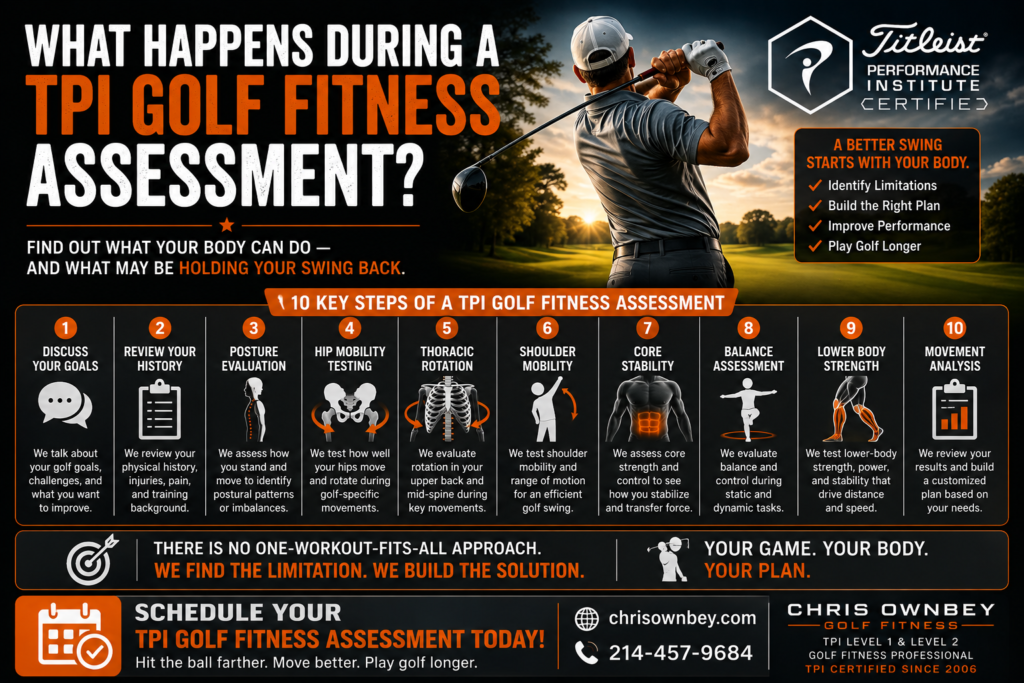
Step 1: We Talk About Your Golf Game
Before testing any movement, I want to understand the golfer in front of me. So we begin with your goals.
Questions Worth Answering First
- What are you trying to accomplish this season?
- Has your distance or swing speed declined?
- Do stiffness or back soreness follow you around after a round?
- Is a complete turn getting harder to make?
- Are you working with an instructor on a specific swing change?
- Finally, do you want to compete, or simply keep playing as you get older?
Your goals matter, because golf fitness should support what you are trying to do on the course.
For instance, a golfer regaining distance after 50 has very different priorities from a junior preparing for tournament play. Likewise, someone wanting pain-free recreational golf needs something different from a competitive player chasing maximum power.
That is precisely why the conversation is part of the assessment.
Step 2: We Review Your Physical History
Next comes your physical background. Typically this includes previous injuries, surgeries, pain, restrictions and exercise history.
For example, a golfer with a history of hip problems often moves quite differently from someone who has never had hip limitations. Similarly, a golfer who has never strength trained presents a different profile from someone training consistently for 30 years.
An Important Distinction
This information provides context for the movement screen, and it helps determine what type of training is appropriate.
To be clear, a TPI assessment is not a medical examination. It does not diagnose injuries or medical conditions. If something falls outside the scope of golf fitness, then the appropriate medical professional needs to evaluate it.
Still, understanding your history creates a safer and far more individualized starting point.
Step 3: We Evaluate Your Posture
Posture influences how you set up and how you move during the swing. Therefore, we look at how you naturally stand and how your body organizes itself.
This is not about manufacturing “perfect posture.” Instead, the goal is understanding whether certain limitations may be affecting your movement.
A golfer who cannot maintain posture during the swing often assumes it is entirely technical. Sometimes that assumption is correct. However, limitations in mobility, strength or stability frequently contribute as well.
Ultimately, understanding the body helps us separate the physical from the technical.
Step 4: We Look at Hip Mobility
Hip mobility ranks among the most important areas for any golfer, because your hips must rotate during both the backswing and the downswing.
When the hips do not move efficiently, your body compensates somewhere else.
Common Hip Compensations
- Swaying off the ball instead of rotating
- Asking the lower back to supply extra rotation
- Becoming overactive through the upper body
- Struggling to clear the hips through impact
- Losing the separation an athletic swing requires
During the assessment, we evaluate how your hips move and where restrictions show up.
Importantly, we are not simply asking whether your hips feel tight. Instead, we are looking at specific movement capabilities. Once we know what is limited, we have a much better idea of what needs training.
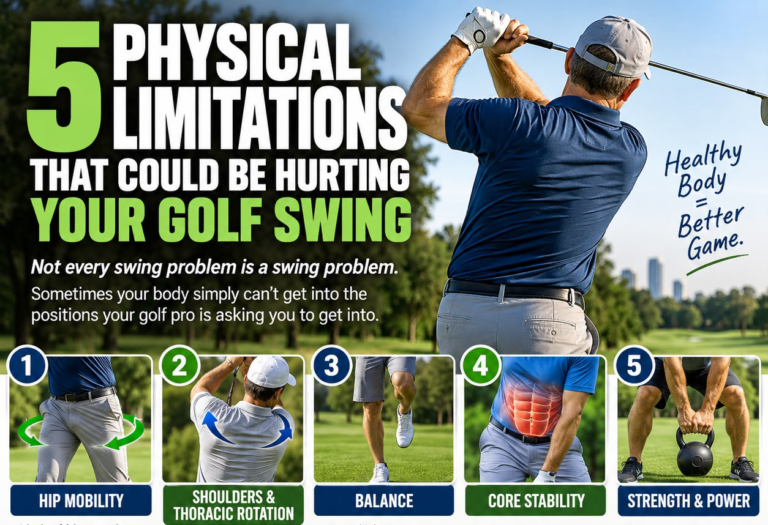
Related reading: 5 Physical Limitations That Can Affect Your Golf Swing.
Step 5: We Assess Thoracic Rotation
Another major area is the thoracic spine, meaning the middle and upper portion of your back.
Golf demands rotation. So when thoracic rotational ability is limited, making a complete turn becomes considerably harder, and your body compensates by moving excessively somewhere else. Often that extra movement comes from the lower back or the arms.
This explains why simply telling a golfer to “turn more” rarely solves the problem. The golfer may physically lack the movement required.
Therefore, the assessment identifies whether thoracic rotation is part of the limitation, and that information then guides mobility and stability training.
Step 6: We Evaluate Shoulder Mobility
The shoulders play an important role too, since your arms must move efficiently while the torso rotates.
Limited shoulder mobility affects how you position the club, and it often contributes to compensations elsewhere. During the assessment, we look at how the joint moves and where restrictions exist.
Range of Motion Is Not the Whole Story
Again, the goal is not achieving the greatest possible range of motion. Rather, the goal is enough usable movement for your golf swing.
Mobility also has to be controlled. Someone can own a huge range of motion while lacking the strength and stability to manage it. For that reason, mobility and stability get evaluated together.
Step 7: We Look at Core Stability
Your core connects the lower and upper body. During the swing, your body must create force, control rotation and transfer energy, and core stability plays a central role in all three.
However, this differs from simply owning strong abdominal muscles. You could perform hundreds of crunches and still lack the stability golf requires.
Golf-specific core function involves stabilizing the trunk, resisting unwanted movement, maintaining posture and controlling rotation.
So during the assessment, we look at whether your trunk stays controlled while other parts of the body move. When the core lacks stability, transferring force efficiently becomes difficult, which eventually shows up as inconsistency and lost speed.
Step 8: We Evaluate Balance
Balance gets overlooked until it becomes a problem. But golf demands tremendous control.
After all, you are rotating, shifting pressure, generating force and swinging a club at high speed, while your body manages every bit of it and stays stable.
What Poor Balance Looks Like
- Difficulty generating and controlling force
- Excessive movement during the swing
- Trouble finishing in a balanced position
- Inconsistent pressure transfer
Balance becomes especially important for golfers over 50, because this quality declines with age unless it is trained deliberately.
During a TPI Golf Fitness assessment, balance helps complete the picture of your overall movement profile.
Step 9: We Look at Lower-Body Strength and Stability
Your lower body drives the power system. Legs, hips and glutes interact with the ground and contribute enormously to force production.
Weakness there reduces your ability to create or transfer force, and it also affects balance and posture.
Why This Matters More After 40
For golfers over 40 and 50, strength becomes particularly important, because muscle mass declines whenever it is not actively maintained.
That loss eventually surfaces in the golf swing. Distance drops off. Fatigue arrives earlier in the round. Meanwhile, the swing starts requiring noticeably more effort for the same result.
Consequently, lower-body strength forms an important part of the overall assessment.
Related reading: Why Golfers Lose Distance After 50 — And What You Can Do About It.
Step 10: We Evaluate Rotational Movement
Golf is a rotational sport. However, rotation never comes from one single part of the body.
Your hips rotate. Meanwhile, the torso rotates, the shoulders move, and the lower body stabilizes and transfers force. All of those pieces must work together.
During the assessment, we look at how you rotate and whether certain areas are doing too much or too little.
For example, a golfer with poor hip rotation often compensates through the upper body. In contrast, a golfer with good mobility but poor stability struggles to control rotation.
The goal is not simply more rotation. Instead, the goal is efficient, controlled rotation.
What Happens After the Assessment?
This may be the most valuable part of the whole process, because the assessment gives us information and now we have to make it useful.
At the end, we review everything identified. I want you to genuinely understand what your body is doing.
Knowing Your Own Priorities
If hip mobility is limited, you should know that. Should your thoracic rotation be good while lower-body strength lags behind, you should understand that too. And if balance is your real challenge rather than flexibility, then you should know before spending months stretching.
Ultimately, the assessment lets us prioritize, so your training gets built around your needs rather than a generic list of golf exercises.
How Does the Assessment Turn Into a Golf Fitness System?
After identifying your limitations, the next step is developing the right system.
For one golfer, that means more mobility work. For another, strength training takes priority. Someone else needs stability and balance before adding speed, while another golfer already moves well and simply needs more rotational power.
What the System Can Include
- Mobility
- Strength
- Core stability
- Balance
- Rotational control
- Power
- Cardiovascular fitness
- Recovery
The priority always depends on the golfer, which is exactly why the assessment comes first.
Assess. Identify. Train. Reassess.
That sequence beats guessing every single time.
Does a TPI Assessment Replace Golf Lessons?
No, because golf instruction and golf fitness serve genuinely different purposes.
While your instructor evaluates the golf swing, a golf fitness professional evaluates the body producing that swing. Together, the two approaches work extremely well.
For instance, imagine your instructor wants more hip rotation. If your assessment shows a significant physical restriction in the hips, then we suddenly have useful information.
So instead of repeatedly forcing a swing change your body struggles to perform, we address the physical limitation while your instructor keeps working on technique.
Who Should Get a TPI Golf Fitness Assessment?
An assessment helps many golfers, though it becomes particularly valuable if you:
- Are losing distance or want more swing speed
- Feel stiff during the swing
- Cannot make the turn you once made
- Struggle with balance
- Fatigue late in the round
- Are returning to golf after a layoff
- Have passed 40 or 50
- Want to begin golf-specific strength training
- Would rather know what your body needs before starting a program
You certainly do not need to be a competitive golfer, and a low handicap is not a prerequisite either. If you want your body performing better for golf, then understanding how it moves is valuable.
Why Golfers Over 50 Should Consider an Assessment
Golf changes as we age. Interestingly, your knowledge of the swing often improves, even while the body performing that swing changes.
Strength declines. Mobility decreases. Balance shifts, power fades, and recovery takes longer than it once did.
However, none of that means you have stopped improving. It simply means your approach needs to become more individualized.
Therefore, an assessment helps golfers over 50 determine which areas deserve the most attention. Rather than training everything equally, you can focus on whatever is most likely to help.
Stop Guessing About What Your Golf Body Needs
Thousands of golf exercises live online. Some are excellent, while others are not.
But even a great exercise can be wrong for you if it fails to address your actual limitation.
Three Ways Good Exercises Go Wrong
- When lower-body strength is the real problem, stretching endlessly will not solve it.
- If hip mobility is the limitation, simply adding heavier squats misses the point.
- Should mobility and strength both be excellent while balance is poor, you need a completely different strategy.
Assessment removes the guesswork, and that is the real value.
Ready to Find Out What May Be Limiting Your Golf Swing?
Your golf instructor works on the swing. Meanwhile, your equipment helps optimize performance, and golf fitness works on the body producing the swing.
If you are losing distance, struggling with mobility, feeling less powerful, or you simply want to keep playing strong as you get older, then start by finding out what your body needs.
A TPI Golf Fitness assessment evaluates your golf-specific mobility, strength, balance and stability, and it identifies the physical limitations affecting your ability to move efficiently. From there, we build the right system around your body and your goals.
Hit the Ball Farther. Move Better. Play Golf Longer.
Call or fill out the form today to schedule your TPI Golf Fitness assessment with Chris Ownbey Golf Fitness.
Serving golfers throughout Dallas, Carrollton, Plano, Frisco, Lewisville, Castle Hills and North Dallas.
Chris Ownbey Golf Fitness 214-457-9684 ChrisOwnbey.com
TPI Level 1 & Level 2 Golf Fitness Professional — TPI Certified Since 2006
Other related topics:
- 5 Physical Limitations That Can Affect Your Golf Swing
- Is Your Body Limiting Your Golf Swing? Golf Fitness Dallas
- Why golfers lose distance after 50?
- How to Stop Slicing the Golf Ball
- Why Your Back Hurts After Playing Golf: The Hidden Cause Most Golfers Never Address
- Why Strength Matters for Golfers Over 50
- Straddle Stretch for Golfers | Dallas Golf Fitness
- Golf Fitness in Dallas – How to Increase Speed, power, and Distance While Preventing Injuries
- How to cure your golf slice in the golf fitness studio
- If you are suffering from lower back pain. Try this stretch.