5 Physical Limitations That Can Affect Your Golf Swing
5 Physical Limitations That Can Affect Your Golf Swing
When your golf swing is not doing what you want, the first reaction is usually to assume something is wrong with your technique. However, physical limitations are just as often the real culprit.
Perhaps you are losing distance, or a full turn has become difficult to make. Maybe your ball striking has turned inconsistent. Alternatively, your instructor keeps asking for a position that feels almost impossible to reach.
So here is a question many golfers overlook entirely. Is this a golf-swing problem, or is your body physically preventing you from making the swing you are trying to make?
Your Swing Is an Athletic Movement
Your hips need to rotate, while your upper back needs to turn. Meanwhile, the lower body produces force and the core stabilizes the trunk. On top of all that, you need enough balance to control the whole sequence while swinging a club at high speed.
When one of those abilities becomes limited, the body rarely just stops moving. Instead, it compensates.
That compensation changes your swing mechanics, and it often makes producing speed, holding posture or striking the ball consistently much harder.
This is exactly why golf fitness matters so much, particularly for golfers over 40 and 50. Rather than only asking what is wrong with the swing, we also need to ask what your body can physically do.
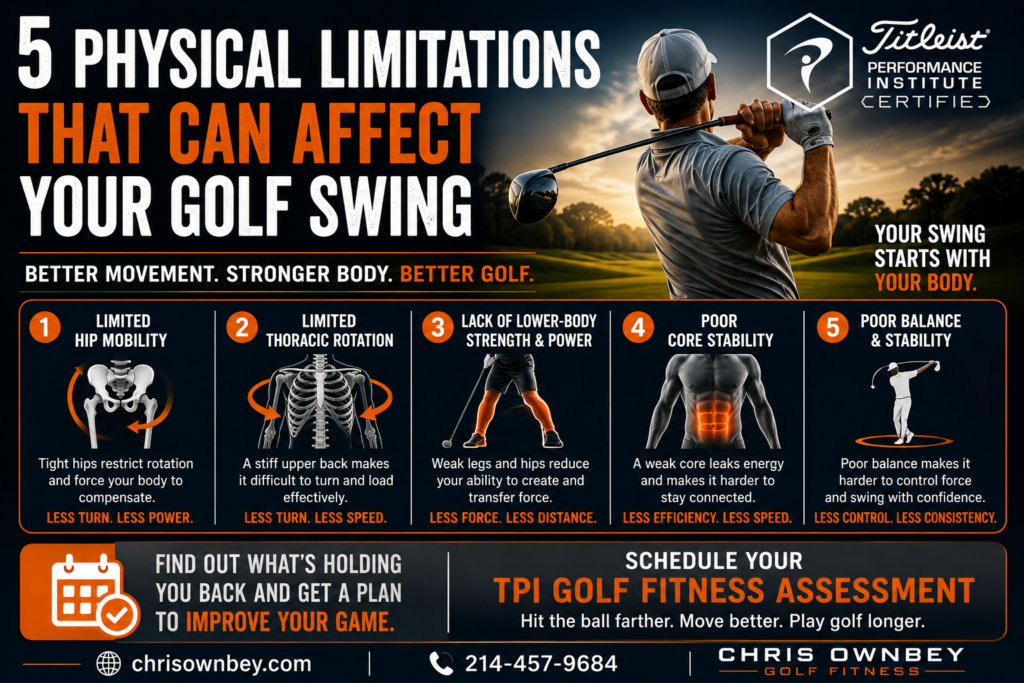
Below are five physical limitations I look at most often when assessing golfers.
1. Limited Hip Mobility
Your hips play a major role throughout the swing. During the backswing, they need enough mobility to let you load and rotate. Then, during the downswing, they rotate the opposite direction while transferring force through your body.
If the hips do not move efficiently, your body finds another way to create that motion.
How Restricted Hips Show Up
- Swaying rather than rotating
- Moving excessively through the lower back
- Struggling to turn into the trail hip going back
- Difficulty clearing the lead hip through impact
- Leaning on the arms and upper body to manufacture speed
For golfers over 50, hip mobility becomes especially important, because years of sitting, old injuries and reduced activity gradually shrink available movement.
However, this does not mean every golfer needs to become dramatically more flexible. There is a real difference between general flexibility and usable golf mobility for golfers over 50. You need enough movement to swing efficiently, plus enough stability and strength to control it.
Stretching your hips every morning may not solve anything if you do not know which movement is actually limited. That is precisely why assessment should come first.
2. Limited Thoracic Rotation
Another important area is the thoracic spine, meaning the middle and upper portion of your back. Since golf demands significant rotation, a restricted thoracic spine makes a good shoulder turn considerably harder.
You have probably heard an instructor tell someone to make a bigger turn. That is good advice, but only when the golfer physically has the ability to make it.
When the upper back is restricted, trying harder does not fix the limitation. Instead, the golfer compensates somewhere else.
Where the Compensation Goes
- The arms lift
- Excessive rotation appears in the lower back
- Posture changes through the swing
- The backswing gets shortened
Each of those changes affects how the body stores and transfers energy.
Think of Your Swing as a Chain
If one link is not moving properly, another link has to work harder. That becomes especially relevant when you are trying to increase swing speed after 50, because speed requires efficient movement.
Moving faster through a restricted range of motion simply makes an already inefficient pattern harder to control.
Therefore, the goal is not forcing more rotation. Rather, the goal is determining how much rotation you currently have and whether improving it would help.
3. Lack of Lower-Body Strength and Power
Golfers frequently underestimate how much the legs and hips contribute. Because the arms hold the club, many assume the power comes mostly from the upper body.
But the lower body creates and transfers the force. Specifically, your legs, hips and glutes provide the physical foundation for the entire swing. When strength declines there, producing the same force becomes far more difficult.
Why This Accelerates With Age
Without resistance training, strength and muscle mass gradually decline, and that loss eventually appears on the golf course.
You may not notice immediately. Instead, small changes creep in over a season or two:
- The driver carries slightly less
- Each swing takes more effort
- Fatigue arrives earlier in the round
- Posture gets harder to maintain
- You start manufacturing distance by swinging harder with the upper body
Strength and Power Are Not the Same Thing
Strength is your ability to produce force, whereas power is your ability to produce that force quickly. Golf demands both.
Because the downswing happens so fast, simply being strong is not enough. You also need to use that strength athletically.
Consequently, golf strength training after 50 should include properly programmed strength and power development. That said, you do not need to lift extremely heavy weights, and you certainly should not copy the workout of a 25-year-old Tour professional.
A well-designed system typically includes squatting patterns, hip hinges, rows, presses, carries, core work and eventually rotational power exercises.
4. Poor Core Stability
Core strength may be the most misunderstood area in golf fitness. When golfers hear “core training,” they usually picture sit-ups, crunches and planks.
Those exercises have a place. However, golf-specific core function goes considerably further, because your core connects the lower and upper body.
What Actually Happens During the Swing
First, your lower body produces force. Next, the hips begin rotating. Meanwhile, the trunk has to stay stable enough to control and transfer that movement. Finally, the upper body continues moving energy toward the club.
When the trunk cannot stabilize effectively, efficiency leaks away. In other words, you are producing force but struggling to transfer it through your body.
Core stability also affects posture. So if you cannot maintain posture through the swing, the problem may not be a bad habit at all. Physical limitations may be driving the movement instead.
What Your Core Actually Needs to Do
- Stabilize the spine
- Resist unwanted movement
- Control rotation
- Transfer force
- Maintain posture
- Coordinate the upper and lower body
All of that requires strength combined with control. Indeed, a golfer can have strong abdominal muscles and still show poor golf-specific stability during a golf fitness assessment in Dallas.
Once again, random exercise selection is not the answer. Identify the limitation first, then train it.
5. Poor Balance and Stability
Balance may be the most overlooked physical quality in the entire game. Consider what you are asking your body to do.
You rotate quickly while transferring pressure, producing force and moving the club at high speed. Simultaneously, you have to stay controlled enough to strike a very small ball consistently. That is a genuine athletic challenge.
What Declining Balance Looks Like
- Excessive movement during the backswing
- Difficulty transferring pressure
- Falling toward the ball through impact
- Trouble finishing in a stable position
Balance also affects confidence, since your body protects itself whenever it does not feel stable. If your nervous system does not trust that you can control a faster movement, then you will naturally limit how aggressively you swing.
This explains why simply trying to swing faster is rarely the answer. Before adding speed, you need the physical ability to control speed.
Balance work becomes particularly valuable through your 50s, 60s and beyond. Fortunately, it does not require circus exercises or standing on unstable surfaces with a club in your hands. Simple, progressive exercises that challenge stability and control work extremely well.
Ultimately, the objective is not performing the most complicated exercise. The objective is building a stronger, more stable golfer.
Your Golf Swing May Be Compensating for Your Body
Here is the big takeaway. A swing fault does not always begin with the swing.
Sometimes what looks like a technical problem is really your body’s solution to a physical limitation.
Three Familiar Examples
- Your instructor says rotate more — but what if your hips cannot rotate?
- The instruction is to maintain posture — but what if you lack the strength and stability to hold it?
- You want more clubhead speed — but what if the lower body has lost strength and power?
None of this means you should stop taking lessons. Quite the opposite, in fact.
Golf instruction and golf fitness complement each other. While your instructor works on what your swing is doing, golf fitness examines what your body is capable of doing. Together, those two views give you a far clearer picture.
Why Identifying Physical Limitations Should Come First
This is exactly why golfers should start with an assessment rather than guessing.
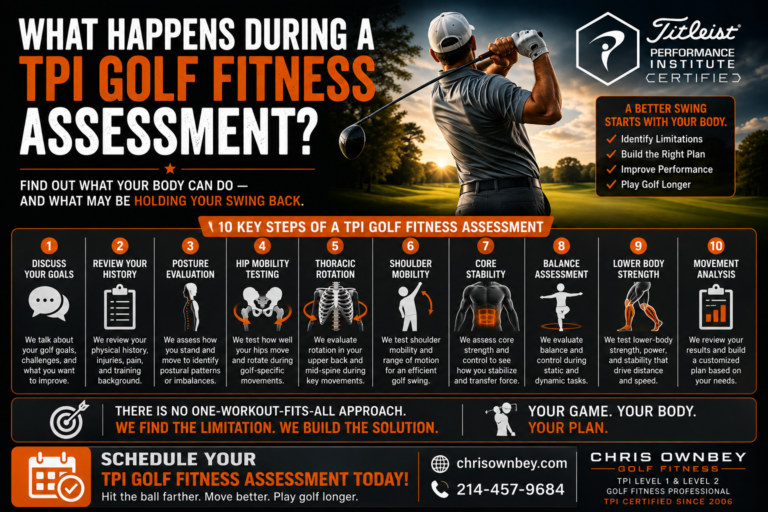
A TPI Golf Fitness Assessment identifies the physical limitations influencing how you move during the swing. Depending on the golfer, we evaluate areas such as:
- Hip mobility
- Thoracic rotation
- Shoulder mobility
- Lower-body movement
- Core stability
- Balance and posture
- Strength
- Rotational movement and overall movement quality
The purpose is not diagnosing an injury or medical condition. Instead, it is identifying what your body can currently do and where limitations exist.
No Single Best Workout Exists
From there, we build the right system around your individual needs. For one golfer, hip mobility takes priority. Another moves extremely well yet needs significantly more strength. Someone else is strong and mobile but poorly balanced, while a fourth golfer needs rotational power above everything else.
There is no universal “best golf workout.” There is only the right system for the individual.
Golfers Over 50 Need to Train the Body Behind the Swing
Past 50, maintaining your game involves considerably more than maintaining technique. You also have to maintain the physical abilities that let you make an athletic swing.
Practically speaking, that means continuing to develop mobility, strength, stability, balance and power.
The objective is not simply playing better next Saturday. Rather, it is continuing to play golf for years to come.
The One Piece of Equipment You Cannot Replace
Drivers get replaced. Irons can be changed, and a new putter is always an option. But every swing you make still depends on your body.
Therefore, taking care of that body belongs in your golf-development plan.
Physical Limitations Are Fixable: Build a Body That Can Swing
If your swing is frustrating you, then don’t automatically assume another swing change is the answer. Find out what your body can actually do first.
Perhaps your hips are limiting rotation, or the upper back is limiting your turn. Strength and power may have quietly declined. Alternatively, the core lacks stability, or balance is capping how much speed you can produce and control.
Once you understand the physical limitations, you can finally address the right problem.
Your instructor works on your swing. Meanwhile, your equipment helps optimize performance, and golf fitness works on the body producing the swing.
Ready to Find Out What May Be Limiting Your Golf Swing?
If you play in Dallas, Carrollton, Plano, Frisco, Lewisville or North Dallas, and you want to know whether physical limitations are affecting your golf swing, then start with a TPI Golf Fitness Assessment.
We evaluate your golf-specific mobility, strength, balance and stability, and we identify the areas limiting your ability to move efficiently. From there, we build the right system around your body and your goals.
Hit the Ball Farther. Move Better. Play Golf Longer.
Call or fill out the form today to schedule your assessment with Chris Ownbey Golf Fitness.
Chris Ownbey Golf Fitness 214-457-9684 ChrisOwnbey.com
TPI Level 1 & Level 2 Golf Fitness Professional — TPI Certified Since 2006
Other related topics:
- Is Your Body Limiting Your Golf Swing? Golf Fitness Dallas
- Why golfers lose distance after 50?
- Why Your Back Hurts After Playing Golf: The Hidden Cause Most Golfers Never Address
- Why Strength Matters for Golfers Over 50
- Straddle Stretch for Golfers | Dallas Golf Fitness
- Golf Fitness in Dallas – How to Increase Speed, power, and Distance While Preventing Injuries
- How to cure your golf slice in the golf fitness studio
- If you are suffering from lower back pain. Try this stretch.