Golf Fitness Dallas TX: How to Hit Longer Drives After 50
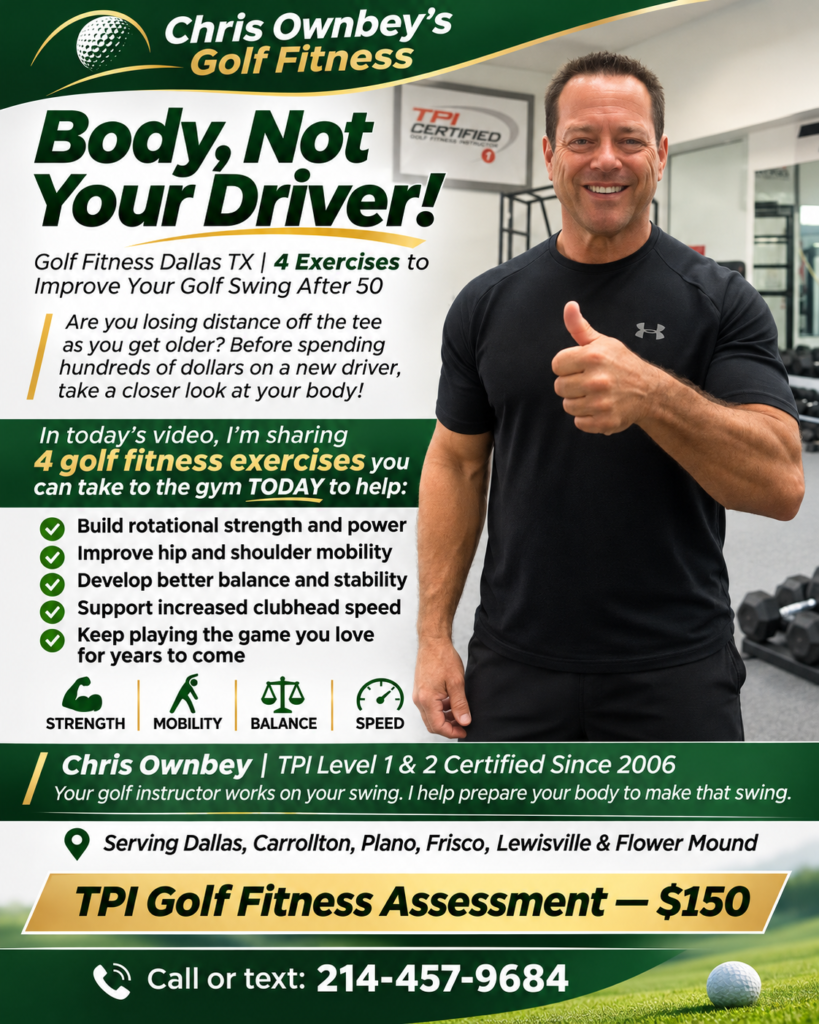
Golf Fitness Dallas TX: How to Hit Longer Drives After 50
By Chris Ownbey | TPI Certified Golf Fitness Professional | Chris Ownbey’s Golf Fitness
Searching for golf fitness Dallas TX golfers can trust? Start with your body, not your driver.
When was the last time you hit a drive and thought, “I used to hit that ball 20 or 30 yards farther”?
If you’re a golfer over 50, you’ve probably felt that frustration. You still love the game, and you may even understand the swing better than you did 20 years ago. Meanwhile, you’ve invested in quality equipment, taken lessons, and spent countless hours on the range.
Yet something has changed. The backswing feels shorter. Hips don’t rotate like they used to. After 18 holes, your lower back feels stiff. And no matter how hard you swing, the ball doesn’t travel as far.
Here’s what I’ve learned from decades of working with golfers. Sometimes the problem isn’t your swing. Instead, it’s the body trying to produce that swing.
At Chris Ownbey’s Golf Fitness, I provide golf fitness Dallas TX golfers over 50 can use to build a stronger, more efficient, and more consistent swing.
The good news? Getting older doesn’t mean you have to stop improving.
1. Why Golfers Over 50 Start Losing Driving Distance
First, let’s look at what happens to the body as we age. Several physical changes can influence golf performance:
- Reduced muscular strength and power
- Decreased hip and shoulder mobility
- Less rotational flexibility through the upper back
- Declining balance and stability
- Reduced coordination and movement efficiency
- Slower recovery between rounds
These changes are common, but their severity varies from person to person. For example, one golfer may have excellent flexibility but lack the strength to produce clubhead speed. Another may be strong but struggle to rotate through the hips and thoracic spine. Meanwhile, a third may have both strength and mobility but lack the balance to control the movement.
This is why I don’t give every golfer over 50 the same workout. Instead, I look at each golfer’s strengths, limitations, and goals. Before you try to improve your swing speed, we need to understand what your body can actually do.
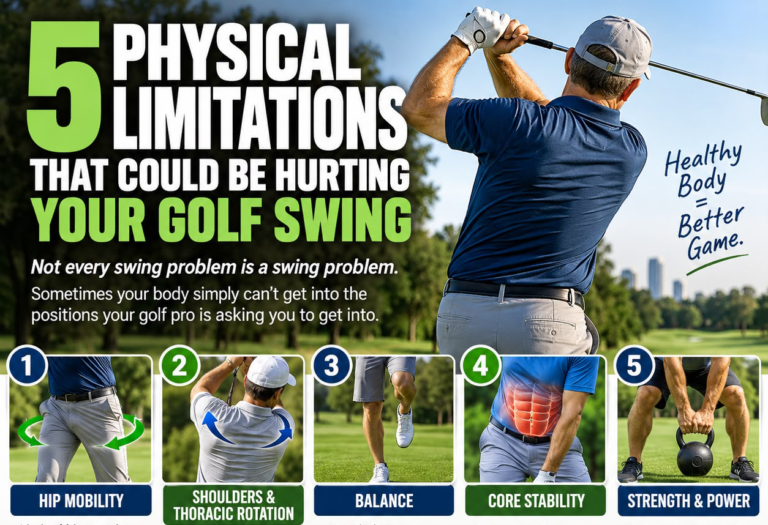
For more insight, read my article on 5 Physical Limitations That Can Affect Your Golf Swing.
2. Your Body Is the Engine Behind Your Golf Swing
Here’s a statement I share with golfers regularly: your golf instructor teaches you how to swing the club. My job, however, is to help your body reach the positions your instructor is asking for.
Your golf professional may want a fuller shoulder turn, a steady spine angle, or better hip rotation through impact. But what if your body physically struggles to make those moves? You can practice proper technique repeatedly. Even so, physical restrictions may still hold you back.
The golf swing is a coordinated athletic movement. First, your feet interact with the ground. Next, your legs produce force and your hips rotate. Then your trunk transfers energy, while your shoulders, arms, and hands guide the club.
When these parts work together, you can produce speed while keeping control. However, when one area lacks mobility, strength, or stability, other areas compensate. That’s where golf-specific fitness training becomes valuable. Instead of asking your body to swing harder, we improve its ability to move and produce force.
3. Rotational Strength: One of the Keys to Longer Drives
Let’s talk about one of my favorite areas of golf performance training: rotational strength.
Many golfers link distance to bigger arms, stronger shoulders, or heavier weights. In reality, the ability to generate and control rotational force is a major part of an effective swing. Therefore, strong rotational muscles matter because they help you transfer force through the body while staying stable.
One exercise I often use is a controlled cable or resistance-band rotation.
Golf Fitness Exercise: Standing Cable Rotation
This exercise can help develop the rotational strength and control used in the golf swing.
- Set up your position. Stand sideways to a cable machine or resistance band anchored at about chest height. Place your feet shoulder-width apart in a comfortable athletic stance.
- Engage your trunk. Hold the handle with both hands. Keep your core engaged without holding your breath or arching your lower back.
- Rotate with control. Slowly rotate your upper body through a comfortable range of motion, allowing appropriate movement through the hips. Avoid forcing the lower back into excessive twisting.
- Return slowly. Control the movement as you come back to the starting position.
- Repeat on both sides. For an appropriate beginner, one or two sets of 8–12 controlled repetitions per side may be a reasonable starting point.
The goal isn’t to move the heaviest weight possible. Instead, the goal is to build coordinated rotational strength while maintaining control.
Golfers with existing back problems, spinal surgery, or pain during rotation should have this exercise modified or cleared by a healthcare professional.
Remember, this is one exercise, not a complete golf fitness system. Ultimately, the best results come from identifying which movements you personally need to improve.
4. Hip Mobility: Why Your Backswing May Be Getting Shorter
One of the most common limitations I see in golfers over 50 is restricted hip mobility. Your hips play an important role in both the backswing and the downswing.
When your hips can’t rotate comfortably, your body may compensate by changing its movement pattern. For example, a golfer may:
- Sway excessively during the backswing
- Lose posture during the swing
- Struggle to complete a comfortable turn
- Move the pelvis inefficiently during the downswing
- Feel extra stress in other areas of the body
Restricted hip movement, in turn, affects how you transfer force and control your swing.
But here’s an important point: more flexibility isn’t automatically better. You need the right combination of mobility and stability. Your hips must be mobile enough to rotate. Likewise, your body needs enough strength and control to use that range.
Because of this, a golf fitness assessment is so valuable. Instead of stretching everything, we identify which areas are restricted and which need more stability.
Watch the video: https://www.youtube.com/watch?v=BDyg2RmvMQw
For a practical mobility exercise, read my article on the Straddle Stretch for Golfers: Improve Rotation and Hip Mobility.
5. Why Balance Matters for Clubhead Speed and Consistency
Think about the last time you watched a good golfer finish their swing. Most skilled players show excellent control of their body throughout the movement. Their swing may be powerful, but it is also coordinated. In fact, balance contributes directly to that control.
As we age, our balance and proprioception (our awareness of our body’s position in space) can change. As a result, poor balance may lead to excessive movement during the swing, inconsistent contact, or trouble holding a stable finish. Imagine swinging a club at high speed while your body struggles to stay in control. That’s not a recipe for consistency.
For that reason, balance training is an important part of golf fitness after 50.
A Simple Balance Exercise for Golfers
- Stand near a sturdy chair or countertop for support.
- Shift your weight onto one leg.
- Lift the opposite foot slightly off the ground.
- Maintain an upright posture.
- Hold for 10–20 seconds if comfortable.
- Repeat on the opposite leg.
As your balance improves, you can progress the exercise based on your ability. The objective is better lower-body stability and body awareness. After all, you can’t consistently control a powerful swing without adequate physical control.
6. Strength Training After 50: Stop Training Like You’re 25
I’ve spent decades in the fitness industry, including years competing in powerlifting, bodybuilding, and other athletic disciplines. One thing that experience has taught me is that training at 50, 60, or 70 should account for the individual. It shouldn’t simply copy the workouts we did at 25.
You can absolutely keep building strength as you get older. In fact, maintaining muscle strength and power becomes more important for both golf performance and long-term physical independence.
However, effective training doesn’t require punishing workouts. You don’t need endless heavy lifting, complicated routines, or exercises that aggravate your joints. Instead, you need the right system.
A well-designed golf fitness Dallas TX program for golfers over 50 may include:
- Lower-body strength: Exercises that strengthen the legs and hips to help produce and control force.
- Core stability: Movements that improve trunk control and support efficient transfer of force.
- Rotational power: Progressive exercises that develop the ability to produce rotational force.
- Shoulder mobility and stability: Exercises that support comfortable upper-body movement.
- Functional movement: Training that improves coordination, balance, and everyday physical capability.
At Chris Ownbey’s Golf Fitness, I emphasize targeted, golf-specific exercises based on each golfer’s assessment. Above all, my goal isn’t to turn you into a bodybuilder. Rather, I want to help you become a physically capable golfer who can enjoy the game for years to come.
7. Golf Fitness Near Me: Why Personalized Training Matters
If you’ve searched Google for “golf fitness near me,” you’ve probably found plenty of general fitness options. But golf fitness Dallas TX training is different from a traditional gym workout.
A general fitness trainer may improve your overall conditioning, which certainly benefits your health. Golf-specific training, on the other hand, goes a step further. It considers the physical demands of the swing and evaluates how your mobility, stability, balance, and strength influence performance.
For example, two golfers may share the same swing fault but need completely different exercises. One may need better hip rotation. The other may have enough rotation but lack the stability to control it. In that case, giving both the same stretching routine won’t address the real problem.
That’s why personalized assessment matters. At Chris Ownbey’s Golf Fitness, I provide golf fitness Dallas TX golfers can access across Dallas, Carrollton, Plano, Frisco, Lewisville, Flower Mound, and surrounding North Texas communities. Rather than guessing what your body needs, we begin by evaluating how you move.
8. Looking for a TPI Golf Fitness Instructor Near Me?
If you’ve searched for a “TPI golf fitness instructor near me,” there’s an important distinction to understand. TPI stands for the Titleist Performance Institute. The TPI approach examines the connection between how a golfer’s body moves and how those physical capabilities can influence the golf swing.
I’ve been TPI certified since 2006 and hold Level 1 and Level 2 certifications. My background combines decades of strength and conditioning experience with golf-specific movement training.
One of the biggest mistakes golfers make is trying to fix a physical limitation through swing practice alone. Sometimes the body needs more mobility, strength, or stability before a technical change becomes easier. For that reason, I start every client with a TPI Golf Fitness Assessment.
During the assessment, we evaluate:
- Hip mobility
- Shoulder mobility
- Thoracic spine rotation
- Core stability
- Balance
- Posture
- Flexibility
- Movement quality
The results help us identify limitations that may affect specific movements in your swing. From there, we build a training system around your physical needs and performance goals.
Learn more in my article, What Happens During a TPI Golf Fitness Assessment?
9. Can Golfers Over 60 and 70 Still Improve Their Driving Distance?
Absolutely, improvement is possible. Age alone doesn’t determine whether you can become stronger, more mobile, or more powerful. Instead, individual health, training history, physical limitations, and consistency all influence your potential.
In my experience, golfers in their 50s, 60s, and 70s want to maintain their swing, improve their movement, and keep enjoying competitive or recreational golf. Effective golf fitness Dallas TX training, therefore, relies on realistic goals and progressive, individualized programming.
Some golfers want more clubhead speed. Others want better flexibility, less stiffness, or improved balance. And some simply want to finish 18 holes feeling better than they do today. All of those are worthwhile goals.
Of course, no fitness professional can guarantee a specific increase in driving distance. Distance depends on swing mechanics, contact quality, launch conditions, equipment, and physical capability. Still, improving strength, mobility, balance, and power gives your body a better foundation for an efficient swing.
For more information, read Golf Fitness Over 50: Are You Losing Distance Because of Your Body?
10. Your Goal Should Be More Than Longer Drives
Distance is important. But longevity is even more important. After all, what good is an extra 10 yards if you can’t enjoy the game five years from now?
Golf fitness should be about more than hitting the ball farther. Instead, it should help you keep the strength, mobility, balance, and physical confidence to do something you love.
Picture yourself at 70, still looking forward to your next round. Then imagine playing with friends, competing in club events, and traveling to great courses without feeling physically limited. That’s the bigger picture.
Move Better. Hit It Farther. Play for Decades.
That’s the philosophy behind Chris Ownbey’s Golf Fitness.
Frequently Asked Questions About Golf Fitness Dallas TX
Can golf fitness really help increase driving distance after 50?
Golf-specific strength, power, mobility, and balance training may improve physical factors linked to clubhead speed and swing efficiency. Individual results depend on physical condition, technique, practice, and consistency.
How often should golfers over 50 strength train?
Many golfers benefit from two or more structured strength-training sessions per week. However, the right frequency depends on fitness level, recovery, medical history, and other activities.
Is golf fitness different from traditional personal training?
Yes. Golf fitness considers the physical demands of the golf swing. It uses golf-related screening and exercises alongside general strength and conditioning principles.
Where can I find golf fitness Dallas TX services?
Chris Ownbey’s Golf Fitness is located at 2538 Golden Bear Drive in Carrollton, Texas, serving Dallas and surrounding North Texas communities.
How much does a TPI Golf Fitness Assessment cost?
The initial TPI Golf Fitness Assessment is $150. It includes an individualized physical screening to evaluate golf-related mobility, stability, balance, and movement limitations.
Ready to Book Your Golf Fitness Dallas TX Assessment?
If you’re tired of losing distance, struggling with flexibility, or feeling like your body is holding back your swing, it’s time to stop guessing. Find out what your body needs to improve.
At Chris Ownbey’s Golf Fitness, we help golfers over 50 build the physical foundation for stronger, more efficient, and more consistent golf. Your first step is a TPI Golf Fitness Assessment.
TPI Golf Fitness Assessment: $150
During your assessment, we’ll evaluate the physical characteristics that may be affecting your swing and discuss the next steps toward your goals.
Chris Ownbey’s Golf Fitness
TPI Level 1 & Level 2 Certified Golf Fitness Professional
2538 Golden Bear Drive, Carrollton, TX 75006
Call or text: 214-457-9684
Website: chrisownbey.com
Other related topics:
The Inner Game of Golf: How to Quiet Your Mind, Trust Your Swing, and Play Better Golf
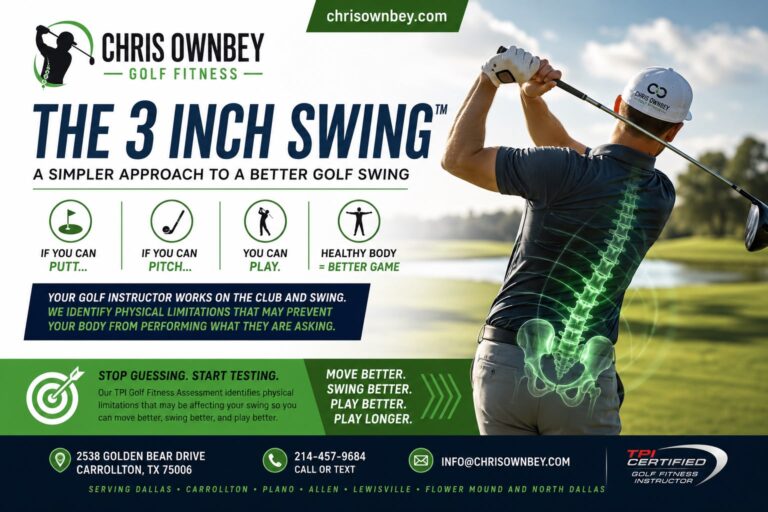
The 3 Inch Swing™: A Simpler Approach to a Better Golf Swing
Personal Training After 40 in Dallas: Get Strong, Lean & Move Better
- What Happens During a TPI Golf Fitness Assessment?
- 5 Physical Limitations That Can Affect Your Golf Swing
- Is Your Body Limiting Your Golf Swing? Golf Fitness Dallas
- Why golfers lose distance after 50?
- How to Stop Slicing the Golf Ball
- Why Your Back Hurts After Playing Golf: The Hidden Cause Most Golfers Never Address
- Why Strength Matters for Golfers Over 50
- Straddle Stretch for Golfers | Dallas Golf Fitness
- Golf Fitness in Dallas – How to Increase Speed, power, and Distance While Preventing Injuries