Back Pain in Golfers: Causes and How to Protect Your Back
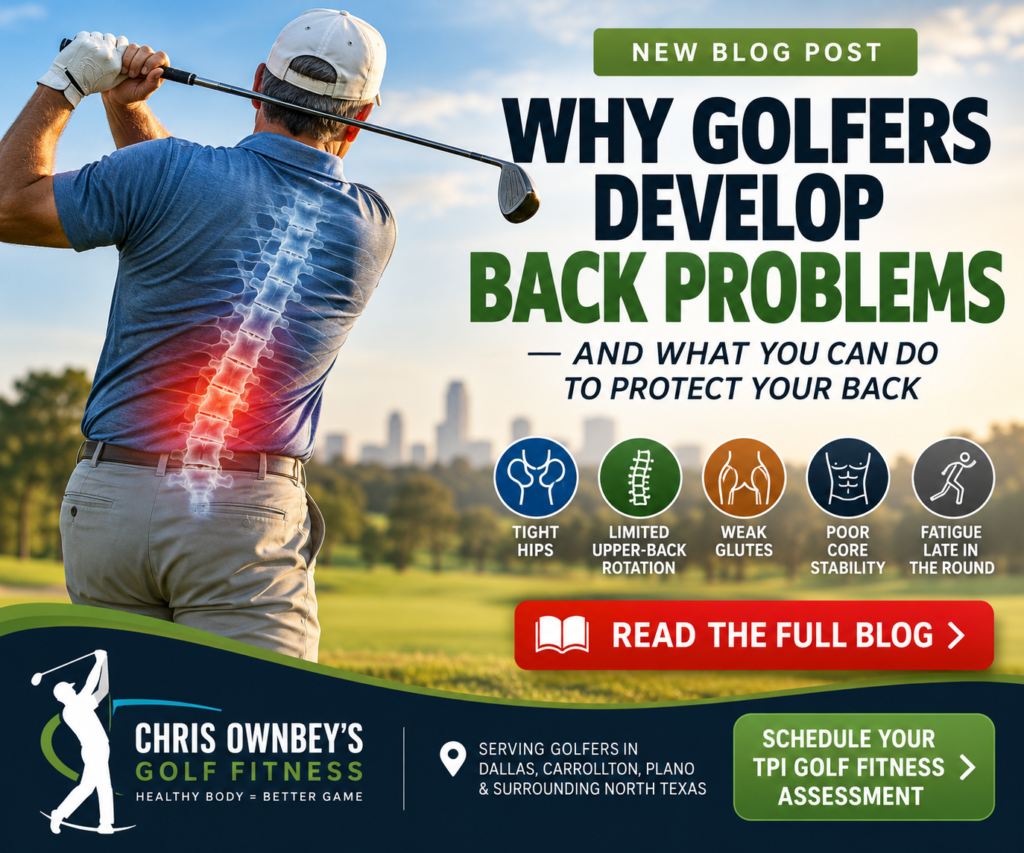
Why Golfers Develop Back Problems—and What You Can Do to Protect Your Back
Back pain is one of the most common physical problems golfers deal with as they get older.
For some golfers, it starts as stiffness after a round. For others, the back begins to tighten after nine holes, during practice at the driving range, or even after sitting in the golf cart.
Eventually, that stiffness can begin affecting the golf swing.
You may shorten your backswing. You may have difficulty rotating through the ball. You may stand up through impact because your body is trying to avoid an uncomfortable position.
And sometimes golfers simply stop playing as much because they know how their back is going to feel afterward.
The golf swing is a powerful rotational movement. When the body has adequate mobility, stability, strength, and coordination, those forces can be distributed throughout the body.
But when one area stops doing its job, another area frequently has to compensate.
For golfers over 40 and 50, the lower back often becomes that compensating area—and that’s where back pain can begin.
The solution isn’t simply to stretch your back more or strengthen your abs. The first step is understanding why your back is being overloaded in the first place.
Why Is Back Pain So Common in Golf?
A golf swing requires coordinated movement through your feet, ankles, knees, hips, pelvis, spine, shoulders, and arms.
Think of the body as a chain.
When the entire chain moves efficiently, you can transfer force from the ground through your body and eventually into the golf club.
But imagine your hips have become tight.
You still have to rotate to make a backswing.
If your hips aren’t giving you enough rotation, your body has to find that motion somewhere else. In many golfers, additional movement comes from the lower back.
Now repeat that compensation during practice swings, range balls and 18 holes.
Over time, the lower back may be asked to perform more work than it was designed to handle.
This is one reason I frequently remind golfers:
Your golf swing can only be as efficient as your body allows.
1. Limited Hip Mobility Can Lead to Back Pain
One of the first areas I look at when assessing a golfer with back problems is hip mobility.
The hips should contribute significantly to rotation during the golf swing.
If they don’t move well, the golfer may attempt to create additional rotation through the lumbar spine.
This becomes particularly important as we get older.
Many adults spend hours each day sitting at desks, driving, traveling or working in relatively fixed positions. Without regular mobility and strength work, hip movement can gradually become more limited.
A golfer may not realize how restricted his or her hips have become because the body is remarkably good at finding another way to complete a movement.
That compensation may work for a while.
Eventually, however, back pain may start to appear.
Improving hip mobility and learning to rotate more effectively through the hips can potentially reduce unnecessary compensation during the swing.
2. Poor Thoracic Rotation Can Make the Lower Back Work Harder
Your thoracic spine is essentially your upper and mid-back.
It plays an important role in creating rotation during the golf swing.
If your thoracic spine doesn’t rotate effectively, your body still needs to turn. Once again, the lower back may be forced to contribute additional movement.
This is why simply stretching the lower back isn’t always the answer.
The area where you feel back pain isn’t necessarily the area creating the problem.
During a golf fitness assessment, I want to know:
- Can your upper body rotate independently?
- Can your hips rotate?
- Can your pelvis move properly?
- Can you separate upper- and lower-body movement?
Those answers can tell us much more than simply asking, “Where does it hurt?”
3. Weak Glutes Can Affect Your Golf Swing
Your gluteal muscles are some of the strongest muscles in your body.
They help control the hips and pelvis and play an important role in generating and transferring force.
When the glutes aren’t doing their share of the work, other muscles may have to compensate.
That can include muscles surrounding the lower back.
For golfers, glute strength isn’t about building bigger muscles for appearance. It’s about creating a stronger and more stable foundation from which to rotate.
Exercises such as appropriately programmed bridges, hip hinges, split-stance movements and other lower-body strengthening exercises may be useful depending on the golfer’s abilities and injury history.
The goal isn’t simply to make the legs tired.
The goal is to build strength that supports movement.
4. Poor Core Stability Can Leave the Back Vulnerable
When golfers hear “core training,” many immediately think of sit-ups and crunches.
That’s not necessarily what the golf swing needs.
Your core’s job includes helping stabilize your spine while transferring force between your lower and upper body.
For golfers, I typically think beyond traditional abdominal exercises.
We want the body to be able to resist unwanted movement, control rotation and maintain good positioning while force is moving through the body.
Exercises involving anti-rotation, controlled carries and properly selected stability movements can often be more applicable than performing hundreds of crunches.
A strong core doesn’t mean having visible abdominal muscles.
It means having a trunk capable of supporting the forces you produce.
5. Loss of Strength After 40 Can Contribute to Back Pain
Strength becomes increasingly important as we age.
Golfers sometimes make the mistake of assuming flexibility is all they need.
They stretch before they play. They work on rotation. They may even take yoga classes.
Mobility is important—but mobility without sufficient strength and stability doesn’t solve every problem.
Your body needs the strength to control the range of motion you have.
Strong legs, hips, glutes, trunk and upper body can provide a better physical foundation for the golf swing.
This becomes particularly important for golfers who want to continue playing into their 60s, 70s and beyond.
The goal isn’t bodybuilding.
The goal is maintaining enough physical capacity to continue doing the things you enjoy.
6. Trying to Create More Distance Can Increase Back Pain
Golfers want distance.
There’s nothing wrong with that.
The problem occurs when golfers try to create more speed than their bodies can safely control.
You may watch a younger golfer make an enormous backswing and decide you need to turn farther.
But if your hips and thoracic spine don’t have the same mobility, forcing additional rotation may simply place more stress somewhere else.
Or you may try swinging harder without first developing the strength, stability and power needed to handle that increased speed.
You shouldn’t simply chase more speed. Build a body capable of producing and controlling speed.
For golfers over 50 especially, this can be an important distinction.
7. Fatigue Can Change the Way You Swing
Have you ever noticed that your swing feels good on the front nine but begins falling apart around holes 13, 14 or 15?
Fatigue could be part of the problem.
When the legs, glutes and trunk become tired, movement patterns can change.
You may lose posture.
Your balance may deteriorate.
Your rotation may become less efficient.
And the lower back may begin doing more work.
This is why cardiovascular conditioning and muscular endurance still matter for golfers.
You don’t need to train like a marathon runner.
But you should have enough physical capacity to walk, swing, bend, rotate and maintain posture for several hours without your movement quality collapsing.
How Can Golfers Prevent Back Pain?
There isn’t one magic exercise that prevents back pain.
A better strategy is to improve the physical qualities that allow your body to handle the demands of golf.
For most golfers, that means working on:
- Hip mobility
- Thoracic rotation
- Core stability
- Glute strength
- Leg strength
- Balance
- Posture
- Cardiovascular conditioning
- Recovery
The exact combination depends on the individual.
That’s an important point.
Don’t copy another golfer’s exercise routine simply because that golfer has a good swing or hits the ball farther.
Your body may have completely different limitations.
Why Assessment Should Come Before Exercise
At Chris Ownbey’s Golf Fitness, I don’t want to guess about what is limiting your movement.
We don’t guess. We assess.
That’s why I recommend starting with a TPI Golf Fitness Assessment.
The assessment looks at physical qualities that can influence your ability to make an efficient golf swing, including mobility, stability, balance and movement patterns.
Maybe your hips aren’t rotating adequately.
Maybe your thoracic spine is restricted.
Maybe you have sufficient mobility but lack the stability to control it.
Those are different problems and may require different approaches.
Your golf professional may be asking you to get into certain positions during your swing.
Your golf pro wants you to get into certain positions. I help your body get there.
That is where golf fitness and golf instruction can complement each other.
Your golf professional works on your golf swing.
My job is to help determine whether your body has the physical ability to perform what you’re being asked to do.
What If You Already Have Back Pain?
If you’re currently experiencing significant, persistent or worsening back pain, especially pain accompanied by numbness, tingling, weakness or symptoms traveling into your leg, get evaluated by an appropriate medical professional before beginning a new exercise program.
Golf fitness isn’t a replacement for medical diagnosis or treatment.
Once you’re medically cleared for exercise, however, improving strength, mobility, stability and overall physical capacity may become an important part of getting back to the activities you enjoy.
The objective isn’t simply to make the pain disappear for tomorrow’s tee time.
It’s to build a body capable of continuing to play golf for years.
Golf Fitness After 50 Is About More Than Your Score
Golfers often come to me because they want more distance.
That’s understandable.
But there’s a bigger goal.
You want to finish 18 holes without back pain.
You want to practice without feeling beat up afterward.
You want to travel and play golf with your friends.
You want to maintain your strength, mobility and independence.
And hopefully, you want to continue playing well into your 60s, 70s and beyond.
That’s why golfers shouldn’t train only for their next round.
Train for your next decade.
Is Your Body Affecting Your Golf Swing?
If your back becomes stiff or uncomfortable when you play, don’t automatically assume it’s simply because you’re getting older.
Your body may be telling you that something isn’t moving, stabilizing or functioning as efficiently as it should.
The first step is figuring out what that limitation is.
At Chris Ownbey’s Golf Fitness, I work with golfers in Dallas, Carrollton, Plano and surrounding North Texas communities to identify physical limitations that may be affecting their golf swing.
Using a TPI Golf Fitness Assessment, we evaluate your mobility, stability, balance and movement so we can identify areas that may need improvement.
From there, we can develop the right system for your body, your goals and your golf game.
Schedule Your TPI Golf Fitness Assessment
If back pain, back stiffness, limited rotation or physical restrictions are affecting your golf game, schedule a TPI Golf Fitness Assessment.
Find out what your body is—and isn’t—allowing you to do in your golf swing.
Healthy Body = Better Game.
Schedule a TPI Golf Fitness Assessment and find out whether a physical limitation is affecting your golf swing.
Chris Ownbey’s Golf Fitness
Dallas–Carrollton–Plano, Texas
214-457-9684
ChrisOwnbey.com
Other related topics:
The Inner Game of Golf: How to Quiet Your Mind, Trust Your Swing, and Play Better Golf
The 3 Inch Swing™: A Simpler Approach to a Better Golf Swing
Personal Training After 40 in Dallas: Get Strong, Lean & Move Better
- What Happens During a TPI Golf Fitness Assessment?
- 5 Physical Limitations That Can Affect Your Golf Swing
- Is Your Body Limiting Your Golf Swing? Golf Fitness Dallas
- Why golfers lose distance after 50?
- How to Stop Slicing the Golf Ball
- Why Your Back Hurts After Playing Golf: The Hidden Cause Most Golfers Never Address
- Why Strength Matters for Golfers Over 50
- Straddle Stretch for Golfers | Dallas Golf Fitness
- Golf Fitness in Dallas – How to Increase Speed, power, and Distance While Preventing Injuries