Golf Fitness Over 40: Flexibility for a Better Swing
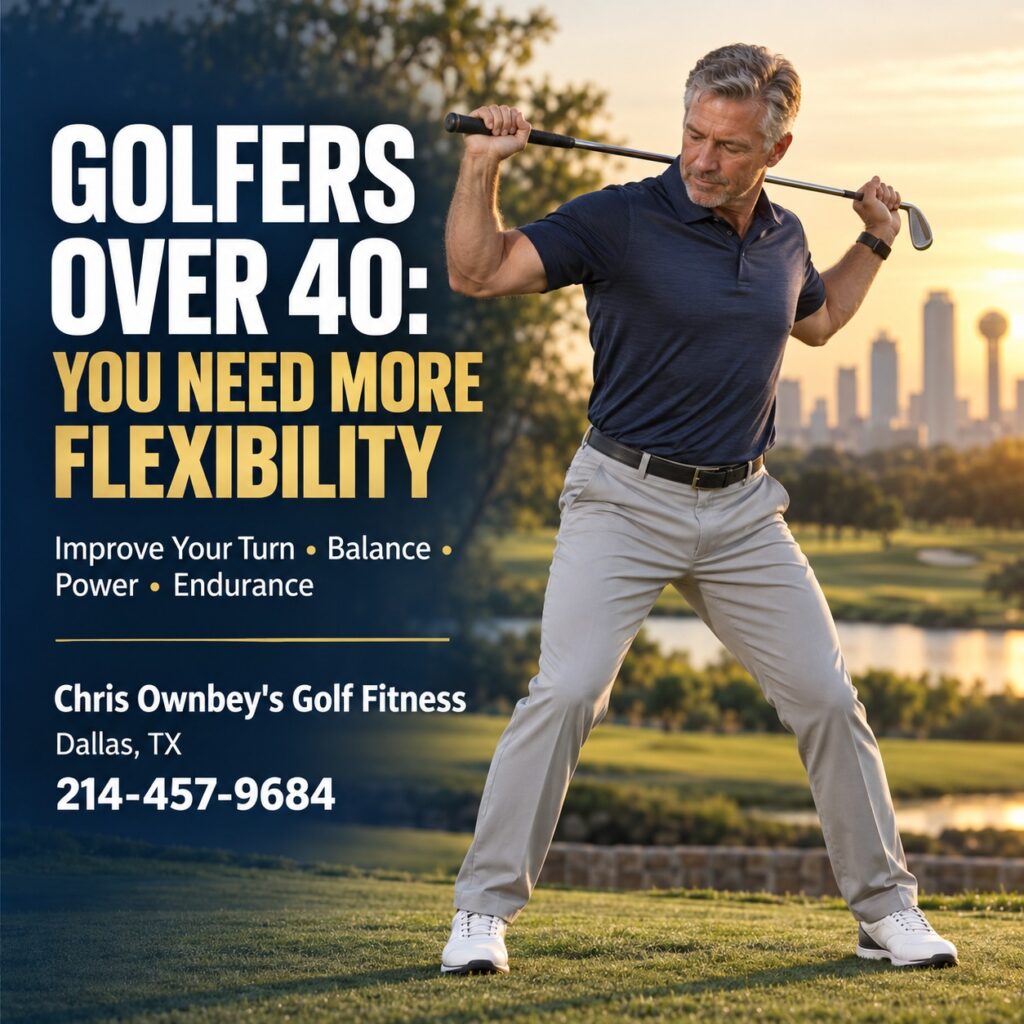
Why Golfers Over 40 Need More Flexibility to Play Their Best
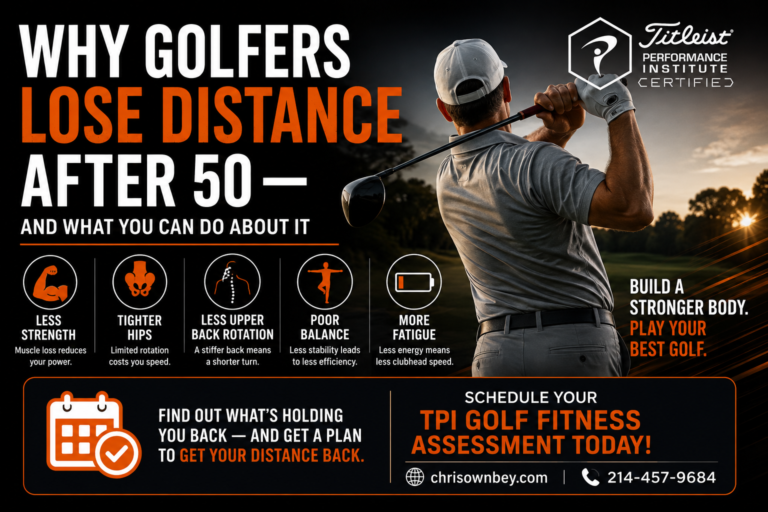
As golfers move through their 40s, 50s, 60s, and beyond, maintaining flexibility becomes increasingly important. Tight hips, limited shoulder mobility, and reduced upper-back rotation can make it harder to complete a comfortable golf swing.
These limitations can affect your distance, balance, consistency, and ability to finish an entire round without stiffness or fatigue.
A properly designed golf fitness program does more than help you stretch. It trains your body to move efficiently, remain stable, and produce strength through the movements required during the golf swing.
Here are five important ways improved flexibility and golf-specific fitness can benefit your game.
1. Increased Power and Clubhead Speed
Many golfers believe producing more distance requires swinging harder. However, greater distance often comes from moving more efficiently — not simply applying more effort.
A powerful golf swing begins with the ability to load the hips, rotate the upper body, and transfer force from the ground through the legs and core. When the body lacks flexibility, this sequence can become restricted.
Golf-specific flexibility and strength training can help you:
- Create a more complete backswing
- Improve hip and upper-body rotation
- Transfer power more efficiently
- Generate greater clubhead speed
- Maintain better control of the clubface
Clubhead speed is only part of the distance equation. The ball must also be struck close to the center of the clubface. This relationship between clubhead speed and the quality of contact is commonly referred to as “smash factor.”
The goal is not simply to swing harder. The goal is to develop the mobility, strength, and coordination needed to produce speed while maintaining control.
2. Better Balance and Swing Stability
Balance is one of the most important — and often overlooked — components of a consistent golf swing.
Throughout the swing, your body must control shifting forces while rotating and transferring weight from one side to the other. If you lack balance, you may lose your posture, move excessively, or struggle to finish the swing under control.
Golf fitness training can improve your ability to:
- Maintain a stable address position
- Control your weight shift
- Rotate without losing posture
- Remain balanced through impact
- Complete the swing with a strong finish
Balance is a trainable skill. Exercises that challenge single-leg stability, core control, and lower-body coordination can help you feel more confident over the ball and more controlled throughout the swing.
Improved balance can also help make your swing more repeatable, which is essential for greater consistency on the course.
3. A More Complete Backswing and Turn
A full turn does not come from forcing the arms farther behind the body. It requires coordinated movement through the hips, upper back, shoulders, and core.
When one area lacks mobility, the body frequently compensates somewhere else. For example, restricted hip or upper-back rotation may cause a golfer to place additional stress on the lower back.
Golf-specific mobility training can help improve:
- Hip rotation
- Upper-back rotation
- Shoulder mobility
- Separation between the upper and lower body
- Overall movement during the backswing and follow-through
A better turn can help create a longer, more efficient swing arc and provide more time to develop speed. It may also reduce the need to force the swing or compensate with movements that affect consistency.
The objective is not to become flexible everywhere. It is to develop the right amount of usable mobility for your body and your golf swing.
4. Increased Endurance for the Entire Round
A round of golf may last four or five hours. Even when riding in a cart, your body must repeatedly walk, bend, rotate, stabilize, and swing.
When your movement is restricted, every swing can require more effort. Over the course of 18 holes, that additional effort may contribute to fatigue, stiffness, and a loss of concentration.
A complete golf fitness program should include more than stretching. It should also develop muscular endurance, cardiovascular conditioning, and the ability to maintain good movement as fatigue begins to set in.
Improved golf endurance can help you:
- Maintain your swing mechanics later in the round
- Stay mentally and physically focused
- Recover more effectively between rounds
- Experience less fatigue during the final holes
- Continue practicing without unnecessarily overworking your body
Your fitness level should support your golf game — not limit it.
5. Better Overall Health and Longevity
Golf-specific fitness can benefit more than your scorecard. It can help you maintain the strength, mobility, balance, and physical confidence needed for everyday life.
A professionally designed program may help reduce stiffness, improve movement quality, and support the areas commonly placed under stress during golf, including the back, hips, knees, shoulders, elbows, and wrists.
No training program can guarantee that you will never experience an injury. However, improving your mobility, strength, balance, and physical preparation may help your body tolerate the demands of the game more effectively.
For golfers over 40, this becomes especially important. The goal is not only to play better today. It is to keep your body capable of playing for many years to come.
Flexibility Must Be Trained
One of the most important principles to understand is this:
Flexibility cannot simply be taught — it must be trained consistently.
Knowing that your hips, shoulders, or upper back are tight is only the beginning. Lasting improvement requires the right exercises, proper technique, and consistent practice.
Random stretches may provide temporary relief, but they do not always address the specific limitations affecting your golf swing. A golf fitness assessment can help identify where your body moves well, where it is restricted, and which areas require greater mobility, strength, or stability.
That information allows your training to be based on what your body actually needs.
Stop Putting Off Your Golf Fitness
If you want to increase your distance, improve your balance, create a better turn, and finish your rounds with more energy, it may be time to make golf fitness part of your regular routine.
About Chris Ownbey
Chris Ownbey has worked in the golf and fitness industry for 39 years and has served Dallas-area golfers since 2006. As a TPI Level 1 and Level 2 Certified Golf Fitness Professional, Chris provides golf fitness assessments and private, 30-minute training designed to improve flexibility, strength, balance, endurance, and rotational power.
Chris Ownbey’s Golf Fitness serves golfers throughout Dallas, Carrollton, Plano, Allen, Lewisville, and Flower Mound.
If you are ready to prepare your body for a stronger, more comfortable, and more consistent golf swing, call or fill out the form today.
Visit ChrisOwnbey.com to learn more.
Other related topics:
Why Men Lose Golf Club Head Speed After 40 | Golf Fitness Dallas
The Inner Game of Golf: How to Quiet Your Mind, Trust Your Swing, and Play Better Golf
Personal Training After 40 in Dallas: Get Strong, Lean & Move Better
- What Happens During a TPI Golf Fitness Assessment?
- 5 Physical Limitations That Can Affect Your Golf Swing
- Is Your Body Limiting Your Golf Swing? Golf Fitness Dallas
- Why golfers lose distance after 50?
- How to Stop Slicing the Golf Ball
- Why Your Back Hurts After Playing Golf: The Hidden Cause Most Golfers Never Address
- Why Strength Matters for Golfers Over 50
- Straddle Stretch for Golfers | Dallas Golf Fitness
- Golf Fitness in Dallas – How to Increase Speed, power, and Distance While Preventing Injuries