The 3 Inch Swing™: A Simpler Approach to a Better Golf Swing
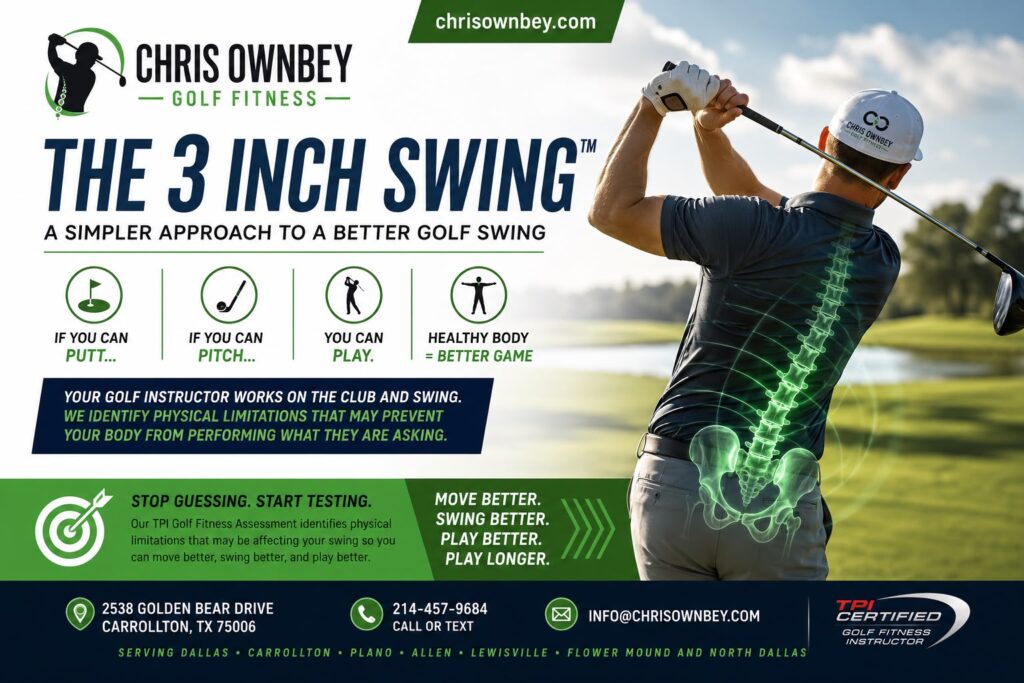
The 3 Inch Swing™: A Simpler Approach to a Better Golf Swing
Golf Doesn’t Have to Be Complicated
Many golfers stand over the ball thinking about grip, takeaway, shoulder turn, hip rotation, weight shift, downswing, club path and follow-through — all before the club ever moves.
That is a lot to process during a movement that lasts roughly two seconds.
After decades of working with golfers and studying how the body affects the swing, I settled on a simple philosophy.
Simplify the swing. Improve the body. Play better golf.
That philosophy became the foundation of what I call the 3 Inch Swing™.
However, the goal is not to replace your golf instructor. In fact, it is the opposite.
While your instructor works on the club and your technique, I identify the physical limitations that may prevent your body from doing what your instructor is asking.
As a result, when those two pieces work together, golfers have a much better opportunity to build a swing that is efficient, powerful and repeatable.
What Is the 3 Inch Swing™?
The 3 Inch Swing™ is a concept I have developed and refined over more than 20 years of working with golfers. Ultimately, it comes down to one word: simple.
If you can putt, and if you can pitch, then you can play.
Even though the club gets longer, the swing does not need to get more complicated.
Unfortunately, most golfers add more movement, more effort and more swing thoughts whenever they want extra distance.
But more is not always better.
Sometimes the answer is simplifying the movement first, then determining what prevents your body from making that movement efficiently.
That is exactly where golf fitness enters the picture.
Your Instructor May Already Be Giving You the Right Advice
Here is something golfers rarely consider. Your instructor may be telling you precisely what you need to do, although your body may not be physically capable of doing it.
When the Instruction Is Right but the Body Says No
For example, imagine your coach asks for a better shoulder turn. You understand the instruction, so you practice it and you try harder.
But what happens if you do not have enough thoracic rotation to make that turn? In that case, your body has to compensate.
Or perhaps your instructor wants you to maintain posture through impact. Again, that could be exactly the right correction.
Still, what happens if you lack the core stability, hip mobility or lower-body strength required to hold that position? Once more, you compensate.
Therefore, changing your swing and improving your body should never be viewed as competing approaches. Instead, they should work together.
While the golf professional identifies what needs to happen with the swing, the golf fitness professional determines whether your body can physically perform it.
Don’t Just Look at the Result — Find the Cause
This is one of the most important principles behind the 3 Inch Swing™.
A golfer slices the ball, but the slice is only the result. Similarly, lost distance is a result, and inconsistent ball striking is a result too.
The Question I Want to Answer Is Why
- Why are you slicing?
- What is causing the distance loss?
- Is something restricting your rotation?
- Where is that posture change coming from?
- Do you lose balance for a physical reason?
- Can you make the move in a practice swing, yet struggle the moment a ball appears?
Sometimes the cause is technical, and that is where your golf instructor comes in. Other times the cause is physical, so that is where golf fitness comes in.
In short, don’t just correct what you see. Identify the cause of what you see.
Your Body Is Part of Your Golf Swing
The golf swing is an athletic movement. Because of that, your hips have to move and your upper body has to rotate.
Meanwhile, the core must stabilize while the lower body produces and transfers force.
Your shoulders also need adequate mobility, and balance has to hold everything together while the whole sequence happens quickly.
If one part is not working efficiently, then another part usually has to compensate.
What We Assess at Chris Ownbey’s Golf Fitness
- Hip mobility
- Thoracic rotation
- Shoulder mobility
- Core stability
- Balance and strength
- Flexibility
- Posture and movement quality
Notably, we are not trying to teach you how to grip the club. Rather, we are helping your body become more capable of performing the swing your instructor is teaching.
That distinction matters enormously.
Golf Instruction Plus Golf Fitness
Think of it this way. While your instructor works on the skill, golf fitness works on the physical ability to perform that skill.
Two Questions for Every Swing Change
If your instructor says “rotate more,” then my question becomes: can your body actually rotate more?
If the instruction is “maintain your posture,” then I ask whether you have the strength, mobility and stability to hold it.
When the advice is “use the ground better,” I want to know whether your hips, legs, balance and core allow you to produce and transfer force efficiently.
And if your coach wants more clubhead speed, then the real question is whether your body has the strength, mobility and power to create it.
These are not competing philosophies. Instead, they are two pieces of the same puzzle.
Ultimately, when the body can perform what the instructor is asking, swing changes often become far easier to achieve.
Why Golfers Over 40 and 50 Need to Understand This
This becomes especially important as golfers get older, because a swing that worked at 30 can be much harder to reproduce at 50, 60 or 70.
That does not automatically mean something is wrong with your swing. More likely, your physical abilities have simply changed.
What Typically Changes Over Time
Mobility. Hips, shoulders and the upper back often become tighter.
Strength. Losing strength makes it harder to maintain posture and produce force.
Balance. Small changes here quickly affect consistency and weight transfer.
Rotation. When rotation gets restricted, other areas of the body compensate.
Power. As a result, many golfers swing harder just to produce the distance they once generated naturally.
That is why golfers frequently tell me: “Chris, I know what my instructor wants me to do. I just can’t get my body to do it.”
Above all, that is the golfer I want to help.
Stop Fighting Your Body
If you have taken lessons but keep struggling with the same movement, then don’t automatically assume you need another swing thought.
Instead, ask yourself one question. Is my body physically capable of doing what I am trying to do?
How Compensation Shows Up
Let’s say your instructor wants a bigger turn. Because your thoracic spine and hips are restricted, your body still has to find that movement somewhere.
- You might sway off the ball
- Posture might break down early
- Sometimes the lower back takes over
- Occasionally you lift out of the shot
- Often the arms change position to make up the difference
In other words, your body is simply trying to complete the task you gave it. That is compensation.
Rather than fighting those compensations round after round, we want to determine why they are happening in the first place.
The 3 Inch Swing™ Is About Repeatability
Watch a golfer putt, and the movement looks relatively simple. Next, watch that same golfer hit a short pitch, and it still looks controlled.
Then hand that golfer a driver.
Suddenly there is more tension, more movement, more effort and more swing thoughts. Why? Because the golfer wants more distance.
Building It in the Opposite Order
- First, start simple.
- Next, develop the movement.
- Then improve your body’s ability to perform that movement.
- Finally, build speed and power on top of it.
The goal is not to create the biggest swing possible. Instead, the goal is a swing you can repeat.
Because ultimately, repeatability creates consistency.
Are Physical Limitations Affecting Your Golf Swing?
Here are a few questions worth asking yourself.
- Do you struggle to make a full turn?
- Has your distance dropped over the last several years?
- Does your lower back tighten up during or after a round?
- Is balance an issue during the swing?
- Does one side of your body feel tighter than the other?
- Are you swinging harder while hitting the ball shorter?
- Can you make the swing your instructor wants in a practice swing, but not with a ball?
- Finally, does your swing deteriorate late in the round?
If you answered yes to several of these, then your body probably deserves a closer look. Fortunately, that is exactly what a golf fitness assessment is designed to reveal.
TPI Golf Fitness Assessment in Dallas
At Chris Ownbey’s Golf Fitness, we don’t start by guessing. We test.
Our assessment looks at how your body moves and identifies the physical limitations that may be influencing your golf swing. Specifically, we assess mobility, stability, balance, strength, rotation, flexibility and movement patterns.
Consequently, we get a clear picture of what your body is genuinely capable of doing. From there, we build a golf fitness program designed around your limitations rather than someone else’s.
I have a simple saying: if you don’t test, it’s just a guess.
So instead of randomly stretching, lifting weights or copying exercises from social media, find out what your body actually needs.
Working With Your PGA Golf Professional
One of the best scenarios for any golfer involves the instructor and the fitness professional working toward the same goal.
For instance, your instructor might identify a swing characteristic that needs to change. Rather than trying to override that advice, my job is to ask whether a physical reason is making the change difficult.
If there is one, then we address it. Meanwhile, your instructor can keep developing your swing while we strengthen the foundation underneath it.
A Team Approach
- Golf instructor: improves the swing and the skill
- Golf fitness professional: improves the body performing the swing
- Golfer: finally gets both pieces working together
That is how golf instruction and golf fitness should complement each other.
Golf Fitness Dallas: Play Better and Play Longer
At Chris Ownbey’s Golf Fitness, we work with golfers from Dallas, Carrollton, Plano, Allen, Lewisville, Flower Mound and communities throughout North Dallas.
Most of them are not looking to rebuild the golf swing completely. Generally, they simply want to:
- Hit the ball more consistently
- Regain lost distance
- Move better and rotate further
- Improve balance
- Develop more strength
- Reduce unnecessary stress on the body
- Keep playing golf as the years go by
That is what golf fitness should be about. Notably, it is not bodybuilding, and it is certainly not lifting heavier weights for the sake of it.
Furthermore, it is not about random exercises that someone labeled “golf exercises.”
Instead, the goal is building a body capable of supporting your golf swing.
Healthy body = better game.
Watch the 3 Inch Swing™ Video
If you have been working on your swing but keep running into the same problem, then watch the video below.
Then ask yourself two questions.
1. What is my biggest golf problem?
Is it:
* Slice
* Hook
* Loss of distance
* Inconsistent ball striking
* Poor rotation
* Lack of balance
* Back tightness
* Poor posture
* Difficulty finishing the swing
* Loss of power
2. WHY do I think it’s happening?
That’s the important question.
Because once we identify the cause, we have a much better chance of changing the result.
⸻
Take the 30-Minute Golf Fitness Challenge
If you’ve been dealing with the same golf problem and haven’t found the answer, let’s take a look at your body.
Give me 30 minutes.
We’ll look at your movement and see whether we can identify a physical limitation that may be contributing to the problem.
If I can’t identify and begin addressing the issue within 30 minutes, my service is free.
The objective isn’t to replace your golf instructor.
It’s to give your instructor a more physically capable golfer to work with.
⸻
Build the Body Your Golf Swing Requires
Golf improvement shouldn’t always mean another swing thought.
Sometimes the swing instruction is correct.
Sometimes the golfer understands exactly what the instructor wants.
The missing piece may simply be the body’s ability to perform it.
That’s where golf fitness can make the difference.
Your golf instructor works on the club and your swing.
We work on the body performing that swing.
Put those two together, simplify the process, and you have the foundation for what the 3 Inch Swing™ is all about:
Move Better.
Swing Better.
Play Better.
Play Longer.
If you’re a golfer in Dallas, Carrollton, Plano, Allen, Lewisville, Flower Mound or North Dallas, let’s find out what’s physically holding your golf swing back.
⸻
Schedule Your Golf Fitness Assessment
Chris Ownbey’s Golf Fitness
2538 Golden Bear Drive
Carrollton, TX 75006
Call or Text: 214-457-9684
Email: chrisownbey@yahoo.com
Serving golfers throughout Dallas, Carrollton, Plano, Allen, Lewisville, Flower Mound and North Dallas.
Ready to stop guessing? Schedule your TPI Golf Fitness Assessment today.
If you don’t test, it’s just a guess.
Other related topics:
Personal Training After 40 in Dallas: Get Strong, Lean & Move Better
- What Happens During a TPI Golf Fitness Assessment?
- 5 Physical Limitations That Can Affect Your Golf Swing
- Is Your Body Limiting Your Golf Swing? Golf Fitness Dallas
- Why golfers lose distance after 50?
- How to Stop Slicing the Golf Ball
- Why Your Back Hurts After Playing Golf: The Hidden Cause Most Golfers Never Address
- Why Strength Matters for Golfers Over 50
- Straddle Stretch for Golfers | Dallas Golf Fitness
- Golf Fitness in Dallas – How to Increase Speed, power, and Distance While Preventing Injuries
- How to cure your golf slice in the golf fitness studio
- If you are suffering from lower back pain. Try this stretch.