Golf Hip Mobility: The Wall Drill for Longer Drives
Golf Hip Mobility: The Wall Drill to Increase Swing Speed and Hit Longer Drives
By Chris Ownbey | TPI Certified Golf Fitness Specialist | Dallas, Texas
Are you losing distance off the tee? Poor golf hip mobility could be the reason.
Does your swing feel tighter than it did five or ten years ago? Maybe your hips aren’t rotating as freely, your backswing feels restricted, or you have to swing harder just to produce the same distance.
If you’re a golfer over 50, you’re not alone. In fact, restricted hip mobility is one of the most common limitations I see when working with golfers throughout Dallas, Plano, and Carrollton.
Here’s what I tell my clients: you don’t necessarily need to swing harder to hit the ball farther. Instead, you need a body that moves efficiently and produces speed. Your hips play an important role in that process.
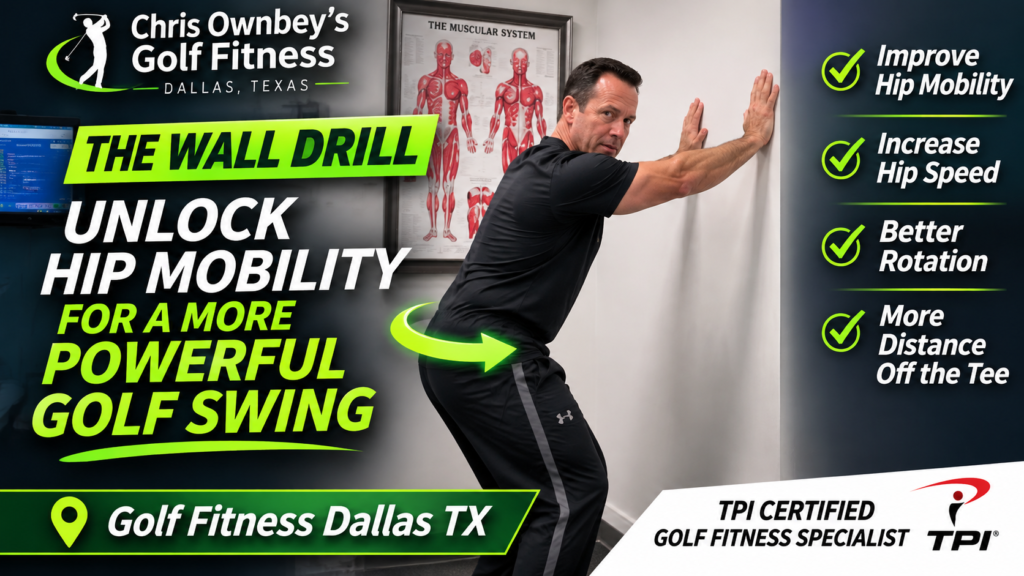
In today’s golf fitness lesson, I’ll introduce a simple exercise called the Wall Drill. It helps golfers improve hip movement, develop rotational control, and build the physical foundation for a more powerful swing.
The best part? You don’t need expensive equipment, a gym membership, or an hour-long workout. All you need is a wall, a few minutes, and a willingness to improve how your body moves.
Why Golf Hip Mobility Matters in Your Swing
Let’s begin with a fundamental principle of golf fitness. Your swing is a coordinated movement involving multiple joints and muscle groups. Your feet create contact with the ground, and your ankles and knees help control movement. Your hips contribute to rotation and force production. Finally, your torso transfers that movement, while your shoulders, arms, and hands deliver the club to the ball.
When one part of that system isn’t working efficiently, another area may have to compensate. The hips are one of the most important areas to evaluate. Your hip joints are designed to move in several directions, including:
- Internal rotation
- External rotation
- Flexion and extension
- Abduction and adduction
During the swing, internal and external rotation are especially important. For a right-handed golfer, the trail hip needs enough internal rotation during the backswing. The lead hip, meanwhile, needs internal rotation as the pelvis turns through the downswing and follow-through. Both hips contribute to the overall pattern.
When hip mobility becomes restricted, you may have trouble turning, holding your posture, or rotating efficiently through impact. That doesn’t automatically mean you’ll lose distance. However, it can make an efficient swing harder to achieve. For a closely related drill, try the Straddle Stretch for Golfers.
Are Your Hips Costing You Distance Off the Tee?
I’ve worked with golfers for more than 20 years, and one frustration comes up again and again: “Chris, I used to drive the ball 250 yards. Now I’m lucky to hit it 220. I guess I’m just getting older.”
My response is always similar. Getting older doesn’t mean you have to stop developing strength, mobility, and speed. Age-related changes in muscle mass, strength, and power can reduce performance. However, physical inactivity, reduced training intensity, movement limitations, and inefficient swing mechanics may also play a role. Many of those factors can improve with the right system. If you want to dig deeper, read why golfers lose distance after 50.
Consider two golfers who are both 60 years old. One has maintained lower-body strength, rotational mobility, balance, and explosive power. The other hasn’t done structured exercise in several years. Although they’re the same age, their physical capabilities may be very different. That’s why I focus on physical performance rather than accepting age as the explanation for declining distance.
Your body is your most important piece of golf equipment. Just like your clubs, it needs regular maintenance.
What Is the Golf Fitness Wall Drill?
The Wall Drill is a simple movement exercise that uses a wall as a reference point. It helps you develop awareness of your hip movement and pelvic rotation.
The objective isn’t to force your hips into a larger range of motion. Instead, it’s to practice moving through a comfortable, controlled range while keeping your balance and limiting unnecessary movement through your lower back. Depending on your mobility and physical limitations, you can use this drill as part of your golf warm-up or your regular golf fitness training.
The wall also gives you feedback. As a result, you can tell whether you’re rotating effectively or compensating with excessive body movement. For golfers who struggle with hip rotation, learning to control the pelvis independently from the upper body is an important first step.
Remember, mobility isn’t just about how far you can move. It’s about how well you can control that movement.
How to Perform the Wall Drill for Better Golf Hip Mobility
Watch the accompanying Wall Drill video for my demonstration and specific positioning. The steps below describe a general wall-supported hip-rotation variation.
- Establish your starting position. Stand in your golf posture near a wall. Place your feet about shoulder-width apart, soften your knees, and hinge slightly at the hips. Keep a neutral, comfortable spine. Use the wall as a light reference point for your glutes or pelvis, depending on the version demonstrated, and avoid leaning heavily into it.
- Begin with controlled hip rotation. Slowly rotate your pelvis as though you’re starting your backswing. Keep your feet grounded and let your hips move naturally. Focus on control rather than maximum rotation. You should feel your hips turning without forcing extra twisting through your lower back.
- Rotate toward your follow-through. Reverse the movement and slowly rotate toward your follow-through position. Maintain your balance and let your pelvis turn comfortably. Don’t push into pain or force your hips beyond their available range.
- Repeat with control. Begin with about 8–10 slow repetitions in each direction. Use a comfortable range of motion and focus on quality. As your movement improves, you may gradually increase the speed while keeping control.
My coaching principle: develop mobility first, establish stability second, and then train speed and power.
If you’ve had a hip replacement or spinal fusion, or you have significant back pain or other orthopedic limitations, you may need to modify the drill or get professional clearance first.
Three Common Mistakes Golfers Make During Hip Mobility Drills
Mistake #1: Trying to Force More Rotation
More movement isn’t always better. Some golfers believe that pushing their hips farther into rotation will automatically produce more clubhead speed. Unfortunately, forcing movement beyond your available range can irritate joints and surrounding tissues. Instead, focus on gradually improving your usable range of motion.
Mistake #2: Rotating Through the Lower Back
Your lumbar spine mainly provides stability while allowing a limited amount of rotation. Your hips and thoracic spine, on the other hand, are the major contributors to rotation in the golf swing. When your hips are restricted, you may compensate with excessive movement elsewhere. This is one reason I evaluate hip mobility and thoracic rotation in golfers who have back discomfort. To learn more, read about back pain in golfers. The objective is coordinated movement, not forcing one area to do all the work.
Mistake #3: Confusing Mobility With Flexibility
People often use these terms interchangeably, but they aren’t identical. Flexibility generally refers to the ability of muscles and other soft tissues to lengthen. Mobility refers to a joint’s ability to move through its available range. Active mobility also requires muscular control. You can have flexible muscles and still struggle to control your hips during the swing. That’s why an effective golf fitness system should address both mobility and stability.
How Golf Hip Mobility Can Help Improve Swing Speed
Let’s talk about what most golfers really want: more distance. Clubhead speed is an important contributor to driving distance, along with centered contact, launch conditions, and other factors.
Improving hip mobility doesn’t automatically increase clubhead speed. However, it may help remove physical restrictions that interfere with your ability to rotate and produce force efficiently. Think of your swing as a coordinated sequence. During the downswing, force production involves the lower body, pelvis, torso, arms, and club. When these segments work together, you have a better chance to generate and transfer speed.
If your hips are restricted, your swing may need compensations that make efficient movement harder. For example, many golfers develop early extension when they can’t rotate the hips freely. This is where mobility training becomes valuable.
Still, mobility alone isn’t enough. If your goal is longer drives, you should also build lower-body strength, rotational power, balance, and the ability to produce speed. To see how that works, read why men lose golf club head speed after 40 or my guide to increasing swing speed, power, and distance. A complete golf fitness system addresses all of these components.
Golf Fitness After 50: Why Strength and Power Matter
As we age, we can experience gradual declines in muscle mass, strength, and power. The age-related loss of muscle mass and function is commonly associated with sarcopenia. Power, which means producing force quickly, is especially important in an athletic activity like golf.
The good news is that resistance training and appropriately progressed power training can help older adults maintain and improve physical performance. You can learn more in why strength matters for golfers over 50.
For golfers over 50, I focus on four physical qualities:
- Mobility: the ability to move through the ranges of motion an efficient swing requires.
- Stability: the ability to control your body while rotating, shifting weight, and producing force.
- Strength: the muscular capacity to support posture, movement, and force production.
- Speed and power: the ability to produce force quickly and transfer that energy into athletic movement. Some golfers also add golf swing trainers to their program.
These qualities work together. A golfer with excellent mobility but limited strength may struggle to generate speed. Likewise, a golfer with tremendous strength but restricted mobility may have difficulty reaching efficient swing positions. The goal is a balanced system that supports both performance and longevity.
How Often Should Golfers Practice the Wall Drill?
For most healthy golfers, a few minutes of controlled hip mobility work is a useful addition to the week. Here’s a simple starting point:
- Before golf: perform one set of 8–10 controlled repetitions in each direction as part of your dynamic warm-up.
- On training days: include two sets of 8–10 repetitions alongside your lower-body strength and mobility exercises.
- On recovery days: use a short, comfortable mobility session to maintain movement quality without creating extra fatigue.
Consistency matters more than trying to do everything in one workout. Over time, small improvements practiced regularly can lead to better movement.
The Chris Ownbey 5-20-5 Golf Fitness System
At Chris Ownbey’s Golf Fitness in Dallas, I help golfers improve their physical performance through private, structured 30-minute training sessions. My approach is built around the 5-20-5 Golf Fitness System:
- 5 minutes: Dynamic preparation. We start with movement preparation designed to improve mobility, activate important muscle groups, and prepare the body for exercise. Drills such as the Wall Drill may be included here.
- 20 minutes: Focused golf fitness training. The next 20 minutes target your individual physical needs. Depending on your assessment, training may include lower-body strength, hip and thoracic mobility, rotational stability, balance and coordination, and speed and power development.
- 5 minutes: Recovery and stretching. We finish with targeted recovery work, mobility exercises, and stretching appropriate for you.
Every golfer is different, so I don’t give everyone the same workout. The objective is a stronger, more capable body without spending hours in the gym. For busy executives and golfers over 50, efficient training makes consistency much easier.
Why a TPI Golf Fitness Assessment Matters
One of the biggest mistakes golfers make is assuming they know which part of their body is limiting their swing. Maybe you think your hips are tight. Maybe your golf instructor has noticed early extension, limited rotation, or trouble maintaining posture. Without evaluating how your body moves, though, you’re making an educated guess.
As a Titleist Performance Institute (TPI) Certified Golf Fitness Specialist, I use a structured screening to identify mobility, stability, and movement limitations that may influence your performance. My TPI Golf Fitness Assessment includes 12 golf-specific tests, takes about 90 minutes, and costs $150. It can help identify areas such as:
- Limited hip internal or external rotation
- Restricted thoracic mobility
- Shoulder movement limitations
- Balance deficiencies
- Lower-body stability challenges
The assessment doesn’t diagnose medical conditions or replace instruction from your golf professional. Instead, it helps identify physical factors that may contribute to your movement limitations. For a full walkthrough, read what happens during a TPI golf fitness assessment, or learn about 5 physical limitations that can affect your golf swing.
Your golf instructor teaches you how to swing the club. My job is to help develop a body capable of getting into those positions.
Golf Fitness Training in Dallas, Plano, and Carrollton, TX
I’ve spent more than 20 years specializing in golf fitness. During that time, I’ve worked with recreational golfers, competitive players, junior athletes, and executives who want to keep enjoying the game for decades.
My clients aren’t necessarily trying to become professional golfers. Many simply want to regain lost distance, move without unnecessary discomfort, maintain their strength, and keep playing the courses they love. Whether you’re 50, 60, or 70, your training should reflect your current physical capabilities, golf goals, and injury history. That’s why I emphasize individualized training over generic golf workouts.
If you’re searching for golf fitness Dallas TX services, a TPI golf fitness trainer in Dallas, or golf-specific exercises to improve mobility and swing speed, I invite you to explore my private golf fitness training and meet Chris Ownbey.
Final Thoughts: Better Hip Movement Can Support a Better Golf Swing
If your swing feels restricted or your driving distance has declined, don’t assume there’s nothing you can do. Your body can continue adapting to well-designed exercise well into later life.
The Wall Drill is one simple tool that may help you develop better hip movement and rotational control. However, no single exercise guarantees longer drives. The greatest improvements come from identifying your physical limitations and following the right system to address them.
Start with mobility. Build stability. Develop strength. Then train your body to produce speed.
Your age doesn’t have to define your golf performance. Your preparation matters.
Frequently Asked Questions About Golf Hip Mobility
Can improving hip mobility increase golf swing speed?
Improving hip mobility may help golfers achieve more efficient rotation and reduce movement restrictions. However, increasing clubhead speed generally requires a combination of mobility, strength, power, coordination, and swing technique.
What causes tight hips in golfers over 50?
Hip restrictions may be associated with reduced physical activity, muscular stiffness, joint changes, previous injuries, and limited exposure to rotational movement. A physical assessment can help determine which factors apply to you.
How often should golfers perform hip mobility exercises?
Many golfers can benefit from comfortable, controlled hip mobility exercises in their warm-ups and regular training several days per week. Adjust the frequency based on your individual needs and recovery.
Is the Wall Drill safe for golfers with lower back problems?
It depends on your condition and the version of the drill. Golfers with spinal fusion, persistent back pain, or other significant orthopedic conditions should seek professional guidance before performing rotational exercises.
Where can I find a TPI Certified Golf Fitness Trainer in Dallas?
Chris Ownbey provides private golf fitness training and TPI-based physical assessments for golfers in Dallas, Carrollton, Plano, and surrounding North Texas communities. Learn more on the Golf Fitness Dallas homepage or read about the TPI Golf Fitness Assessment.
Ready to Improve Your Golf Fitness?
I’m Chris Ownbey, a TPI Certified Golf Fitness Specialist serving golfers throughout Dallas, Carrollton, Plano, and surrounding North Texas communities. If you’re ready to improve your hip mobility, build strength, increase your swing-speed potential, and enjoy golf for years to come, I’d welcome the chance to work with you.
Not sure what’s limiting your swing? Learn what the TPI Golf Fitness Assessment includes, then book below.
Schedule Your TPI Golf Fitness Assessment
Chris Ownbey’s Golf Fitness | Dallas, Texas
Website: chrisownbey.com
Your body is your most important piece of golf equipment.
Other related topics:
Strength Training for Junior Golfers Ages 12–16 | Dallas Golf Fitness
The Inner Game of Golf: How to Quiet Your Mind, Trust Your Swing, and Play Better Golf
The 3 Inch Swing™: A Simpler Approach to a Better Golf Swing
Personal Training After 40 in Dallas: Get Strong, Lean & Move Better
- What Happens During a TPI Golf Fitness Assessment?
- 5 Physical Limitations That Can Affect Your Golf Swing
- Is Your Body Limiting Your Golf Swing? Golf Fitness Dallas
- Why golfers lose distance after 50?
- How to Stop Slicing the Golf Ball
- Why Your Back Hurts After Playing Golf: The Hidden Cause Most Golfers Never Address
- Why Strength Matters for Golfers Over 50
- Straddle Stretch for Golfers | Dallas Golf Fitness
- Golf Fitness in Dallas – How to Increase Speed, power, and Distance While Preventing Injuries