Why Men Lose Golf Club Head Speed After 40 | Golf Fitness Dallas
Why Men Lose Golf Club Head Speed After 40 — And 5 Ways to Get It Back
Golf club head speed after 40 tends to disappear quietly, one yard at a time. You step onto the tee with your driver, and a few years ago you could carry the bunker on the right without thinking twice.
Today, though, you hit what feels like a solid drive and the ball lands 15 or 20 yards short of where you remember.
So you swing harder. Nothing changes. Then you buy a new driver and maybe gain a few yards. Next come new shafts, more swing work, and teeing the ball higher.
Eventually you ask the question I hear constantly from golfers over 40: “Where did my distance go?”
For many players, the answer is not the golf swing at all. Instead, it is the body.
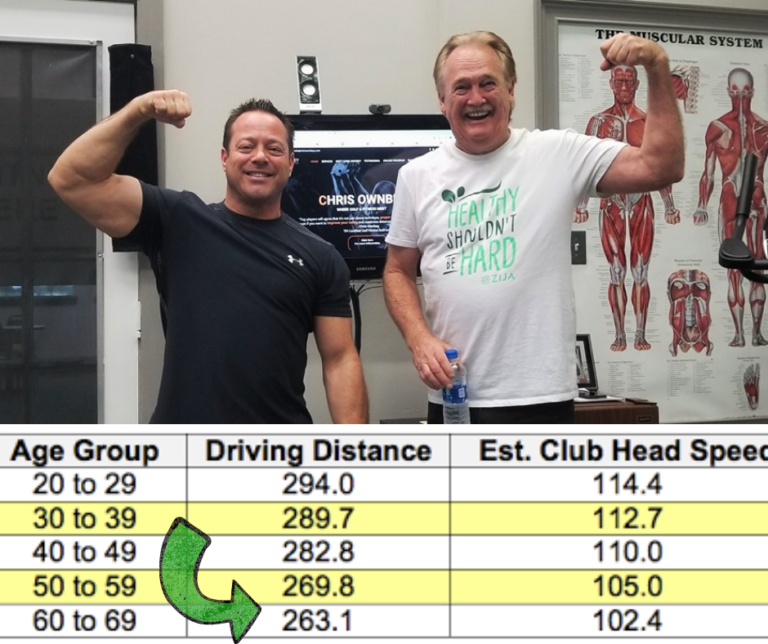
After 40, changes in strength, muscle mass, power, mobility and the ability to produce force quickly all affect how fast you can move the club.
However, the important thing to understand is this: losing golf club head speed as you age does not mean you have to accept being a shorter golfer.
If your body becomes stronger, more powerful and better able to move efficiently, then your ability to generate speed can improve.
Below are five areas worth addressing.
Why Does Golf Club Head Speed Begin Declining After 40?
Your golf swing is an explosive athletic movement. The body produces force from the ground, transfers it through the legs and hips, rotates through the torso, and finally delivers that energy through the arms and club.
When everything works together, the result is tremendous speed.
But your body at 45, 55 or 65 is not the body you had at 25. Years of sitting, working, injuries, reduced activity and inadequate strength training gradually take their toll.
For most golfers, five physical changes matter most.
1. You’re Losing Strength
One of the biggest mistakes is assuming golf power comes primarily from the arms. It doesn’t.
Your legs, hips, glutes, trunk and upper body all contribute to producing and transferring force.
Therefore, the message for any golfer over 40 is simple. If you stop training strength, then producing speed will predictably get harder.
You certainly do not need to become a bodybuilder. Rather, you need enough usable strength to create force and transfer it through your swing.
What to Do
Build your program around movements that develop:
- Leg and hip strength
- Glute strength
- Pushing and pulling strength
- Core stability
- Rotational strength
- Grip strength
The objective is not simply lifting heavier weights. Instead, the goal is a stronger foundation from which speed can be created.
Strength is your foundation. Power determines how quickly you can use it.
2. You’re Losing Power
This may matter even more than strength, because power is your ability to produce force quickly.
Golf never gives you five seconds to gradually build force. Since the downswing happens extremely fast, your nervous system has to recruit muscle, generate force and transfer that energy in a fraction of a second.
Consequently, someone can be relatively strong in the gym and still produce unimpressive golf club head speed. They have the strength, but they have never trained to express it quickly.
What to Do
Once an appropriate strength foundation exists, begin adding safe power movements based on your age, injury history and ability. Examples include:
- Medicine-ball rotational throws
- Medicine-ball chest passes
- Cable rotational work performed with intent
- Explosive step variations
- Controlled jumping, for suitable golfers
- Speed-oriented resistance exercises
- Golf-specific velocity training
The key word throughout is appropriate. A 55-year-old with two previous back surgeries should not train like a healthy 22-year-old collegiate golfer.
Ultimately, the goal is not destroying yourself in the gym. Instead, it is teaching your body to produce force faster.
3. You’ve Lost the Mobility Your Swing Needs
Here is where golfers get genuinely frustrated. They know exactly what their golf professional wants, yet they physically cannot get into the position.
Perhaps hip rotation has declined, or the upper back no longer rotates the way it did. Maybe the shoulders are tight, or twenty years behind a desk have quietly taken something away.
Your instructor says “turn more.” Meanwhile, your body answers: “that’s all I’ve got.”
Flexibility Alone Isn’t the Answer
This sits at the heart of the TPI Body-Swing Connection, since physical limitations influence how a golfer moves during the swing.
However, an important distinction applies here. More flexibility by itself does not automatically produce more golf club head speed.
So the goal is not becoming as flexible as possible. Rather, the goal is enough usable mobility to swing efficiently while maintaining stability and control.
What to Do
Golfers over 40 should pay particular attention to:
- Hip internal and external rotation
- Thoracic spine rotation
- Shoulder mobility
- Ankle mobility
- Pelvic control
Above all, don’t stretch randomly. Test first, find out where your limitations actually are, and then work specifically on those areas.
That is exactly why a golf fitness assessment is so valuable. If you don’t test, it’s just a guess.
4. You’re Not Using the Ground Efficiently
Watch a powerful golfer in slow motion and something becomes obvious. The swing is not happening from the waist up. Instead, the golfer is interacting with the ground.
Pressure shifts. Then the lower body starts producing force, the pelvis rotates, and energy moves upward through the trunk, arms and eventually the club.
This coordinated transfer is commonly called the kinematic sequence. When it works efficiently, energy passes from one segment to the next, rather like cracking a whip.
But when the legs and hips are not producing enough force, or the body cannot transfer it efficiently, you start compensating with your arms.
That is when golfers tell me they are swinging harder while the ball goes nowhere. More effort does not always create more speed. Frequently, it just creates more tension.
What to Do
Your training should include exercises that teach you to:
- Push into the ground
- Stabilize through the lower body
- Generate force from the legs and hips
- Control the pelvis
- Rotate through the torso
- Transfer energy from the lower body upward
This is precisely where traditional bodybuilding-style training falls short. Golfers don’t just need muscle. They need usable athletic strength.
5. You Stopped Training Speed
This one surprises people. If you want to move fast, then at some point you have to practice moving fast.
Many golfers over 40 perform every gym exercise slowly. Afterward, they go to the range and hit balls at the same comfortable speed, year after year.
Naturally, their body gets extremely good at exactly what it is being asked to do: move at one speed.
Speed is a skill, and like any other physical quality it should be trained intelligently. One important principle involves controlling the volume of maximum-effort swings, rather than hitting driver after driver until you are exhausted.
What to Do
After a proper warm-up, perform a small number of high-intent swings while measuring golf club head speed. Then rest, and repeat.
The goal is quality rather than fatigue. You are not trying to hit 100 balls as hard as possible. Instead, you are teaching your nervous system how fast you want it to move.
Once velocity starts dropping significantly, the speed portion of the session is finished.
Power training should look like power training: fast, focused, rested and explosive.
The Golf Speed Formula After 40
When golfers come to us wanting distance, I don’t hand them five random exercises from Instagram. First, we determine why speed is disappearing.
For one golfer, weakness is the primary issue. Another has plenty of strength but very little rotational power. Someone else has physical restrictions limiting the backswing, while a fourth is strong and mobile yet has never trained speed at all.
That is why I view golf performance as a combination of qualities:
Mobility + Stability + Strength + Power + Speed = A Body Built for Golf
You don’t necessarily need more of everything. Instead, you need to identify the weakest link.
Stop Trying to Buy Back the Distance Your Body Has Lost
Golf equipment is genuinely incredible now. Drivers have improved, shaft technology has improved, and the balls are better than ever. Meanwhile, launch monitors give us information golfers could not have dreamed of decades ago.
However, equipment cannot fully compensate for a body that has become weaker, slower and less powerful.
So before spending another $600 on a driver hoping to find 15 yards, ask a different question. Is my body physically capable of producing more speed?
After all, the most important piece of equipment you may be overlooking is the golfer swinging the club.
How Much Does Golf Club Head Speed Matter?
Quite a lot, because golf club head speed is among the major contributors to potential driving distance. That explains why it receives so much attention at the highest levels of the game.
Fortunately, you don’t need Tour-level speed. Even a modest gain, combined with good contact and appropriate launch conditions, makes golf noticeably easier.
More speed generally means shorter clubs into greens, more chances to reach par 5s, and less pressure on your long-iron game.
Perhaps most importantly, golf becomes fun again.
The Biggest Mistake Golfers Over 40 Make
They wait.
First they lose five yards, then ten, then twenty. Eventually they move up a tee box. Meanwhile the back gets tighter, the hips get weaker, and balance quietly declines.
Finally they conclude: “I guess I’m just getting old.”
But age is only part of the equation. How you train matters, and so does how you move. Remaining strong matters. Maintaining power matters. Above all, continuing to challenge your body to move quickly matters.
You can’t stop birthdays. Still, you absolutely can influence the physical qualities you bring to the first tee.
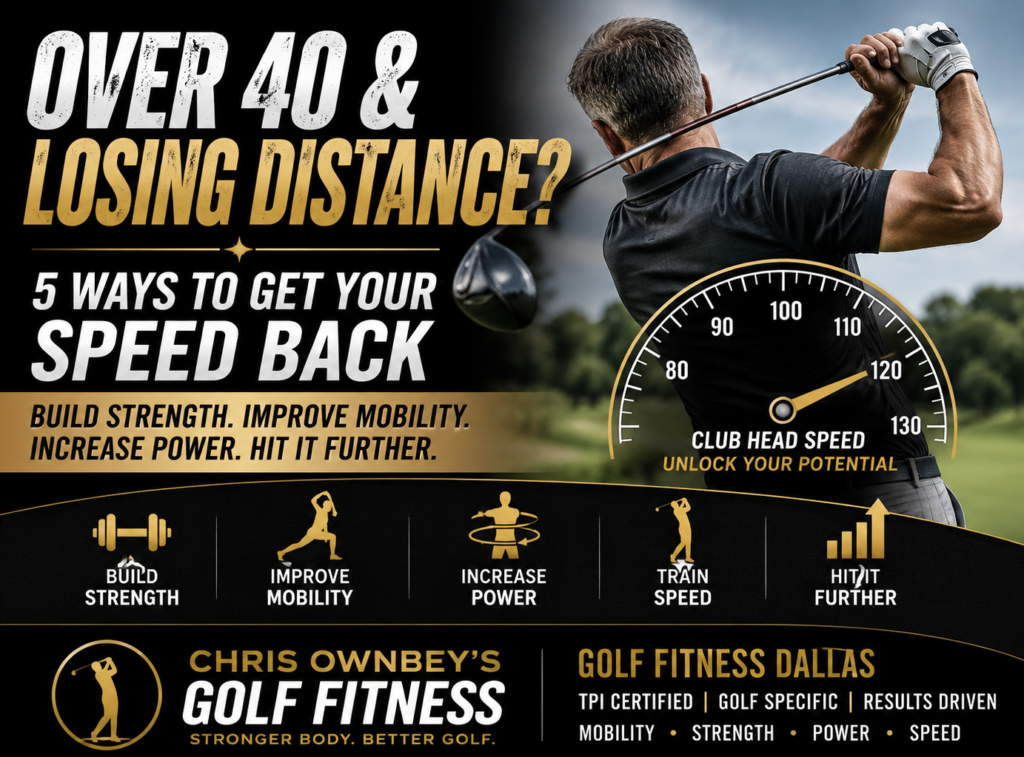
The 5-Step Golf Club Head Speed Plan for Golfers Over 40
If you are serious about maintaining or improving your golf club head speed after 40, then start here:
- Build strength. Focus on the legs, hips, glutes, core and upper body.
- Convert strength into power. Train your body to produce force quickly.
- Restore the mobility you actually need. Identify restrictions instead of stretching everything randomly.
- Improve force production and sequencing. Learn to use the ground and transfer energy efficiently.
- Train speed. Practice high-quality, high-intent swings with adequate recovery.
Before any of that, however, find out what your body actually needs.
Golfers Over 40: Don’t Guess, Get Tested
At Chris Ownbey’s Golf Fitness, we use a golf-specific physical assessment to identify the limitations affecting your swing.
Our 90-minute Golf Fitness Assessment includes 12 golf-specific tests examining mobility, stability, balance, strength, rotation and the physical limitations influencing how you move.
The objective is not simply handing you another workout. Rather, it is determining what your body needs so your training has a purpose.
After decades of working with golfers, and TPI Certified since 2006, one lesson keeps proving itself: if you don’t test, it’s just a guess.
While your golf instructor works on your swing and your club fitter works on your equipment, we work on the body swinging the club.
Ready to Get Your Golf Speed Back?
If you play in Dallas, Carrollton, Plano or the surrounding North Dallas area, and your drives have been getting shorter, then don’t assume your best golf is behind you.
Your body may simply need the right system. So let’s identify where you are losing mobility, strength, power or speed, and then build a program around it.
Schedule Your Golf Fitness Assessment
Chris Ownbey’s Golf Fitness Dallas / Carrollton, Texas Call: 214-457-9684
90-Minute Golf Fitness Assessment: $150
Stop guessing why you’re losing distance. Get tested, find the weak link, build the body, and increase your potential for speed.
Call 214-457-9684 today to schedule your assessment.