TPI Certified Golf Fitness Assessment
TPI Golf Fitness Assessment Dallas: Discover What’s Limiting Your Golf Swing
You’ve taken golf lessons.
You’ve worked on your swing.
You may have bought a new driver, changed shafts, watched countless golf videos and spent hours on the range.
But what if the problem isn’t your golf swing?
What if your body physically cannot make the golf swing you’re trying to make?
That is exactly what a TPI Golf Fitness Assessment is designed to help uncover.
At Chris Ownbey Golf Fitness in Dallas, we evaluate how your body moves and identify physical limitations that may be affecting your swing, distance, consistency and ability to play without discomfort.
If you don’t test, you’re just guessing.
And when it comes to improving your golf game, we don’t want to guess.
We assess.
What Is a TPI Golf Fitness Assessment?
A TPI Golf Fitness Assessment is designed to examine the relationship between your body and your golf swing.
Golf requires a unique combination of:
Mobility
Stability
Strength
Balance
Coordination
Flexibility
Rotation
Posture
Movement efficiency
When one or more of these physical abilities becomes limited, your body has to find another way to complete the golf swing.
That’s called compensation.
For example, if your hips don’t rotate properly, your lower back may be forced to create more movement.
If your upper back doesn’t rotate efficiently, you may struggle to make a complete shoulder turn.
If you lack stability or balance, maintaining posture throughout the swing becomes much more difficult.
The golfer sees the swing fault.
The assessment helps us look for the physical reason behind it.
Your Swing May Be Telling You Something About Your Body
This is one of the most important concepts I teach golfers.
Your golf swing doesn’t happen independently of your body.
Your swing is influenced by what your body is physically capable of doing.
You may be trying to correct a movement your body simply isn’t prepared to perform.
That can create an endless cycle:
You take a lesson.
You work on the correction.
It improves temporarily.
Then the old swing pattern comes back.
Why?
Sometimes it’s because the underlying physical limitation was never addressed.
That’s why golf instruction and golf fitness can work so well together.
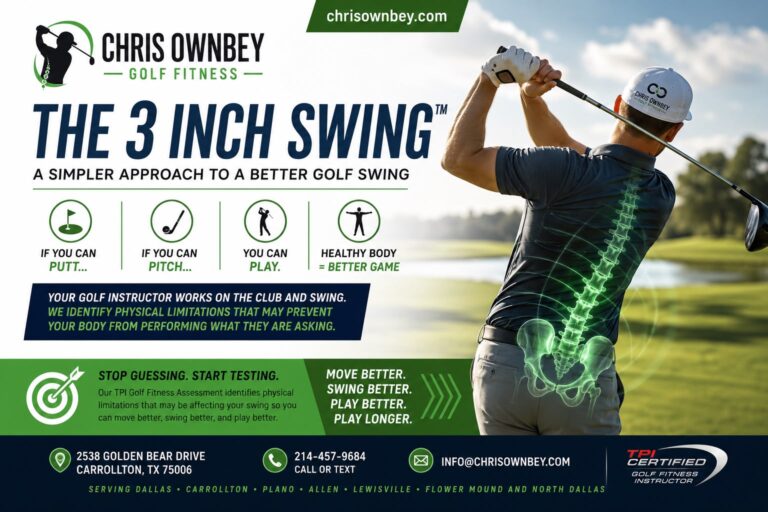
Your golf professional works on the technical side of the swing.
Golf fitness works on developing the physical capabilities necessary to perform that swing.
What Do We Evaluate During Your Golf Fitness Assessment?
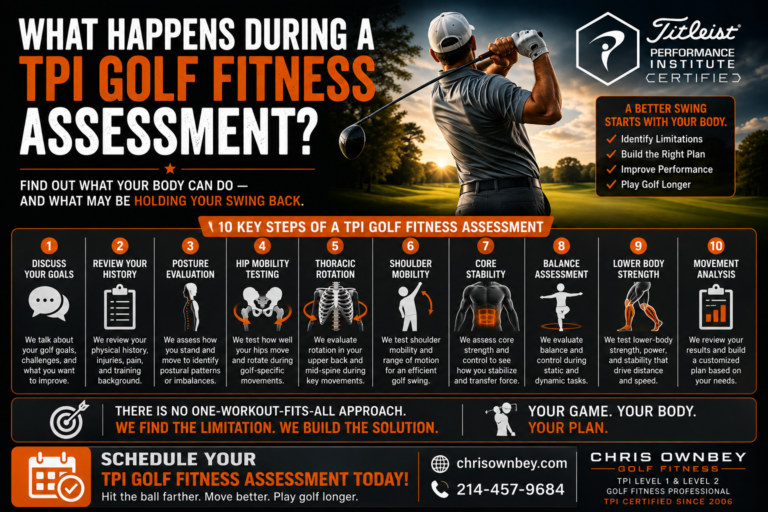
Your assessment takes you through a series of golf-specific movement screens designed to evaluate the physical characteristics important to an efficient golf swing.
We look at areas including:
Hip Mobility
Your hips play a major role in rotation, weight transfer, power production and maintaining posture.
Restricted hip mobility can force other areas of the body—especially the lower back—to compensate.
Thoracic Rotation
Your thoracic spine, or upper and middle back, needs sufficient rotational mobility to create an effective backswing and follow-through.
Limited thoracic rotation can make it difficult to create separation between your upper and lower body.
Shoulder Mobility
The shoulders must move through significant ranges of motion during the golf swing.
Restrictions can affect your backswing, club position and ability to complete the swing efficiently.
Core Stability
Your core provides the connection between your lower and upper body.
Good core stability helps you transfer force while maintaining control throughout the golf swing.
Balance
Golf is a rotational movement performed while controlling your center of gravity.
Poor balance can affect consistency, sequencing, weight transfer and your ability to finish the swing under control.
Flexibility and Mobility
As golfers get older, stiffness can gradually begin affecting the positions they can achieve.
This is especially important for golfers over 40 and 50 who want to continue playing at a high level.
Strength
Strength provides the foundation for producing and controlling force.
For golfers, strength isn’t about becoming a bodybuilder.
It’s about developing a body capable of creating a powerful, controlled and repeatable golf swing.
Why Golfers Over 40 and 50 Should Consider an Assessment
The body you played golf with at 30 isn’t necessarily the same body you’re playing with at 50 or 60.
Years of sitting, working, previous injuries, decreased activity and normal changes associated with aging can gradually affect your mobility and strength.
You may begin noticing:
Less distance off the tee
Reduced swing speed
Tight hips
Difficulty making a full backswing
Lower-back stiffness
Poor balance
Fatigue late in the round
Inconsistent ball striking
Loss of flexibility
Difficulty maintaining posture
Many golfers respond by trying to swing harder.
That isn’t always the solution.
You may need to improve the body producing the swing.
Why Are You Losing Distance?
Distance isn’t produced by the arms alone.
Your entire body contributes to creating and transferring force into the golf club.
Your legs create force.
Your hips rotate.
Your core transfers energy.
Your upper body rotates.
Your arms and club deliver that energy to the golf ball.
Restrictions anywhere along that chain can potentially reduce efficiency.
That’s why improving your body can be an important part of increasing golf performance.
Before simply trying to swing faster, we want to determine whether physical limitations are preventing you from moving efficiently.
Golf Fitness and Lower-Back Pain
Lower-back discomfort is another common reason golfers come to see me.
The golf swing requires tremendous rotational movement.
But your lower back isn’t designed to produce all of that rotation by itself.
Your hips and thoracic spine need to contribute.
When they don’t move properly, the lumbar spine may be forced to compensate.
This is why simply stretching your lower back isn’t always enough.
We need to look at the entire movement system.
A golf fitness assessment can help identify limitations such as restricted hip rotation, poor thoracic mobility, weak glutes, reduced core stability or poor balance that may be contributing to inefficient movement.
Instead of focusing only on where you feel the problem, we look at how your entire body moves.
Stop Guessing About Your Golf Fitness
This is why I tell golfers:
If you don’t test, it’s just a guess.
Without an assessment, you might spend months stretching muscles that don’t need stretching or strengthening areas that aren’t actually limiting your swing.
The assessment gives us a starting point.
Once we understand what your body can and cannot do efficiently, we can develop a golf-specific training strategy based on your individual needs.
Not someone else’s workout.
Not a random golf workout from the internet.
Not a generic gym routine.
Your body. Your limitations. Your golf game.
What Happens After Your Assessment?
Your assessment isn’t the finish line.
It’s the blueprint.
Once we’ve identified the physical limitations potentially affecting your swing, we can develop a golf-specific training system to address those areas.
Depending upon your assessment, your training may include:
Hip mobility exercises
Thoracic rotation exercises
Golf-specific flexibility
Core stability
Glute strengthening
Balance training
Rotational strength
Movement-pattern training
Golf-specific strength
Posture and stability work
The objective isn’t simply to make you tired.
Every exercise should have a purpose.
We’re trying to improve your ability to move so your golf swing can become more efficient.
Golf Fitness Works With Your Golf Professional — Not Against Them
Golf fitness doesn’t replace golf instruction.
They should complement each other.
Your PGA or LPGA professional understands the golf swing and the technical changes they want you to make.
Our job is to help improve the physical capabilities necessary to perform those movements.
Imagine your golf professional asks you to increase your hip rotation.
That’s good instruction.
But what happens if your hips physically don’t have the mobility necessary to perform the movement?
You can practice the correction hundreds of times, but your body may continue finding another way to accomplish the task.
Improve the physical limitation and suddenly the technical correction may become much easier to perform.
Better body. Better movement. Better opportunity for a better swing.
Why Work With Chris Ownbey Golf Fitness?
I’ve spent decades studying physical performance and working with golfers who want to move better, become stronger and continue playing the game they love.
As a Titleist Performance Institute Certified Golf Fitness Professional, my philosophy is simple:
Improve the body that produces the golf swing.
Golfers don’t come to me because they want to become bodybuilders.
They come because they want to:
Hit the ball farther
Increase swing speed
Improve rotation
Move without restriction
Reduce stiffness
Improve balance
Become stronger
Maintain their game as they age
Play more golf
Keep playing for years to come
Your golf clubs are important.
Your instructor is important.
Your swing technique is important.
But there is another piece of golf equipment you can’t replace.
Your body.
Take care of it.
Ready to Discover What’s Limiting Your Golf Swing?
If you’re a golfer in
Dallas, Carrollton, Plano, Lewisville or the surrounding North Dallas area and feel like your body may be holding back your golf game, your first step should be finding out exactly how your body moves.
Schedule your TPI Golf Fitness Assessment with Chris Ownbey Golf Fitness.
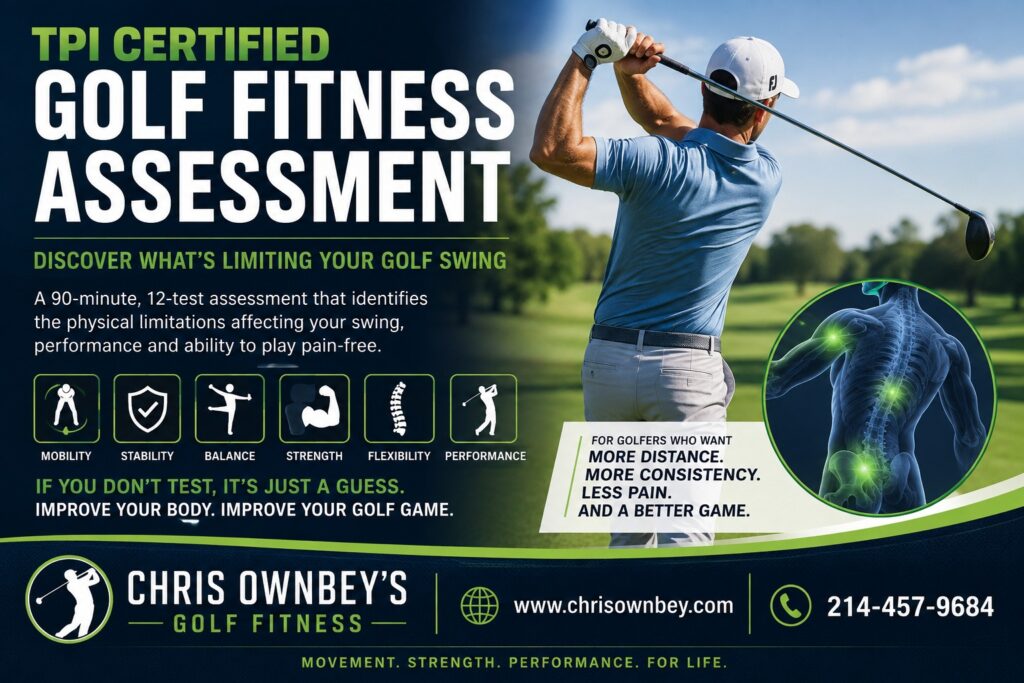
We’ll evaluate your mobility, stability, balance, flexibility, strength and overall movement—and identify physical limitations that may be affecting your golf swing.
Stop guessing.
Get assessed.
Schedule Your TPI Golf Fitness Assessment
Chris Ownbey Golf Fitness
TPI Certified Golf Fitness Professional
Dallas, Texas
Call or text: 214-457-9684
Your golf swing is only as capable as the body producing it.
Improve your body. Improve your movement. Give yourself the opportunity to play better.
Other related topics:
- Is Your Body Limiting Your Golf Swing? Golf Fitness Dallas
- Why Your Back Hurts After Playing Golf: The Hidden Cause Most Golfers Never Address
- Why Strength Matters for Golfers Over 50
- Straddle Stretch for Golfers | Dallas Golf Fitness
- Golf Fitness in Dallas – How to Increase Speed, power, and Distance While Preventing Injuries
- How to cure your golf slice in the golf fitness studio
- If you are suffering from lower back pain. Try this stretch.