Golf Exercises for a Better Golf Swing
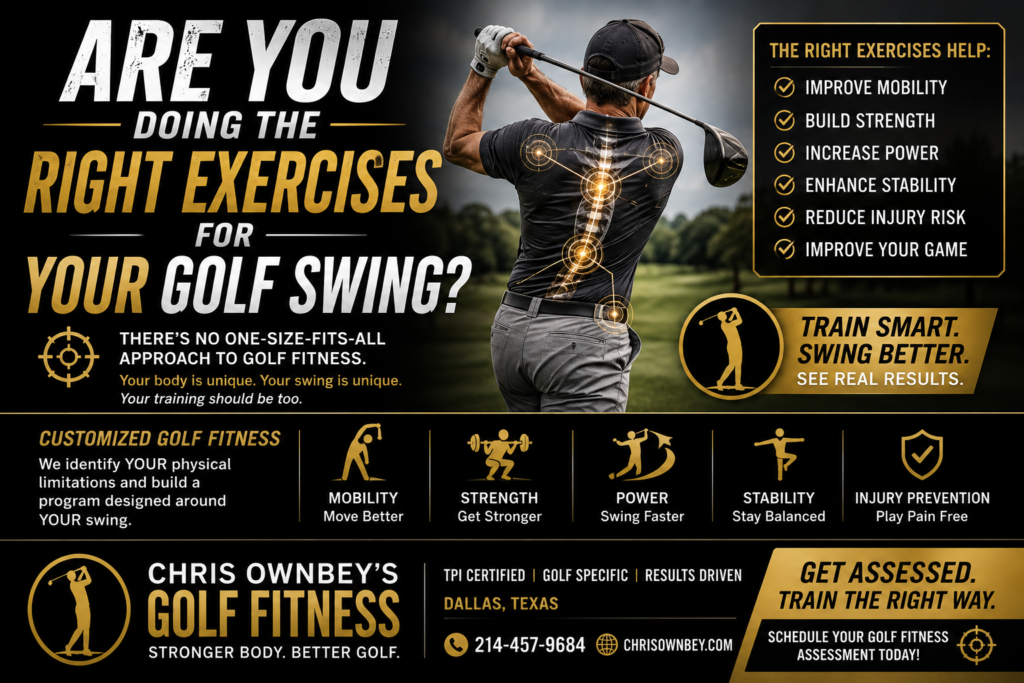
Are You Doing the Right Exercises for YOUR Golf Swing?
BARBELL SQUAT
Great exercise. But is it right for YOU?
CABLE WOODCHOP
Rotation is important. But movement quality comes first.
By Chris Ownbey | TPI Certified Golf Fitness Professional | Dallas, TX
You work hard in the gym.
You squat. You lift weights. You train your core. You perform rotational exercises because they seem similar to the golf swing.
However, there is an important question to ask:
Is your workout actually helping your golf game, or could some of your exercises be working against your swing?
At Chris Ownbey’s Golf Fitness, we work with golfers who want to improve the physical side of their game. Many of these golfers already exercise regularly and stay active.
The problem, therefore, usually isn’t a lack of effort.
Instead, the issue is that general fitness and golf fitness are not always the same thing.
An exercise can be excellent for overall strength and conditioning. However, it may not be the best choice for every golfer.
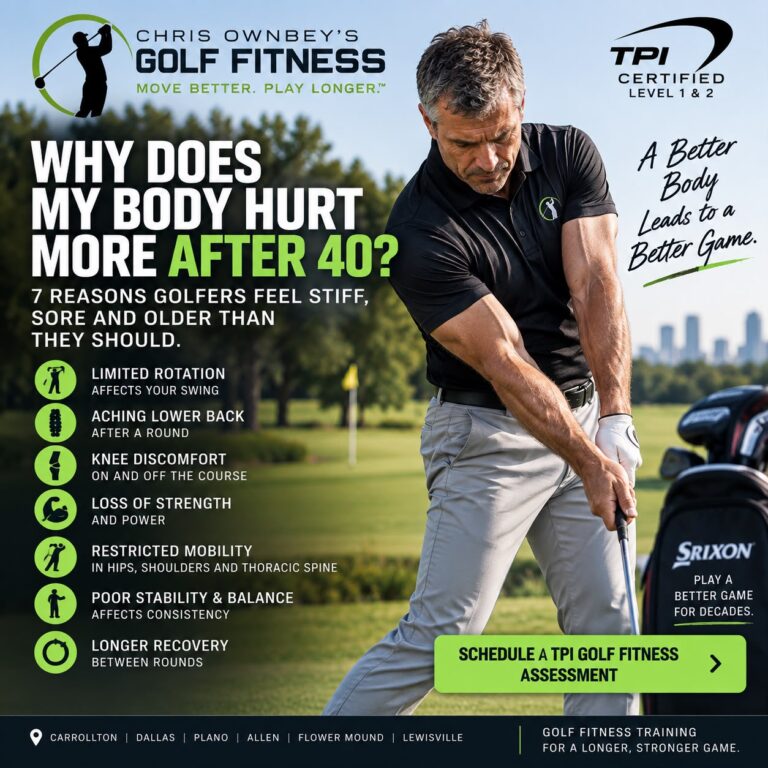
This becomes especially important for golfers over 40 and 50. At this stage, limits in hip mobility, thoracic rotation, ankle mobility, balance, and stability can begin to affect the golf swing.
If your body cannot move well, simply becoming stronger may not solve the problem.
In some cases, it may even reinforce the limits you already have.
So, let’s look at two common gym exercises that golfers should evaluate carefully.
Why Traditional Gym Training Doesn’t Always Transfer to Golf
Golf requires a unique combination of physical skills.
A golfer needs:
- Mobility
- Stability
- Balance
- Coordination
- Rotational control
- Lower-body strength
- Core stability
- Upper- and lower-body separation
- The ability to produce force quickly
That combination is very different from simply moving a heavy weight from Point A to Point B.
The golf swing also happens very quickly. In fact, the entire movement takes approximately one second.
During that short period, your body must create force from the ground. Then, that force must move through your legs and hips. At the same time, your trunk must stay stable while your upper body, arms, and club create speed.
If one part of this chain does not work well, another part of the body often tries to compensate.
That is why a golf fitness assessment can be so valuable.
Rather than guessing which exercises you need, you can identify the physical limits that may be affecting your swing.
If you don’t test, you’re guessing.
Exercise #1: The Traditional Barbell Squat
Let’s make one thing clear:
The barbell squat is not a bad exercise.
For the right person, a properly performed squat can be an excellent way to build lower-body strength.
However, that does not mean heavy barbell squats are the best golf exercises for every golfer.
Why Squatting Can Be a Problem for Some Golfers
A traditional back squat requires enough mobility in several areas.
These include the:
- Ankles
- Hips
- Thoracic spine
Your ankles need enough dorsiflexion to help you squat while maintaining good positioning.
Likewise, your hips must move freely enough to reach the required depth without compensation.
Your upper back also needs enough mobility and control to maintain an appropriate torso position.
When one of these areas is limited, your body may find another way to complete the movement.
For example, you may lean too far forward.
Your knees may also move inward.
Your heels could rise from the floor.
In addition, your pelvis may tuck underneath you.
Your lower back may then compensate for limited movement elsewhere.
Now imagine adding a heavy barbell to that movement.
For a golfer who already has limited hip or thoracic mobility, repeatedly loading a poorly controlled squat pattern may not address the problem affecting the golf swing.
Instead, it could reinforce the same movement pattern.
Golfers Need More Than Leg Strength
Lower-body strength is important for golf.
However, golfers do not only need to produce force vertically. They also need to control force while rotating and shifting pressure.
Think about what happens during your golf swing.
First, you load into the trail side.
Next, you change direction and shift pressure.
Then, your pelvis rotates while your torso follows.
After that, you move into the lead side and maintain your balance through the finish.
This sequence requires strength. At the same time, it requires mobility, stability, balance, and coordination.
For that reason, lower-body training should be selected based on what your body needs. It should not be based only on how much weight you can put on a bar.
Better Strength Training for Golfers
There is no single exercise that every golfer should perform.
Instead, movement quality should come first.
Depending on the golfer, a golf fitness program may include exercises that improve:
- Single-leg stability
- Hip mobility
- Glute strength
- Lateral strength
- Split-stance strength
- Balance
- Core stability
- Rotational control
For example, a split squat variation may be a better choice for one golfer.
Another golfer may need to improve hip mobility before adding more resistance.
Someone else may benefit from improving glute activation or single-leg stability.
The exercise should fit the golfer.
The golfer should not be forced to fit the exercise.
Exercise #2: The Traditional Woodchop
The second exercise golfers should evaluate is the traditional cable woodchop.
At first, it looks very golf-specific.
You are standing.
You are holding a cable.
You are rotating your body.
You are moving your arms across your body.
Because of this, the movement may look similar to a golf swing.
So, does that mean it will automatically improve your golf swing?
Not necessarily.
Rotation Isn’t Automatically Golf-Specific
One common mistake in golf fitness is assuming that every rotational exercise is good for golf.
Golf certainly requires rotation. However, it requires the right rotation, from the right areas, at the right time.
During an efficient golf swing, different parts of the body need to move independently. At the same time, other areas must remain stable.
For example, your hips and shoulders should not simply rotate together as one solid unit.
Instead, there needs to be separation and proper sequencing between different parts of the body.
A poorly performed woodchop can turn into several problems.
For example, the arms may end up pulling the weight.
The lower back may twist too much.
The hips and shoulders may rotate together.
Momentum may also replace muscular control.
As a result, you may perform a movement that looks athletic without addressing your actual limitation.
Adding resistance to a poor movement pattern does not automatically correct it.
Sometimes, you are simply making the incorrect movement stronger.
Golfers Need Rotational Control Before Rotational Power
Before trying to create more rotational power, you need to learn how to control rotation.
This is especially important for golfers over 40 and 50.
Many golfers come to us because they want more clubhead speed.
They may assume the answer is to immediately perform explosive rotational exercises.
However, what happens if the golfer does not have enough hip mobility?
What happens if the thoracic spine does not rotate well?
What happens if the golfer struggles with balance?
What happens if the core cannot stabilize the pelvis?
The body will still find a way to swing the club.
Unfortunately, it may rely on compensations to do so.
Over time, those compensations can contribute to inconsistent ball striking and inefficient movement.
Instead of immediately adding speed, we want to build a better physical foundation first.
What Should Golfers Train Instead?
An effective golf fitness program should be based on the individual golfer.
At Chris Ownbey’s Golf Fitness, we focus on four important physical qualities.
1. Mobility
First, ask yourself:
Can your body get into the positions required for your golf swing?
Important areas include the:
- Hips
- Thoracic spine
- Shoulders
- Ankles
If you do not have enough mobility, your body will often compensate somewhere else.
2. Stability
Mobility gives you the ability to move.
In contrast, stability gives you the ability to control that movement.
For golfers, stability is especially important through the:
- Pelvis
- Core
- Hips
- Knees
- Shoulders
You want to create force without losing control of your body.
3. Balance
Golf is a dynamic movement performed from a relatively small base of support.
Therefore, balance allows you to create speed while maintaining control.
Poor balance can contribute to:
- Sway
- Sliding
- Loss of posture
- Inconsistent contact
- Difficulty finishing the swing
Better balance can provide a more stable platform for producing force.
4. Rotational Control
Golfers do not simply need the ability to rotate.
Instead, they need to control where rotation happens and when it happens.
For that reason, we may use exercises that teach golfers to stabilize the pelvis while moving the upper body.
We may also stabilize the torso while moving the lower body.
Eventually, these skills can be combined into a complete movement pattern.
Only after control is established do we progressively add speed and power.
Why Golfers Over 50 Need a Different Approach
This becomes even more important as golfers get older.
One of the first changes many golfers notice after 50 is a loss of driving distance.
They may immediately think:
“I’m getting older. I’m losing distance.”
Age certainly affects the body. However, age alone does not explain every change in golf performance.
Over time, golfers can lose:
- Muscle mass
- Strength
- Hip mobility
- Thoracic mobility
- Balance
- Rotational speed
- Power
If you continue performing the same gym routine without addressing these changes, you may become stronger at movements that do not solve the limitations affecting your swing.
As a result, golfers over 50 should train with a purpose.
Don’t just train harder. Train for what your body needs to play better golf.
The Goal Isn’t to Turn Your Workout Into a Golf Swing
Another common mistake is trying to make every gym exercise look like a golf swing.
You do not need to stand in your golf posture for every exercise.
Likewise, you do not need to hold a cable and pretend it is a golf club.
You also do not need every exercise to involve rotation.
Instead, the gym has a different job.
The goal is to build the physical tools your golf swing requires.
Then, your PGA teaching professional can help you use those physical abilities to improve your swing.
Golf instruction and golf fitness should complement each other.
Your golf instructor works on your swing.
Golf fitness works on the body that produces that swing.
Stop Guessing: Find Out What’s Limiting Your Golf Swing
If you have been working out consistently but still struggle with distance, rotation, balance, or consistency, do not assume you simply need to train harder.
You may need to train differently.
That is where a TPI Golf Fitness Assessment can help.
At Chris Ownbey’s Golf Fitness, our golf fitness screening looks at physical characteristics that can influence your ability to move efficiently during the golf swing.
We evaluate areas such as:
Mobility
Can your hips, shoulders, and thoracic spine move through the ranges your swing requires?
Stability
Can you control those positions while you move?
Balance
Can you maintain control while shifting and rotating?
Strength
Do you have the physical strength needed to create and transfer force?
Movement Patterns
Is your body compensating because one area is not doing its job?
Once we identify your physical limitations, we can build a golf-specific fitness system around what your body needs.
Your Workout Should Support Your Golf Game
The takeaway is not that squats are bad.
It is not that woodchops are bad either.
The real question is:
Are These Exercises Appropriate for Your Body and Your Golf Game?
A 25-year-old athlete with excellent mobility may respond differently to an exercise than a 55-year-old golfer who sits behind a desk most of the week and has limited hip and thoracic mobility.
For that reason, golf fitness should be individualized.
You do not need random golf exercises from social media.
You do not need to copy the workout of a PGA Tour player.
You also do not necessarily need to lift heavier.
Instead, you need to determine what your body can and cannot do. Then, you can train accordingly.
Want to Know What’s Limiting YOUR Golf Swing?
If you want more distance, better rotation, improved balance, and a body that can continue playing golf for years to come, start by finding out where your limitations are.
At Chris Ownbey’s Golf Fitness, we specialize in helping golfers improve the physical side of their game through golf-specific assessment and training.
We serve golfers throughout Dallas, Carrollton, Plano, and North Dallas.
Schedule Your Golf Fitness Assessment
Chris Ownbey’s Golf Fitness
TPI Certified Golf Fitness Professional
Phone: 214-457-9684
Call 214-457-9684 today to schedule your assessment and discover what may be limiting your golf swing.
Improve your body. Improve your golf game.
Other related topics:
The 3 Inch Swing™: A Simpler Approach to a Better Golf Swing
Personal Training After 40 in Dallas: Get Strong, Lean & Move Better
- What Happens During a TPI Golf Fitness Assessment?
- 5 Physical Limitations That Can Affect Your Golf Swing
- Is Your Body Limiting Your Golf Swing? Golf Fitness Dallas
- Why golfers lose distance after 50?
- How to Stop Slicing the Golf Ball
- Why Your Back Hurts After Playing Golf: The Hidden Cause Most Golfers Never Address
- Why Strength Matters for Golfers Over 50
- Straddle Stretch for Golfers | Dallas Golf Fitness
- Golf Fitness in Dallas – How to Increase Speed, power, and Distance While Preventing Injuries