Golf Fitness Exercises After 50: Boost Backswing & Power
Two Golf Fitness Exercises to Improve Your Backswing, Strength, and Power After 50
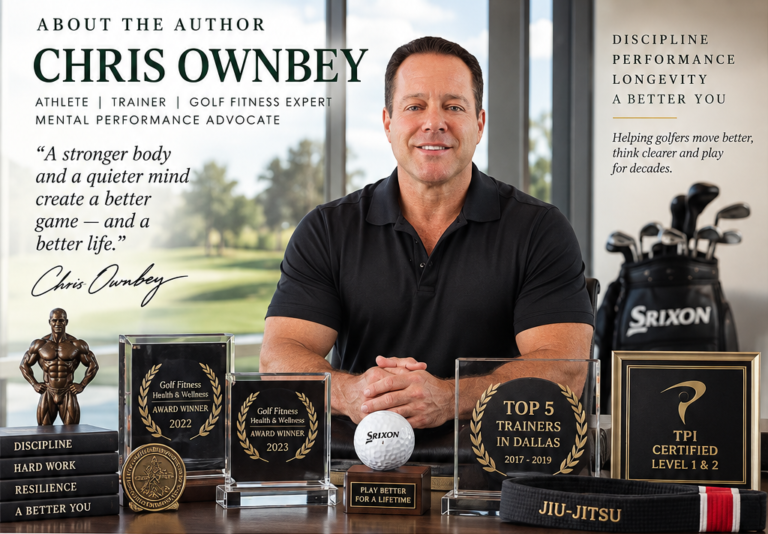
By Chris Ownbey | TPI Level 1 & Level 2 Certified Golf Fitness Professional | Dallas, Texas
Move Better. Hit It Farther. Play for Decades.™
“You don’t play golf to get in shape. You get in shape to play better golf.” – Chris Ownbey
Golf fitness exercises can change how you swing after 50. If you’re a golfer over 50, you’ve probably noticed your game shifting. The swing that once felt smooth may now feel restricted. For example, your backswing might not turn as far as it used to. Likewise, you may struggle to generate the same clubhead speed. Perhaps your lower back even feels tight after 18 holes.
Most golfers blame their swing mechanics first. As a result, they book another lesson, buy a new driver, or watch another instructional video. Some even spend hours on the range searching for that missing 20 yards.
But what if the problem isn’t only your golf swing? What if your body simply can’t perform the movement you’re asking it to make?
Who Is Chris Ownbey?
I’m Chris Ownbey, a Titleist Performance Institute (TPI) Level 1 and Level 2 Certified Golf Fitness Professional. I’m also a man pushing 60 who has had two back and neck surgeries in four years. Because of this, I knew my swing, but my body was not able to follow it.
Since 2006, I’ve worked with golfers throughout Dallas, Carrollton, Plano, and North Texas. Along the way, I’ve learned that a better golf swing often begins with better body movement.
In my video, I demonstrate two golf fitness exercises that target backswing mobility and lower-body strength. Neither requires expensive equipment, and you can modify both to match your current abilities.
Why Your Golf Swing Changes as You Get Older
Golf is an athletic activity, so it takes more than good technique. A functional swing involves your ankles, knees, hips, pelvis, spine, shoulders, and arms. Together, these body segments work in what we call the kinetic chain.
When one area can’t move or stabilize well, another area compensates. For example, stiff hips make it hard to turn into your backswing without changing your posture. Likewise, a stiff thoracic spine (the middle and upper back) limits upper-body rotation. As a result, it’s hard to turn while keeping your lower body stable. Weak legs, in turn, can cost you balance and efficient force.
As we age, several changes can affect golf performance:
- Reduced joint mobility and flexibility
- Loss of muscle strength and power
- Changes in balance and coordination
- Less physical activity outside the golf course
- Previous injuries or surgeries
- Reduced confidence in certain movements
However, none of these changes means your best golf is behind you. Instead, they simply mean your training needs differ from what worked at 25. The goal isn’t to train like a tour pro. Rather, you want to build the physical capabilities your swing needs.
Golf Fitness Exercise #1: Resistance-Band Backswing Mobility
The first exercise uses a resistance band to encourage a controlled backswing movement. It improves rotation. Also, it helps you understand how your shoulders, torso, and hips work together.
Why Backswing Mobility Matters
Many golfers over 50 struggle to make a comfortable backswing. For instance, some try to force a bigger shoulder turn. Others lift their arms higher because their torso won’t rotate enough. Unfortunately, forcing extra motion creates compensations elsewhere.
The goal isn’t the longest backswing possible. Rather, you want a comfortable, controlled range of motion that protects your balance and posture. As a result, a more functional backswing can improve consistency, sequencing, and your transition into the downswing.
How to Perform the Backswing Mobility Exercise
In the video, I place a resistance band around my upper torso. The band creates light resistance while I move into a golf-specific backswing position. Here is the general progression:
- Establish your setup. First, stand with your feet about shoulder-width apart. Then soften your knees and hinge forward from your hips. Keep a comfortable spinal position.
- Position the resistance band. Use a light band and secure it as shown in the video. Also, make sure it can’t slip or snap back toward your face.
- Move into your backswing. Next, rotate your torso into a comfortable backswing position. Keep control of your posture and balance.
- Let your body move naturally. Instead of forcing rotation through your lower back, coordinate your hips, torso, and shoulders.
- Return slowly. Finally, control the movement back to the start. Avoid using momentum.
Start with 8–10 controlled repetitions, provided the movement feels comfortable. Also, keep the resistance light enough for smooth repetitions.
What Should You Feel?
Expect gentle muscular effort through your torso, shoulders, and the muscles that control rotation. However, sharp back pain, pinching in the shoulders, or discomfort that travels down your arms or legs are warning signs. If a movement causes pain, stop and have it evaluated.
Why I Like This Exercise for Golfers Over 50
This drill lets you work on a golf-relevant movement without hitting balls. Instead of forcing a longer backswing on the driving range, you practice the underlying movement in a controlled setting. Movement quality comes first. Then, with practice, we apply that improved movement to your swing.
Golf Fitness Exercise #2: Squat-to-Extension for Lower-Body Strength and Power
The second exercise focuses on lower-body movement and controlled force production. I demonstrate a squat pattern followed by an upward extension against band resistance. As a result, it trains your legs and hips to contribute to an athletic movement.
Why Your Legs Matter in the Golf Swing
Golfers often focus on shoulder rotation and arm speed. Because of this, they forget the lower body. However, your legs and hips provide the foundation for producing and transferring force. In addition, a well-coordinated downswing involves pressure shifts, controlled rotation, extension, and good timing.
That doesn’t mean every golfer needs heavy squats or explosive jumps. In fact, many golfers over 50 benefit from building basic strength, control, and balance first. Once those qualities are in place, we can progress toward more powerful movements when appropriate.
How to Perform the Squat-to-Extension Exercise
- Secure the resistance band. First, attach a light band to a stable, appropriate anchor. Then stand far enough away to maintain controlled resistance.
- Assume an athletic stance. Place your feet comfortably apart and soften your knees. Also, keep a neutral, comfortable trunk position.
- Perform a controlled squat. Next, bend through your hips and knees. Lower only as far as your mobility and comfort allow. Stay balanced, and avoid collapsing forward.
- Rise into extension. Push through your feet and straighten your legs and hips while controlling the band. Keep the motion deliberate instead of a sudden, uncontrolled pull.
- Reset and repeat. Finally, return to your starting position. Then perform the next repetition with good technique.
For a starting point, try 2 sets of 8–10 repetitions. Also, adjust the resistance and volume to your ability.
What Does This Exercise Train?
This movement develops several physical qualities relevant to golf:
- Lower-body strength
- Hip and knee extension
- Balance during movement
- Coordination between the upper and lower body
- Controlled acceleration against resistance
As your movement quality improves, your trainer can decide whether to add speed or resistance. However, power training requires control as well as speed. Ultimately, the goal is to produce force efficiently and safely.
Your Golf Swing Is Not Just a Simple Rotation
The golf swing is more complex than turning your shoulders around your spine. In fact, the club travels along a three-dimensional path. Therefore, your body must coordinate rotation, side bending, posture changes, and other movements throughout the swing.
This matters most for golfers with previous back problems. For example, forcing a large rotation through an area that tolerates rotation poorly can cause discomfort or compensations. So we want the right joints and muscles contributing to the movement.
That means evaluating how your hips move, how your thoracic spine rotates, how your lower body stabilizes, and how your whole body coordinates. A resistance-band drill can help. However, it isn’t a substitute for understanding your individual physical limitations.
Why Golf Fitness Is Different From General Fitness
You can be in excellent condition and still struggle with your golf swing. For example, you might bench press impressive weights or run several miles. But can you rotate comfortably into your backswing? Do you keep your posture? Is your balance steady as you shift your weight? Likewise, can you produce force without excessive tension?
These are different physical abilities. General fitness is valuable for overall health. Golf-specific fitness, on the other hand, looks at how your body meets the demands of golf.
This is where a TPI Golf Fitness Assessment helps. Instead of guessing, we evaluate mobility, stability, balance, and movement quality. Next, we identify limitations that may be affecting your swing. Finally, we build a focused training plan from what we find.
Golfers Over 50: Train Smarter, Not Just Harder
After decades of working with golfers, I see the same mistake often. Players try to improve by adding more practice without addressing their physical limitations. If your body can’t comfortably perform a movement, repeating it hundreds of times isn’t the solution.
Sometimes the answer is mobility, and sometimes it’s strength. In other cases, it’s balance, coordination, or the way your body segments move together. Finally, the best next step may be working with your golf instructor on a technical adjustment that matches your physical capabilities.
Because no single exercise works for every golfer, I believe in individual assessments instead of one-size-fits-all workouts.
How Often Should You Do Golf Fitness Exercises?
For many golfers, two or three short golf-specific sessions per week make a practical starting point. For example, a session might include:
- Gentle mobility exercises
- Controlled rotational movements
- Lower-body strengthening
- Balance training
- Core stability exercises
- Golf-specific movement practice
However, the right frequency depends on your current fitness, recovery, injuries, and overall training schedule. Also, you don’t need to exhaust yourself to make progress. Instead, focus on consistency, appropriate progression, and exercises chosen for your needs.
Can Golf Fitness Exercises Help You Hit the Ball Farther?
Potentially. Better strength, mobility, coordination, and power can improve your physical capacity for producing clubhead speed. However, more flexibility doesn’t automatically mean more yards.
Distance depends on several factors, including swing mechanics, sequencing, clubhead speed, quality of contact, equipment, and launch conditions. Because of this, golf fitness improves the physical foundation behind your swing. Then you work on turning those improvements into better performance on the course.
That approach is far more productive than promising that one stretch or exercise will add 20 yards to your driver.
Your Best Golf Doesn’t Have to Be Behind You
One of the most rewarding parts of my work is helping older golfers keep enjoying the game they love. Whether you’re 50, 60, 70, or beyond, maintaining strength and mobility supports your ability to stay active.
You might want to regain some driving distance. Maybe you want to finish 18 holes without feeling exhausted. Perhaps you simply want another 10 or 20 years on the course. Whatever your goal, your body deserves attention. Because you invest in clubs, lessons, and practice, consider making the same commitment to the body that swings those clubs.
Schedule Your TPI Golf Fitness Assessment in Dallas, TX
If you’ve noticed less rotation, stiffness, lost distance, or changes in your balance, start by understanding how your body moves. At Chris Ownbey’s Golf Fitness, I identify physical limitations and build individualized golf fitness training. In addition, my approach combines TPI assessment principles with mobility, strength, balance, and movement training.
I serve golfers throughout Dallas, Carrollton, Plano, Lewisville, Flower Mound, and North Dallas.
Ready to improve the body behind your golf swing? Schedule your TPI Golf Fitness Assessment today.
CHRIS OWNBEY’S GOLF FITNESS
Move Better. Hit It Farther. Play for Decades.™
📍 2538 Golden Bear Drive, Carrollton, TX 75006
📞 Call or Text: 214-457-9684
🌐 Website: chrisownbey.com
✉️ Email: golffitnessdallastx@gmail.com
Don’t just practice your golf swing. Develop the body that makes your golf swing possible.