The Inner Game of Golf: How to Quiet Your Mind, Trust Your Swing, and Play Better Golf

The Inner Game of Golf: How to Quiet Your Mind, Trust Your Swing, and Play Better Golf
Have you ever hit golf balls beautifully on the driving range, only to walk onto the first tee and feel like you suddenly forgot how to swing?
Your tempo changes, and your grip gets tighter.
Then you start thinking about your backswing, your takeaway, your hips, your head position and everything that could possibly go wrong.
Don’t hit it right. Keep your head down. Don’t come over the top. Slow down.
And then you hit exactly the shot you were trying to avoid.
The problem may not be that you suddenly lost your golf swing. Instead, you may have simply stopped trusting it.
After nearly four decades in fitness, athletics and performance training, and working specifically in golf fitness in the Dallas area since 2006, I’ve learned that performance isn’t purely physical.
Your body has to be prepared. Your mind has to be prepared, too. Eventually, you have to trust what you’ve trained.
That, in short, is what I call The Inner Game of Golf.
There Are Two Golf Games Being Played
Whenever you step onto a golf course, you’re playing two games.
The outer game is obvious. It includes the golf course, fairways, greens, bunkers, wind, water, distance and ultimately your score.
However, there’s another game happening at exactly the same time.
The inner game includes fear, doubt, expectations, frustration, overthinking, tension, self-criticism and pressure.
In other words, you can have a technically good golf swing and still struggle to access it when your mind starts interfering.
One of the simplest ways to understand this is:
PERFORMANCE = POTENTIAL − INTERFERENCE
Golfers spend enormous amounts of time trying to increase their potential. For example, they buy new clubs, take lessons, watch swing videos, work on mechanics and practice.
Of course, those things can absolutely help.
But there comes a point when another swing thought isn’t necessarily what you need. Rather, you may need less interference.
The Two Golfers Inside Your Head
Think of yourself as having two golfers.
Golfer #1: The Internal Coach
This golfer never stops talking.
“Keep your head down. Turn your shoulders. Don’t sway. Shift your weight. Release the club. Don’t hit it in the water.”
It believes that constantly controlling your movements will produce a better swing.
However, the opposite often happens. In fact, the more instructions you give yourself, the less athletic the movement becomes.
Golfer #2: The Athlete
This is your trained nervous system. In other words, it’s your coordination, balance, rhythm, feel, timing and learned movement.
For example, think about throwing a ball to someone.
You don’t consciously calculate the position of your elbow, wrist, shoulder and hips. Instead, you look at the target and throw, and your body organizes the movement.
Golf isn’t quite that simple technically. Still, the performance principle is important:
Train the movement. Then learn to trust the movement.
Why Trying Harder Can Make Golf More Difficult
This is one of golf’s great paradoxes: trying harder doesn’t always mean performing better.
For example, picture yourself standing over a six-foot putt to win a match or shoot your best score.
Suddenly, everything becomes important: your grip, your shoulders, your wrists, the putter face, your stroke and your tempo.
As a result, you become so determined to make the putt that the stroke no longer feels natural.
In fact, you are trying to consciously control a movement that you’ve performed thousands of times.
That’s interference.
Of course, this doesn’t mean you shouldn’t care. Rather, it means you need to learn when to think and when to perform.
Awareness Before Correction
One of the biggest mistakes I see golfers make is trying to correct every bad shot immediately.
For example, you hit a hook, so you think: “I need to hold the face open.”
Then the next ball goes right, so you decide: “I need to release the club.”
Twenty minutes later, you’re working with four different golf swings.
Instead, try something different. Observe before you correct.
- Where did the ball start?
- How did it curve?
- Where was the contact on the clubface?
- How was your balance?
- What did you feel?
All of this is useful information.
So instead of thinking, “That was a terrible swing,” ask yourself, “What actually happened?”
There is an enormous difference between judgment and awareness.
Play Golf With a Target, Not a Swing Thought
This may be one of the most important concepts in the entire Inner Game of Golf.
Stop making your golf swing the target. Instead, make the shot the target.
Before you swing, determine where you want the ball to go. See the starting line, the trajectory and the landing area, and feel the shot.
Then give your body permission to execute.
Consider these two golfers.
One stands over the ball thinking: Turn, don’t sway, drop the club, rotate, release.
Meanwhile, the other sees: 150 yards, slight draw, right-center of the green.
The second golfer is playing golf. The first golfer, on the other hand, is essentially taking a golf lesson during his backswing.
Practice mechanics on the range, but play golf on the course.
Trust Your Golf Swing
Trust doesn’t mean believing you’re going to hit every shot perfectly. After all, nobody does.
Instead, trust means that once you’ve made your decision, you allow yourself to execute it.
So choose the club, the target and the shot. Then commit and swing.
However, if you’re standing over the ball thinking “I’m not sure this is the right club,” “I don’t like this target” or “Maybe I should hit something else,” back away.
Make your decision first. Then step back over the ball.
My simple rule is:
SEE IT → FEEL IT → TRUST IT → SWING IT
And afterward? Accept it.
The Next Shot Is the Most Important Shot
Let’s say you make double bogey. Immediately, your mind starts:
“I can’t believe I did that. I was playing so well. There goes my round. Now I need two birdies.”
However, the double bogey isn’t necessarily what destroys your round. Sometimes it’s your reaction to the double bogey.
One bad hole becomes two or three because mentally you’re still playing the previous hole.
That is why a mentally strong golfer learns:
THE NEXT SHOT IS THE ONLY SHOT I CAN PLAY.
After all, you can’t change the drive you hooked. You can’t get back the three-footer you missed, either. And you certainly can’t hit the shot on the 18th hole while you’re standing on the 14th.
You have one shot you can control. This one.
Stop Protecting Your Score
Let’s say you’re playing one of your best rounds, and you’re two over after 14 holes.
Then the thought appears: “If I par the last four holes, I’ll shoot 74.”
Suddenly, something changes. You’re no longer playing golf. Instead, you’re protecting 74.
As a result, your grip tightens, your swing becomes careful and every putt suddenly feels more important.
But you can’t shoot 74 standing on the 15th tee. You can only hit the 15th tee shot.
So return your attention to:
Target → Shot → Commitment → Execution
Let the score become the result rather than the task.
Golf Under Pressure
Pressure is fascinating because the golf ball doesn’t know you’re nervous.
Similarly, the cup doesn’t know you’re trying to break 80, and the fairway doesn’t know there’s money on the match.
In other words, the physical task hasn’t necessarily changed. Only the meaning you’ve attached to it has.
Suddenly, the putt isn’t simply a putt. Instead, it’s:
“This is for $100. This is to break 80. Everyone is watching. I can’t lose to him.”
So bring yourself back to what is actually happening.
There’s a golf ball and a target. Your job is simply to execute the shot.
Everything else is noise.
A Simple Pre-Shot Routine
A consistent routine can help you move from thinking into performing.
1. Think
Behind the ball, determine your distance, wind, lie, club, target and shot shape. Then make the decision there.
2. Feel
Before you address the ball, take your rehearsal swing and feel the movement or tempo you want.
3. Trust
Address the ball and stop coaching yourself. Then look at your target and allow yourself to swing.
4. Observe
Watch the result and learn from it. Then move on.
Remember:
THINK → FEEL → TRUST → OBSERVE
The Inner Game of Golf After 40
This is especially important for the golfers I work with through Chris Ownbey’s Golf Fitness in the Dallas area.
Golfers Over 40 often fall into another mental trap. Specifically, they compare themselves with the golfer they were 10, 20 or 30 years ago.
“I used to hit it 280. My turn used to be much bigger. Back then, I could play five days a week.”
However, your objective isn’t to force your current body to move exactly like it did at 25. Instead, your objective is to maximize the golfer you are today.
That’s where golf fitness becomes important.
As we age, maintaining the physical qualities behind the golf swing becomes increasingly valuable: mobility, strength, balance, stability, endurance, rotational ability and recovery.
So build a body capable of supporting your golf game. Then trust that body to perform.
Don’t continually force yourself into positions your body isn’t prepared to produce.
Why This Message Is Personal to Me
These ideas didn’t begin for me with golf. Instead, they developed through a lifetime of athletics and performance.
I’ve spent 39 years in the fitness and performance industry.
Before specializing in golf fitness, I competed as a state champion powerlifter, won four bodybuilding competitions, and spent 17 years training and competing in mixed martial arts.
I also served in the United States Marine Corps.
These were different environments with different challenges. Still, they repeatedly taught me the same lesson:
Physical preparation matters. Mental performance matters, too. And when the moment comes, you have to trust what you’ve trained.
After all, you cannot consciously control every detail when you’re competing. Eventually, preparation has to become performance.
That’s one of the biggest lessons I’ve carried into my work with golfers.
Since 2006, I’ve helped Dallas-area golfers improve the physical side of their game through golf-specific mobility, strength, balance and performance training.
However, the ultimate objective isn’t merely to become stronger. Rather, it’s to build the physical capacity and confidence that allow you to step over the golf ball and trust yourself.
The Five Principles of the Inner Game of Golf
If you remember nothing else from this article, remember these five ideas:
- Awareness: Observe what’s actually happening rather than immediately judging yourself.
- Target: Give your brain a clear external objective.
- Trust: Allow your trained body to organize the movement.
- Acceptance: Once you’ve hit the ball, accept the result and learn from it.
- Next Shot: Bring your attention back to what you can control right now.
Together, these become your Inner Game system.
Your 30-Second Inner Game Routine
Before your next golf shot:
- SEE IT: Visualize your target and ball flight.
- FEEL IT: Feel the swing or stroke you’re trying to produce.
- TRUST IT: Stop giving yourself a list of mechanical instructions.
- SWING IT: Allow your athletic ability and preparation to take over.
- ACCEPT IT: Observe the result without emotionally carrying it into the next shot.
Then start again.
You May Already Be Better Than Your Score Shows
Golfers spend years trying to build better swings, and there is nothing wrong with improving your technique.
But eventually, you have to stop practicing your golf swing and play golf.
In fact, you may already possess more ability than your scores reveal.
The missing ingredient may not be another swing thought. Instead, it may be learning to get out of your own way.
So quiet the internal coach, choose your target and trust your preparation. Then make your swing and accept the result.
Finally, play the next shot.
The best golf isn’t always produced by thinking more. Sometimes it’s produced by interfering less.
Dallas Golf Fitness: Build a Body You Can Trust on the Golf Course
If you’re a golfer Over 40 in Dallas, Carrollton, Plano, Allen, Lewisville, Flower Mound or the surrounding North Dallas area, your golf game may not need another quick fix.
Instead, you may need the right system for your body and your game.
At Chris Ownbey’s Golf Fitness, I use golf-specific assessments and private training to help golfers improve flexibility and mobility, strength, balance, stability, endurance and rotational performance.
The goal is simple:
Move better. Hit it farther. Play for decades.
Call or fill out the form today to schedule your golf fitness assessment.
Other related topics:
The 3 Inch Swing™: A Simpler Approach to a Better Golf Swing
Personal Training After 40 in Dallas: Get Strong, Lean & Move Better
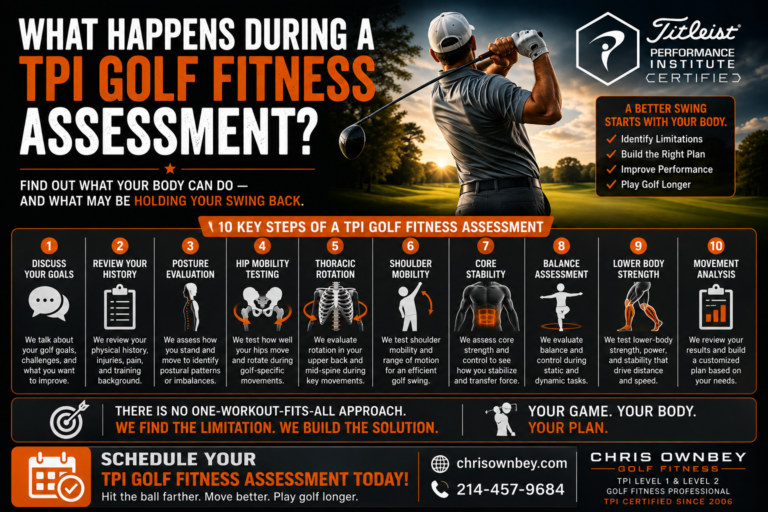
- What Happens During a TPI Golf Fitness Assessment?
- 5 Physical Limitations That Can Affect Your Golf Swing
- Is Your Body Limiting Your Golf Swing? Golf Fitness Dallas
- Why golfers lose distance after 50?
- How to Stop Slicing the Golf Ball
- Why Your Back Hurts After Playing Golf: The Hidden Cause Most Golfers Never Address
- Why Strength Matters for Golfers Over 50
- Straddle Stretch for Golfers | Dallas Golf Fitness
- Golf Fitness in Dallas – How to Increase Speed, power, and Distance While Preventing Injuries