Physical Limitations Hurting Your Golf Swing After 50
5 Physical Limitations That Could Be Hurting Your Golf Swing
You can take lessons, buy new clubs, and spend hours on the driving range. But if physical limitations are holding your body back, your swing may not improve.
Sometimes the problem isn’t your golf swing.
Sometimes your body simply can’t get into the positions your golf pro is asking you to get into.
Physical limitations become especially important for golfers over 50.
As we get older, changes in mobility, stability, balance, strength, and power can gradually affect the way we move. You may compensate without even realizing it.
Your backswing gets shorter.
You struggle to rotate through the ball.
Your balance changes.
Your posture becomes harder to maintain.
Or you start losing distance even though you feel like you’re swinging just as hard as you always have.
This is one reason I believe golf instruction and golf fitness should complement each other.
Your golf pro works on your swing. I work on helping your body get into the positions your golf pro wants you to achieve.
After working with golfers for decades and being TPI Certified since 2006, I commonly see five physical limitations that can influence how effectively a golfer moves.
Here are five areas worth evaluating.
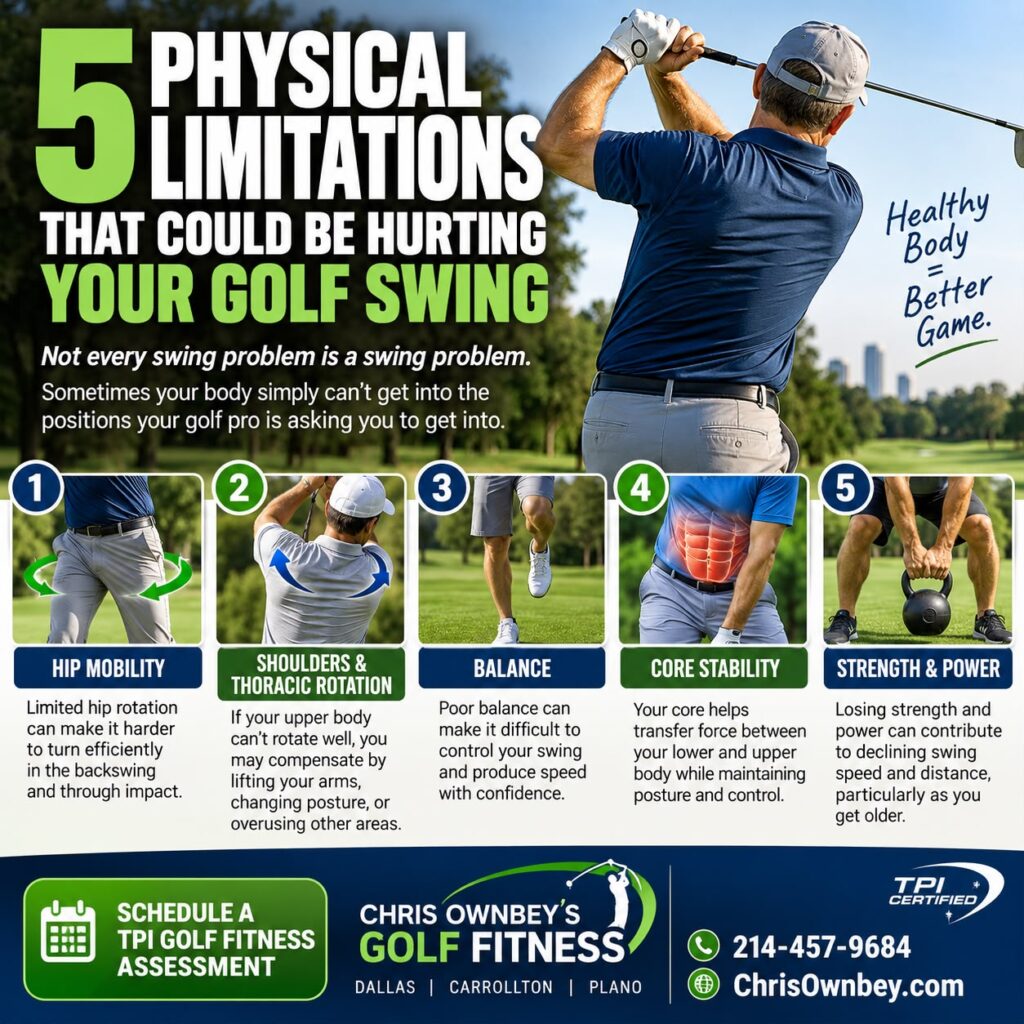
1. Limited Hip Mobility
Your hips play a major role in producing an efficient golf swing.
During the backswing and downswing, your pelvis needs the ability to rotate while your body maintains stability and posture.
When hip mobility becomes restricted, your body has to find another way to create movement.
That compensation may come from your lower back, knees, feet, or upper body.
For example, a golfer who lacks adequate hip rotation may have difficulty making a comfortable turn into the backswing. Instead of rotating efficiently through the hips, the golfer may compensate by swaying, lifting, changing posture, or placing additional movement demands on the lumbar spine.
The same problem can appear during the downswing.
Your hips need to rotate toward the target while the rest of your body coordinates around that movement.
If your hips don’t move well, your swing may become more dependent on your arms and upper body.
Signs your hips may be limiting your golf swing:
- Your backswing feels shorter than it used to.
- You struggle to rotate through the ball.
- Your lower back gets tight after playing.
- One side rotates noticeably better than the other.
- You feel stiff after getting out of the golf cart.
- Your knees or feet move excessively when you try to rotate.
The answer isn’t necessarily stretching your hips harder.
First, you need to determine why the movement is limited.
It could involve mobility, stability, muscular control, previous injuries, or simply movement patterns that have changed over time.
That’s where an assessment of your physical limitations becomes valuable.
2. Limited Shoulder and Thoracic Rotation
Golf requires rotation throughout the body—not just at the hips.
Your thoracic spine, which is the middle and upper portion of your spine, plays an important role in allowing your upper body to rotate during the swing.
Your shoulders also need adequate mobility to achieve many of the positions your golf instructor may be trying to teach.
When thoracic or shoulder mobility becomes limited, golfers frequently try to manufacture rotation somewhere else.
That can change the entire swing.
A golfer may lift the arms instead of turning.
Another may excessively rotate the pelvis because the upper body can’t rotate independently.
Some golfers may lose posture during the backswing or feel like they have to force themselves into positions that once felt natural.
This becomes increasingly important as we age because many of us spend hours sitting at desks, driving, working on computers, or looking down at phones.
Over time, those habits can create physical limitations in the upper back, including a more rounded posture and reduced rotational movement.
You may notice:
- Difficulty making a full shoulder turn.
- A shorter backswing.
- Tightness across the chest or shoulders.
- Difficulty separating upper-body and lower-body rotation.
- Your arms feel like they’re doing most of the work.
- Your golf swing feels increasingly restricted.
Trying to create a bigger turn isn’t always the solution.
If the body doesn’t currently have the mobility to achieve that position, forcing more rotation may simply create another compensation.
The goal is to determine what movement is available and then work systematically to improve it.
3. Poor Balance
Balance may be one of the most overlooked physical limitations in golf.
A golf swing happens quickly, but your body has to control significant forces while transferring pressure from one side to the other.
You need enough balance and stability to maintain your position during the backswing, transition, impact, and follow-through.
When balance begins declining, golfers often unconsciously slow down their movements.
That’s actually a logical response from the nervous system.
If your body doesn’t feel stable, it may be reluctant to produce maximum speed.
Poor balance can also make your swing less repeatable.
One swing feels good.
The next feels completely different.
You may finish one shot balanced on your lead leg and stumble slightly after the next.
Common signs of a balance limitation include:
- Difficulty standing on one leg.
- Excessive movement during the backswing.
- Losing your finish position.
- Feeling unstable when swinging harder.
- Difficulty transferring pressure effectively.
- A noticeable difference between your right and left sides.
Balance isn’t simply standing on one foot.
For golf, we want the ability to maintain control while the body is rotating and producing force.
That’s why balance training for golfers should eventually become dynamic and golf-specific rather than relying exclusively on static balance exercises.
4. Poor Core Stability
When golfers hear “core,” many immediately think about abdominal exercises.
But core stability is much more than doing crunches.
Your trunk helps connect the lower body and upper body.
During the golf swing, forces are being generated and transferred rapidly through your body. Your core needs enough stability to control those forces while still allowing rotation to occur.
Think of it as the connection between your hips and shoulders.
If that connection isn’t stable, energy can be lost as you move through the swing.
A golfer may have good hip mobility and good shoulder mobility but still struggle to control those movements.
That’s an important distinction:
Mobility gives you access to movement. Stability helps you control it.
As one of the less obvious physical limitations, poor trunk stability may contribute to excessive movement, loss of posture, difficulty controlling rotation, or an inconsistent ability to transfer force.
Signs your core stability may need attention:
- Difficulty maintaining golf posture.
- Excessive movement during rotation.
- Poor control when performing rotational exercises.
- Lower-back fatigue during or after golf.
- Difficulty separating upper- and lower-body movement.
- Your swing becomes less controlled as you try to generate more speed.
Good golf-fitness training should develop the core in multiple directions.
That includes resisting unwanted extension, rotation, and lateral movement—not simply performing hundreds of abdominal repetitions.
5. Loss of Strength and Power
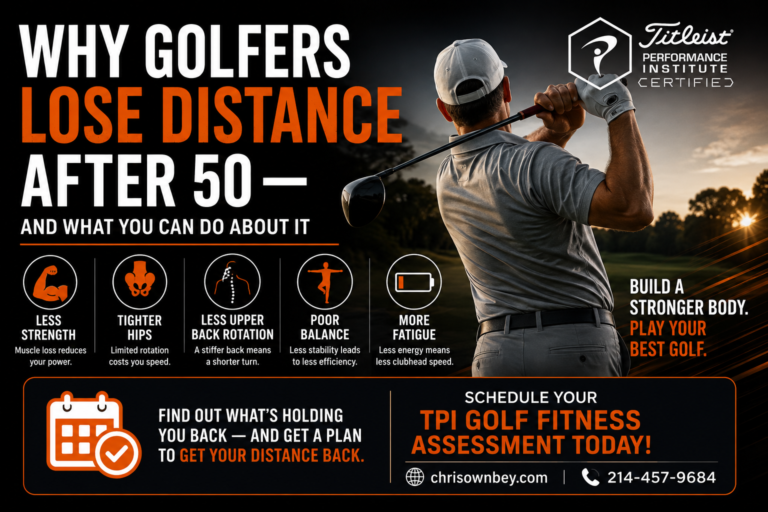
This may be one of the biggest physical limitations golfers notice as they get older.
They simply don’t hit the ball as far.
The driver that once carried 250 yards might carry 225.
Then 215.
Many golfers respond by trying to swing harder.
But swinging harder and having the physical capacity to produce more force aren’t necessarily the same thing.
Strength provides part of the foundation for power.
Power is your ability to produce force quickly.
Golf requires both.
Your legs, hips, trunk, back, shoulders, and arms all contribute to producing and transferring force through the golf swing.
If strength declines, your potential to generate speed can decline with it.
Age-related loss of muscle and power can become increasingly relevant after 50, particularly if you aren’t performing consistent resistance training.
That doesn’t mean golfers need to become bodybuilders.
It means your training should give your body enough strength to support the demands of your golf swing.
A properly designed golf-fitness program may include exercises for:
- Lower-body strength.
- Hip strength.
- Upper-body pushing and pulling strength.
- Core stability.
- Rotational control.
- Power development.
- Movement speed.
The exact exercises depend on the individual golfer.
A 52-year-old golfer with excellent mobility but poor strength doesn’t necessarily need the same program as a 68-year-old golfer with good strength but significant mobility restrictions.
That’s why I don’t believe in giving every golfer the same list of “10 Best Golf Exercises.”
Assessment should drive the system.
Which Physical Limitations Are Affecting Your Golf Swing?
This is the question that matters.
You might assume your hips are tight when the bigger problem is actually thoracic rotation.
You might think you need more flexibility when you really need better stability.
You might think you’re losing distance because of your swing when declining strength and power are contributing to the problem.
Or you could have a combination of several limitations.
Guessing isn’t the best way to find out.
Testing is.
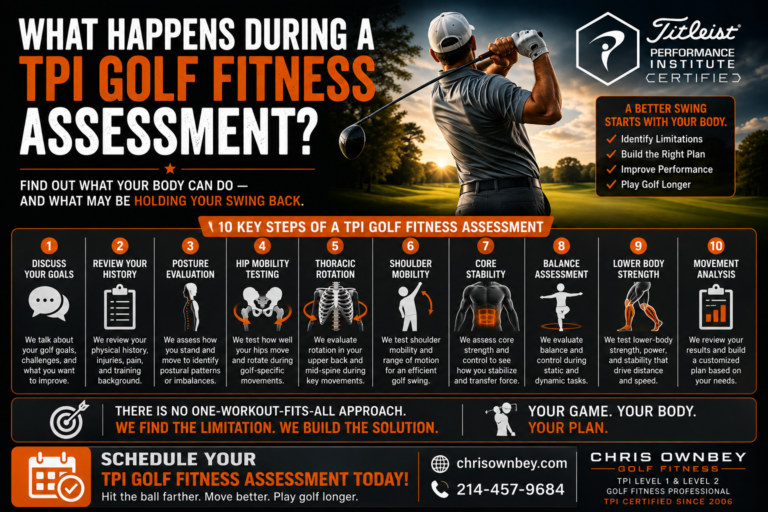
That’s one reason I begin with a TPI Golf Fitness Assessment.
The assessment allows us to look at areas such as mobility, stability, balance, and how your body moves.
From there, we can identify physical limitations that may be making certain golf positions more difficult.
Your golf instructor can continue working on the technical side of your swing.
My role is different.
Your golf pro wants you to get into certain positions. I help your body get there.
Golf Fitness After 50: Train the Body Behind the Swing
If you’re 50, 60, or 70+, the goal isn’t to train like you’re 25.
It’s also not to accept losing mobility, strength, and distance without doing anything about it.
The goal is to determine what your body needs and train accordingly.
For one golfer, that may mean improving hip rotation.
For another, it could mean improving thoracic mobility.
Someone else may need significantly more strength, balance, or power.
Once you identify your physical limitations, your training becomes much more specific.
And that’s where golf fitness can become extremely valuable.
Instead of randomly stretching, lifting weights, or copying golf exercises you see online, you can train the physical qualities that actually need attention.
Start With a TPI Golf Fitness Assessment
If your swing feels restricted, you’re losing distance, or your body simply doesn’t move the way it used to, don’t automatically assume you need another swing change.
First, find out whether physical limitations are preventing you from making the movement you’re trying to make.
I’ve been TPI Certified since 2006 and have spent decades helping golfers improve the physical side of their game.
At Chris Ownbey’s Golf Fitness in Dallas, we start by assessing how your body moves before deciding what you need to work on.
Healthy Body = Better Game.
Ready to Find Out What’s Limiting Your Swing?
Schedule a TPI Golf Fitness Assessment and find out whether a physical limitation is affecting your golf swing.
Chris Ownbey’s Golf Fitness
Dallas–Carrollton–Plano, Texas
214-457-9684
ChrisOwnbey.com
Other related topics:
The Inner Game of Golf: How to Quiet Your Mind, Trust Your Swing, and Play Better Golf
The 3 Inch Swing™: A Simpler Approach to a Better Golf Swing
Personal Training After 40 in Dallas: Get Strong, Lean & Move Better
- What Happens During a TPI Golf Fitness Assessment?
- 5 Physical Limitations That Can Affect Your Golf Swing
- Is Your Body Limiting Your Golf Swing? Golf Fitness Dallas
- Why golfers lose distance after 50?
- How to Stop Slicing the Golf Ball
- Why Your Back Hurts After Playing Golf: The Hidden Cause Most Golfers Never Address
- Why Strength Matters for Golfers Over 50
- Straddle Stretch for Golfers | Dallas Golf Fitness
- Golf Fitness in Dallas – How to Increase Speed, power, and Distance While Preventing Injuries