Golf Fitness for Men Over 40: How to Keep Your Distance, Mobility and Golf Game for the Next 20 Years
Golf Fitness for Men Over 40 in Dallas: Keep Your Distance, Mobility and Golf Game for the Next 20 Years
Golf fitness for men over 40 in Dallas usually starts with a quiet realization on the course. If you are between 45 and 70 and you love this game, then you have probably noticed a few things changing.
The club no longer moves quite as fast, and the ball is not going as far as it once did. Meanwhile, your hips and shoulders feel tighter every season.
Your back may be stiff after 18 holes, or sometimes after nine. Furthermore, loosening up beforehand takes longer, and recovering afterward takes longer still.
So you find yourself thinking: “I love golf. I just want my body to keep up with my game for the next 20 years.”
That is exactly where golf fitness becomes important.
However, the goal is not training like you are 25 again. Instead, the goal is developing the mobility, stability, balance, strength and power your body needs to keep producing an efficient swing as you age.
At Chris Ownbey’s Golf Fitness, we specialize in golf fitness for men over 40 in Dallas and the surrounding communities.
Above all, I want golfers to understand one thing. Getting older does not mean you have to stop performing — but it may mean you need to start training differently.
Why Golf Starts Feeling Different After 40
Golf is incredibly demanding on the body. During the swing, you create rotation through multiple areas while maintaining posture, balance and stability. Then you have to produce all of that movement quickly.
The Chain Your Swing Depends On
A good golf swing requires coordination through your:
- Feet and ankles
- Knees
- Hips and pelvis
- Core
- Thoracic spine
- Shoulders and arms
When one area stops moving properly, your body hunts for that movement somewhere else. Consequently, compensations start appearing in the swing.
Perhaps the hips are not rotating like they once did. Alternatively, the upper back has stiffened, leg strength has quietly declined, or balance is not quite what it was.
Lessons Alone May Not Solve It
You can keep taking lessons and working on mechanics. Still, sometimes the problem is not the mechanics at all. Rather, your body is making it difficult to perform the movement your instructor is asking for.
That is precisely why golf fitness and golf instruction work so well together. While your instructor works on the swing, your golf fitness professional improves the body producing it.
1. You Are Losing Distance
Distance loss is usually the first thing golfers notice as they get older. Maybe your driver carried 240 yards and now sits closer to 220. Or perhaps you are hitting 6-iron into greens that used to require an 8-iron.
Naturally, the first reaction is buying a new driver, changing shafts or simply swinging harder. Equipment certainly helps. However, your body is very likely part of the equation too.
Speed Is a Physical Quality
Clubhead speed requires your body to create and transfer force, which demands a specific combination:
Mobility + Stability + Strength + Power + Sequencing
So if you have lost hip rotation, thoracic mobility, lower-body strength or the ability to generate force quickly, then reproducing your old speed becomes considerably harder.
Therefore, the answer is rarely swinging harder. Improving your body’s ability to produce speed works far better.
Why Strength Matters After 40
Muscle mass and strength grow more important with every passing decade.
Your legs and hips create force against the ground. Meanwhile, the core transfers that force, and the upper body delivers the energy through the club.
Because of that, an effective program cannot consist only of stretching. Golfers need real strength, and maintaining it becomes increasingly important as the years add up.
2. Your Golf Swing Is Getting Stiffer
Plenty of golfers tell me the same thing: “I just don’t turn like I used to.”
That matters, since the swing fundamentally requires rotation. But here is where many golfers go wrong. Simply doing more stretches is not automatically the answer, because first you need to know where you are actually restricted.
Where Is the Restriction Coming From?
- Your hips?
- The thoracic spine?
- Shoulders or ankles?
- Something in the pelvis?
- Or is mobility fine while stability is the real gap?
That is exactly why testing matters. Instead of guessing which stretches you need, we evaluate how your body genuinely moves.
If you don’t test, it’s just a guess.
3. Your Back Isn’t What It Used to Be
Back stiffness ranks among the most common complaints as golfers age, largely because the swing places significant rotational demands on the body.
When the hips and thoracic spine are not moving efficiently, your body creates that movement somewhere else. Often the lower back ends up doing far more than it should.
To be clear, this does not mean every golfer with back pain shares the same problem. Back pain has many causes, and it should be medically evaluated when appropriate.
Better Questions to Ask
From a golf fitness perspective, however, we want to examine the whole movement system:
- Can your hips rotate?
- Does your upper back rotate well?
- Are you able to maintain posture?
- Do your glutes stabilize the pelvis?
- Can your core resist unwanted movement?
- Is your balance under control while you move?
Rather than concluding “my back hurts, so I need to stretch my back,” we ask why the back is being asked to work so hard in the first place. Ultimately, that is a much better question.
4. Balance Becomes More Important as You Get Older
Balance rarely receives the attention it deserves. Yet watch any great player, and you will see tremendous speed produced while they stay remarkably balanced.
When balance declines, your body naturally becomes more cautious. As a result, generating force and rotating aggressively through the ball gets harder.
Fortunately, balance training does not mean standing on unstable equipment performing circus tricks. Instead, it should have a clear purpose: improving your ability to control your body and transfer force efficiently from the ground through the club.
For men over 40, balance is both a performance quality and a longevity quality.
5. You Need Power, Not Just Strength
Strength and power are genuinely different things. Strength is your ability to produce force, whereas power is your ability to produce that force quickly.
Golf demands power, because the swing happens in a remarkably short window. You do not get five seconds to gradually build force during the downswing. You have to create it now.
Build the Foundation First
Consequently, golfers who want to keep their clubhead speed should include appropriate power training. That said, power has to be introduced intelligently.
Before trying to move faster, we make sure sufficient mobility, stability, balance and strength are already in place:
Mobility → Stability → Strength → Power → Speed
Skipping the foundation and immediately swinging as hard as possible rarely works out well.
The Biggest Golf Fitness Mistake Men Over 40 Make
The most common mistake I see is continuing to train exactly the way you trained at 25.
Your goals have changed since then. So has your body, and so has your golf game. Therefore, your training should reflect all of that.
The Space Between Two Extremes
A golfer in his 50s does not need to train like a young bodybuilder. Equally, he should not assume that aging means stretching and walking are all that remain. There is enormous room between those extremes.
- Getting stronger is still possible.
- Mobility can still improve.
- Power training remains available to you.
- Balance responds well at any age.
- Depending on your situation, clubhead speed may improve too.
The key is simply using the right system for your body.
Golf Fitness Isn’t About Doing “Golf Exercises”
Another common mistake is assuming every exercise should look like a golf swing. It shouldn’t.
Golf fitness improves the physical abilities required to perform your swing. In fact, the best exercise for your game often looks nothing like golf at all.
Depending on the golfer, that might mean more hip mobility, better thoracic rotation, stronger glutes and legs, improved core stability, better balance or more rotational power.
Those qualities then support the swing you are building with your PGA professional. Clearly, that is a very different approach from randomly performing cable rotations because they resemble a golf swing.
What Is a TPI Golf Fitness Assessment?
This is where I recommend every golfer starts.
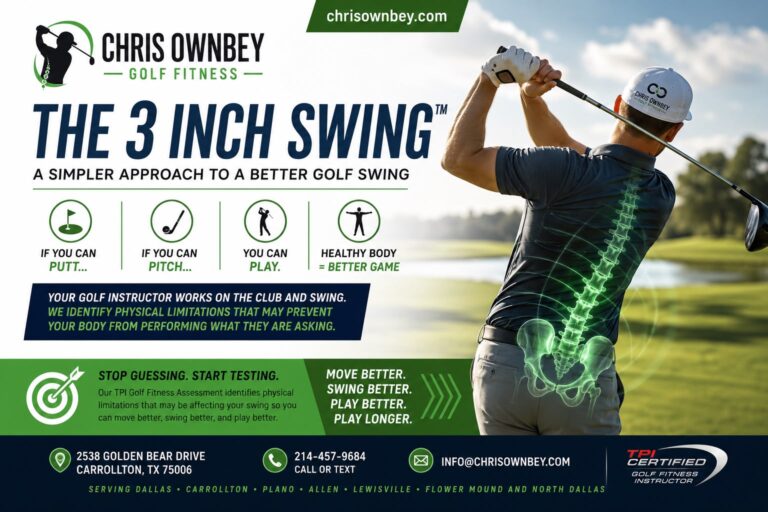
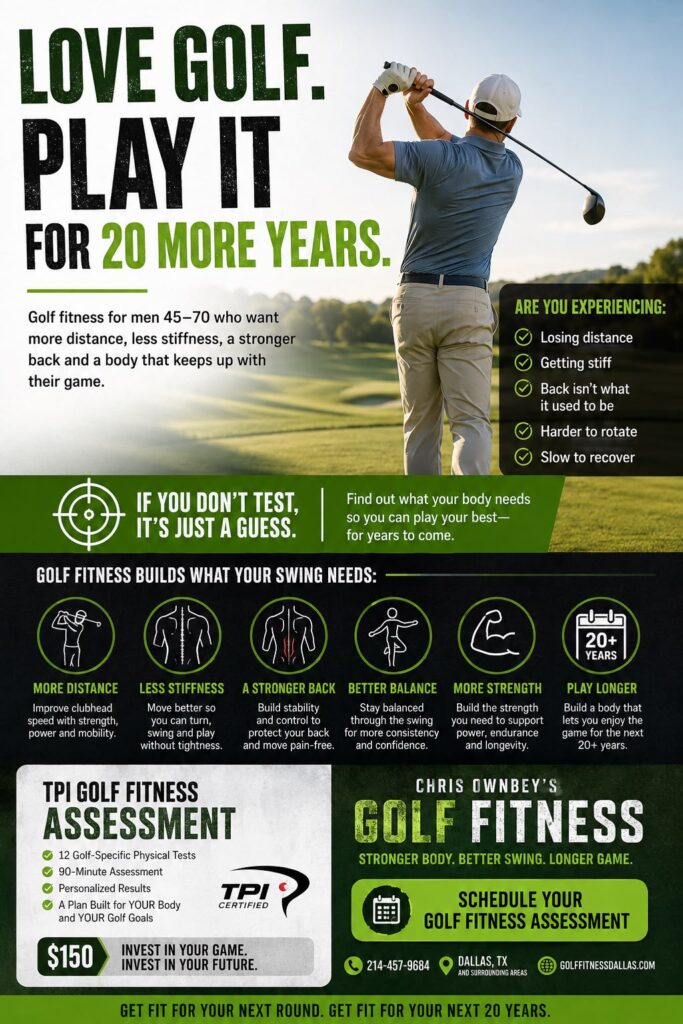
Our TPI Golf Fitness Assessment identifies the physical limitations affecting your swing. Specifically, it consists of 12 golf-specific tests covering mobility, stability and balance.
Rather than handing you a generic workout immediately, we first want to understand how your body moves.
What the Assessment Can Reveal
- Limited rotation
- Difficulty maintaining posture
- Poor balance
- Reduced power and lost clubhead speed
- Trouble completing the backswing
- Physical compensations during the swing
Once we understand your limitations, we build a program around your body and your golf goals.
Don’t Guess — Test
After years of working with golfers, one principle keeps proving itself. If you don’t test, it’s just a guess.
Two golfers can present the exact same swing fault for completely different physical reasons. One lacks hip mobility, while another has plenty of mobility but poor stability.
Giving both the same exercises simply does not make sense. Therefore, your program should begin with an assessment instead of a collection of exercises pulled off the internet.
First, find out what your body can do. Next, find out what it cannot do. Then build the program around those results.
What Should Golf Fitness for Men Over 40 Look Like?
For most golfers past 40, I want to evaluate and develop several key areas:
- Mobility: can your body move through the ranges your swing requires?
- Stability: can you control those positions?
- Balance: can you stay controlled while moving and producing force?
- Strength: can your muscles generate enough force?
- Power: can you generate that force quickly?
- Golf-specific movement: do those abilities transfer into your actual swing?
Naturally, the exact combination differs for every golfer. That is entirely the point, because your program should be built around you.
Stop Training for Your Next Round. Train for Your Next 20 Years.
This may be the most important shift for golfers between 45 and 70.
Of course you want to play well this weekend. More distance, better ball striking and lower scores all matter. However, there is a bigger goal underneath those.
You want to keep playing. Teeing it up at 60, then 65, then 70 and 75 is the real objective.
Above all, you want to walk off the 18th green thinking about tomorrow’s round instead of wondering whether your back will recover.
That is why golf fitness after 40 should be about far more than adding ten yards to your driver. Ultimately, it is about building a body capable of supporting the game you love for decades.
Golf Fitness for Men Over 40 in Dallas
If you play in Dallas, Carrollton, Plano, Allen, Lewisville, Flower Mound or the surrounding North Dallas area, then you do not have to guess what your body needs. Start with an assessment instead.
At Chris Ownbey’s Golf Fitness, we work with golfers who want to move better, maintain strength and power, and keep playing the game they love as they get older.
Chris Ownbey is a TPI Certified Golf Fitness Trainer with decades of experience in strength, fitness and golf-specific physical development.
Our approach is not about beating your body up. Rather, it is about identifying what your body needs and building the right system around it.
Schedule Your TPI Golf Fitness Assessment
Are you losing distance, feeling stiffer or having difficulty rotating? Perhaps balance has become a struggle, or you are simply thinking: “I want to keep playing good golf for the next 20 years.”
Either way, start by finding out what your body is telling you.
TPI Golf Fitness Assessment 12 golf-specific physical tests · 90-minute assessment · $150
We evaluate how your body moves and identify the physical limitations affecting your swing and performance.
If you don’t test, it’s just a guess.
Ready to Get Golf Fit?
Chris Ownbey’s Golf Fitness Call: 214-457-9684
Serving Dallas, Carrollton, Plano, Allen, Lewisville, Flower Mound and surrounding North Dallas communities.
Schedule your assessment today and start building a body that can support your golf game for the next 20 years.