Golf Fitness for Golfers Over 40: 6 Keys to a Better Swing
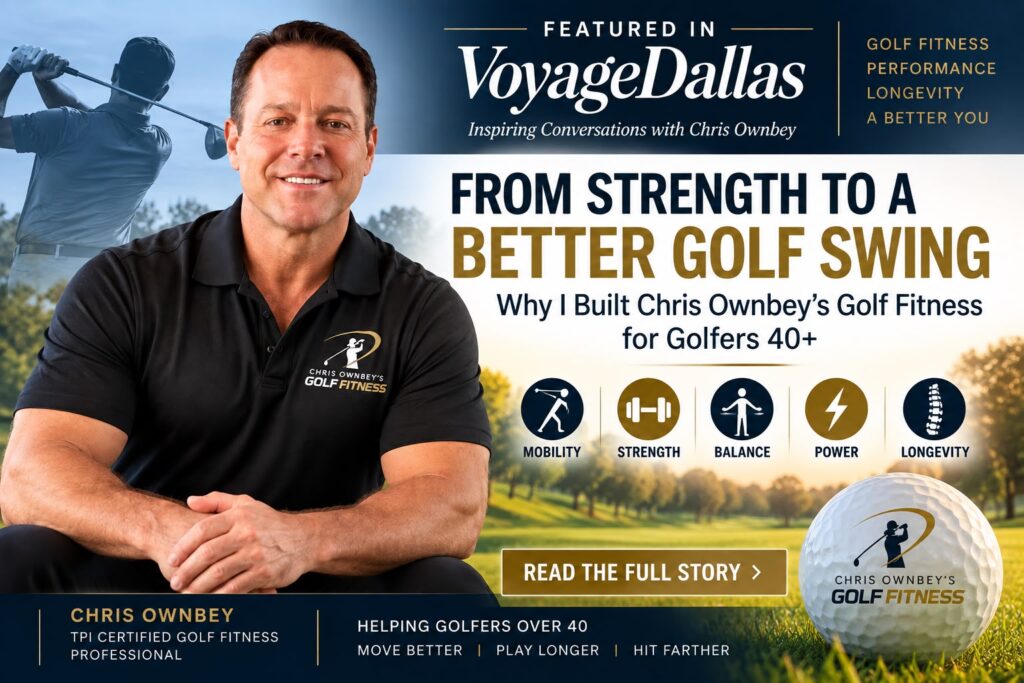
From Strength to a Better Golf Swing: Why I Built Golf Fitness for Golfers Over 40
By Chris Ownbey | TPI Certified Golf Fitness Professional
Chris Ownbey and Chris Ownbey’s Golf Fitness were recently featured in VoyageDallas. This article expands on that story. In particular, it explains how decades in fitness and performance shaped my approach to golf fitness for golfers over 40. In addition, it shares how my own physical setbacks changed the way I help golfers improve mobility, strength, balance, power, and longevity.
I’ve spent more than three decades in fitness and performance. During that time, I’ve competed in bodybuilding and powerlifting, trained in mixed martial arts, and served in the United States Marine Corps. I’ve also worked with athletes and spent years helping golfers improve what their bodies can do.
However, as I’ve gotten older, and after my own neck and back fusion surgeries, my understanding of golf fitness has changed. For example, I’ve learned that golfers in their 40s, 50s, 60s and beyond usually don’t need to train like younger athletes. Instead, they need to train for their body, their golf swing, and the years of golf they still want to play.
That philosophy is at the heart of Chris Ownbey’s Golf Fitness.
To be clear, my goal isn’t to teach you how to swing a golf club. That’s your golf professional’s job. Rather, my job is to help your body become physically capable of doing what your golf professional is asking you to do.
Your Golf Pro Wants You to Get Into Certain Positions. I Help Your Body Get There.
This is one of the simplest ways I can explain golf fitness.
Golfers often assume every problem in their golf swing is technical. Sometimes it is. However, sometimes the body simply can’t get into the position the golfer is trying to create.
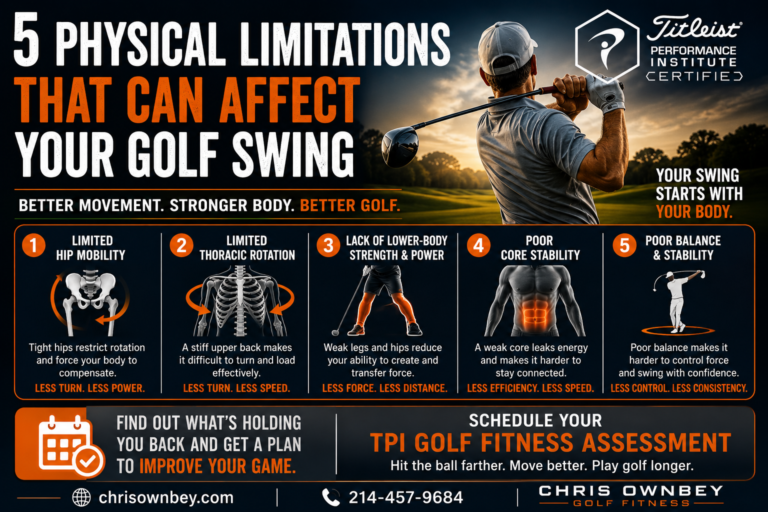
For instance, your golf professional may tell you that you need more rotation, a better turn, improved posture or a different movement through impact. But what happens if your body isn’t ready? Consider these common limitations:
- Your hips don’t have enough mobility.
- The thoracic spine doesn’t rotate well.
- Stability is lacking, so you can’t control the position.
- Balance is difficult to maintain.
- Strength or power is missing, so you can’t create the speed you want.
In that case, you can keep trying to force the movement. Still, the physical limitation hasn’t disappeared. That’s where golf fitness comes in.
Rather than replacing golf instruction, the goal is to support it. In other words, your golf instructor works on your swing, while I work on the body making the swing.
My Journey Started Long Before Golf Fitness
My approach to training was shaped by decades of experience before I specialized in golf fitness. First and foremost, the discipline and resilience I learned in the United States Marine Corps became the foundation for everything that followed.
After my military service, I became deeply involved in fitness and athletic performance. Specifically, I competed in bodybuilding and powerlifting, becoming a Mr. Metroplex Bodybuilding Champion and Texas State Powerlifting Champion. I also spent approximately 17 years involved in mixed martial arts. As a result, those environments taught me about strength, conditioning, discipline, preparation and performance.
Eventually, though, golf presented a completely different challenge. After all, a golfer doesn’t simply need to be strong. Above all, the golf swing demands rotation. It also requires mobility, stability and balance. On top of that, a golfer must produce and transfer force. Most importantly, those physical qualities need to work together within the demands of the swing.
That’s one reason I became involved with the Titleist Performance Institute (TPI). In fact, I have held TPI golf fitness certifications since 2006. Over the years, I’ve worked with golfers ranging from recreational players to competitive golfers. Today, much of my work focuses on golfers over 40.
Golf Changes as Your Body Changes
As golfers get older, some of the most common things I hear are:
“I’m losing distance.”
“My back gets tight after I play.”
“I don’t turn like I used to.”
Consequently, these golfers may spend thousands of dollars on clubs, lessons and equipment trying to solve the problem. Yet there’s another question worth asking: What has changed physically?
If you’re 55 today, you’re not playing golf with the same body you had at 25. That doesn’t mean you’re finished improving. On the contrary, it means your physical preparation becomes increasingly important.
Over time, mobility may decrease. Similarly, strength can decline if it isn’t trained. Balance can change, and recovery can take longer. Previous injuries can also affect movement. Meanwhile, the golfer often adapts without even realizing it. For example, the swing may become shorter, hips or shoulders may compensate, and speed may gradually decrease.
For this reason, I believe golfers over 40 should assess the body instead of simply guessing about what they need.
Why Golf Fitness for Golfers Over 40 Starts With a TPI Assessment
When someone comes to me for golf fitness training, I don’t immediately start giving them exercises. First, I want to know what their body can and cannot do.
That’s why the first step in my system is a TPI Golf Fitness Assessment. Specifically, the assessment looks at physical characteristics that can influence the golf swing, including:
- Hip mobility
- Thoracic rotation
- Shoulder mobility
- Balance
- Stability
- Core control
- Strength
- Power
- Movement quality
Importantly, the objective isn’t to diagnose a medical condition or critique your golf swing. Instead, it’s to identify physical limitations that may be affecting your ability to move efficiently. Once we understand those limitations, we can build the right system around what your body actually needs.
Clearly, that’s very different from searching online for “five best exercises for golfers” and hoping they address your problem.
My Own Surgeries Changed How I Train Golfers
Some of the most important lessons of my career came when I wasn’t the trainer. Instead, I was the person trying to get my own body back.
Over the years, I’ve undergone major neck and back fusion surgeries. For someone who spent his life training and competing, those limitations changed my perspective completely.
In other words, I experienced what many older golfers experience: the frustration of not moving the way you once did, the uncertainty about what you should or shouldn’t do, the desire to become stronger without making things worse, and the realization that simply trying harder isn’t always the answer.
As a result, those experiences made me a different coach. They also reinforced something I now tell golfers regularly: Train smarter, not simply harder.
After all, a 55-, 65- or 75-year-old golfer doesn’t necessarily need to train like a 25-year-old athlete to improve performance. Instead, the goal is to identify what that particular golfer needs and address it intelligently.
Strength Training Matters for Golfers Over 40
Historically, many golfers have been hesitant about strength training. Often, they worry that lifting weights will make them tight or hurt their swing. However, properly designed strength training doesn’t have to do that.
In fact, for golfers over 40, maintaining muscle and strength becomes increasingly important. This matters not only for golf performance but also for everyday life. Moreover, strength provides a physical foundation from which golfers can create and control movement.
That said, I don’t believe golf fitness should be based on strength alone. Therefore, my programs can include several components, depending on what we discover during the assessment.
The 6 Physical Qualities I Focus On With Golfers
1. Mobility
A golf swing requires movement from multiple areas of the body. So, if the hips or thoracic spine are restricted, the body may try to find movement somewhere else. Therefore, improving appropriate mobility can help golfers access positions more comfortably.
2. Stability
Mobility without control isn’t enough, though. You also need the ability to stabilize the body while other areas move. This is especially important during a golf swing, because the body must manage significant rotational forces.
3. Balance
Golf requires you to produce force while maintaining control. Consequently, balance becomes particularly important as golfers age, both for performance and overall physical function.
4. Strength
Strength provides the foundation for many physical qualities. In addition, for golfers over 40, maintaining or improving strength can help counter the gradual decline that comes with aging and inactivity.
5. Power and Speed
Power and strength aren’t identical. For example, a golfer can be strong without necessarily being able to produce force quickly. So, when appropriate, power and speed training can become part of the program.
6. Core Control
The core isn’t simply about doing crunches. For golfers, the trunk plays an important role in stabilizing the body. It also transfers forces between the lower and upper body.
Altogether, these qualities influence what a golfer is physically capable of doing.
Losing Distance After 50 Isn’t Always Just Your Swing
Distance loss is one of the biggest concerns I hear from golfers over 50. Naturally, golfers start looking at equipment and swing mechanics. Of course, those things matter. However, your physical capabilities matter too.
For instance, if you’ve lost strength, rotational mobility or the ability to generate power, your body may not produce the same clubhead speed it once did.
That’s why I don’t want to guess; instead, I want to assess. If we find a physical limitation, then we have something specific to work on. On the other hand, if we don’t find one in a particular area, we don’t waste time fixing something that isn’t broken. Ultimately, that’s one of the biggest advantages of an assessment-first approach.
Golf Fitness Isn’t About Becoming a Gym Athlete
Most of the golfers I work with aren’t trying to become bodybuilders. Rather, they’re trying to become better golfers.
For example, they want to hit the ball farther and move more freely. Many also want to finish 18 holes without feeling beaten up. Others simply want to keep playing with their friends. Most importantly, they all want to keep playing for years.
That’s why my philosophy has increasingly become about golf longevity. Of course, your handicap, distance and score all matter. Equally, being physically capable of playing the game you love at 60, 70 and beyond matters too.
Golf Fitness After 40 Is About Longevity
One of the biggest changes I’ve seen in my clients is how they define performance as they get older:
- Younger golfers may primarily be concerned with speed.
- In his 50s, a golfer may want speed, but he also wants his back to feel good.
- By his 60s, distance still matters, yet maintaining strength and mobility becomes a priority.
- Later, in his 70s, he may simply want to keep playing multiple rounds per week and enjoying the game.
Fortunately, those aren’t mutually exclusive goals. In fact, the right physical preparation can address both performance today and longevity tomorrow.
Ultimately, that’s what I want Chris Ownbey’s Golf Fitness to represent. We’re not just training for your next round. Instead, we’re preparing your body for the golf you want to play 10 or 20 years from now.
Experience Has Changed the Way I Coach
After decades in fitness and performance, I’ve learned there isn’t one perfect golf exercise. Likewise, there isn’t one perfect workout. And there certainly isn’t one program every golfer should follow. In fact, the right exercise for one golfer may be inappropriate for another.
That’s why assessment and individualization matter so much. For one golfer, the need may be more mobility. For another, strength is the bigger issue. In other cases, it’s balance or power. And occasionally, what the golfer assumes is the problem isn’t what we discover during the assessment.
In the end, my role is to identify those physical limitations and build the appropriate training system around them.
Golf Fitness in Dallas, Carrollton and Plano
Today, I work with golfers throughout Dallas, Carrollton, Plano and surrounding North Dallas communities. Many are men over 40 who love golf but have noticed their bodies beginning to change.
For example, they may be losing distance, or their hips may feel tighter. Some notice that their backs don’t recover as quickly or their shoulders don’t turn as freely. Others simply recognize that if they want to play golf for another 20 years, they need to take care of the body swinging the club.
That’s exactly who Chris Ownbey’s Golf Fitness was built to help.
You Work on Your Golf Swing. Don’t Forget About the Body Making the Swing.
Lessons, practice and equipment all matter. Even so, your body is still the engine behind your golf swing.
So, if your golf professional asks you to create a movement your body struggles to perform, more repetition may not solve the underlying limitation. Sometimes you need to work on the swing. At other times, you need to work on the body. Often, you need both.
That’s why I like to put it this way: Your golf pro wants you to get into certain positions. I help your body get there.
Find Out What Your Body Is Bringing to Your Golf Swing
Are you over 40 and noticing that you’re losing distance, becoming stiffer or struggling with rotation? Or perhaps you simply want to prepare your body to keep playing golf for years to come. Either way, don’t guess about what you need. Find out.
The first step is a 90-minute TPI Golf Fitness Assessment. During the assessment, we’ll evaluate your mobility, stability, balance, strength, power and other golf-related physical qualities. Then, we’ll identify potential limitations and use what we find to determine the right system for you.
Chris Ownbey’s Golf Fitness — Serving golfers in Dallas, Carrollton, Plano and surrounding North Dallas communities.
Read the full interview As Featured in VoyageDallas: Chris Ownbey