Why Golfers Lose Distance After 50?
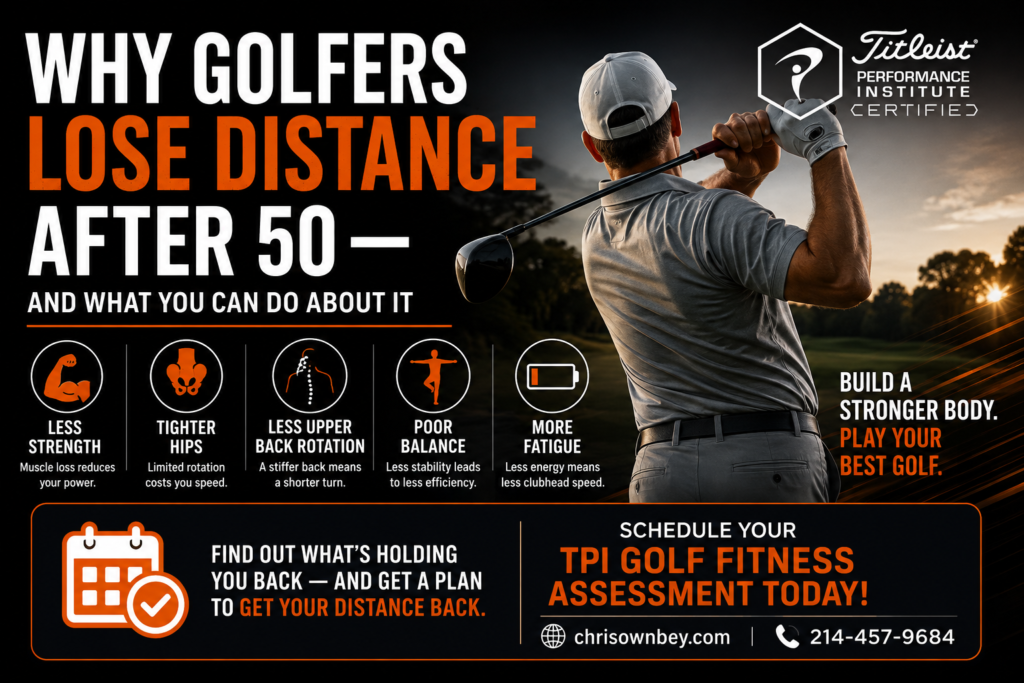
Why Golfers Lose Distance After 50 — And What You Can Do About It
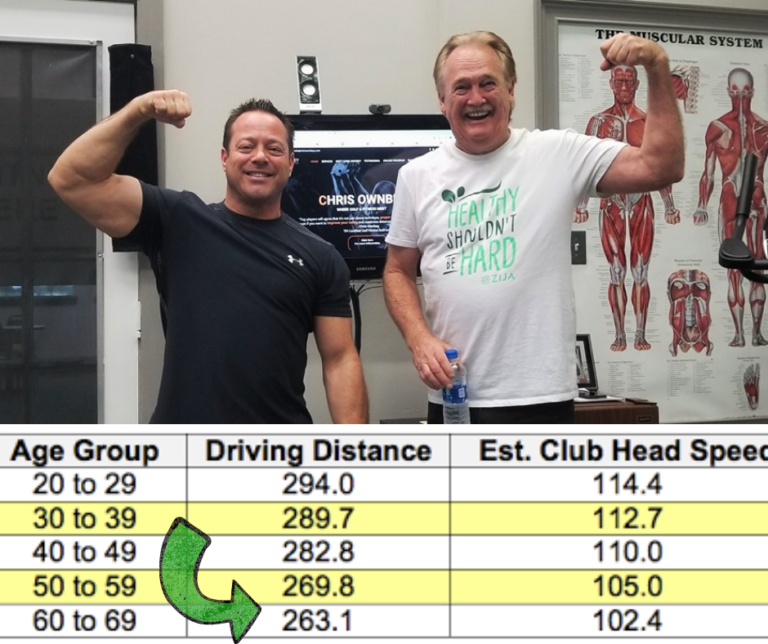
If you are a golfer over 50, there is a good chance you have noticed something changing in your game.
The driver does not carry quite as far.
The iron you used to hit comfortably now comes up short.
You may feel like you are swinging just as hard as ever, but the ball is not traveling the same distance.
For many golfers, this is frustrating because they immediately assume the problem is their swing.
So they book another lesson.
They change their equipment.
They buy a new driver.
They switch shafts.
They spend more time on the range.
Sometimes those things help.
But sometimes the real issue is not the club or the swing.
It is the body producing the swing.
Your ability to create golf distance depends on more than technique.
It also depends on strength, mobility, balance, stability, coordination and rotational power.
As those physical qualities change with age, your golf performance can change with them.
The good news is that many of those qualities can be improved with the right system.
If you are losing distance after 50, the answer may not be to swing harder.
It may be to improve the body behind your golf swing.
Why Golfers Lose Distance After 50
Golf distance is influenced by several factors.
Clubhead speed is one of the most important.
The faster the clubhead is moving at impact, all else being equal, the greater potential you have to create ball speed and distance.
But clubhead speed does not come from simply swinging your arms harder.
A powerful golf swing requires your entire body to work together.
Your feet interact with the ground.
Your legs and hips help produce force.
Your core helps transfer that force.
Your upper body rotates.
Your arms and hands deliver the golf club.
When the entire system works efficiently, you can create speed without feeling like you are swinging out of your shoes.
When one part of the system becomes limited, your body often compensates.
That is where golfers over 50 can begin losing distance.
1. Loss of Strength Can Reduce Your Ability to Produce Force
One of the biggest physical changes associated with aging is a gradual decline in muscle mass and strength if we do not actively train to maintain them.
This matters for golf.
The golf swing is an athletic movement.
Your lower body, hips, trunk and upper body all need to contribute to the movement.
If your legs are weaker than they were 10 years ago, you may not be able to produce the same amount of force.
If your hips and glutes are weaker, you may struggle to load and rotate effectively.
If your core is less stable, transferring force from the lower body to the upper body may become less efficient.
The result can be less speed.
Golfers sometimes avoid strength training because they believe lifting weights will make them tight.
Proper strength training should not make you stiff.
A well-designed strength program can help you maintain muscle, improve force production and create a stronger foundation for your golf swing.
The goal is not bodybuilding.
The goal is becoming a stronger golfer.
2. Power Can Decline Even When You Still Feel Strong
Strength and power are related, but they are not the same thing.
Strength is your ability to produce force.
Power is your ability to produce that force quickly.
Golf requires power because the downswing happens very fast.
You do not have several seconds to gradually produce force.
Your body needs to create force rapidly.
This is one reason golfers may still feel reasonably strong in everyday life but notice their swing speed declining.
You might still be able to carry groceries, lift weights or do yard work.
But that does not automatically mean you can produce force quickly enough to maintain the same clubhead speed.
Power needs to be trained.
That can include appropriately programmed movements such as medicine-ball throws, rotational drills and explosive exercises.
The key is matching the exercise to the golfer.
A 60-year-old recreational golfer should not automatically follow the same program as a 25-year-old professional athlete.
The right system should reflect your experience, health, ability and goals.
3. Hip Mobility Can Have a Major Impact on Your Swing
Your hips play an important role in the golf swing.
They help you load during the backswing, rotate through the downswing and finish the swing in balance.
As golfers get older, hip mobility often decreases.
Years of sitting, old injuries, lack of mobility work and reduced activity can all contribute.
When your hips do not rotate efficiently, your body has to find another way to complete the swing.
You may compensate through your lower back.
You may shorten your backswing.
You may slide rather than rotate.
You may struggle to clear your hips through impact.
You may start relying more on your upper body and arms.
All of those changes can affect how efficiently you create speed.
This is why golf fitness training should include an assessment of hip mobility.
Do not just assume your hips are tight.
Find out what your body can actually do.
4. Limited Thoracic Rotation Can Reduce Your Turn
The thoracic spine is the middle and upper part of your back.
It plays a significant role in rotational movement.
Golfers often say:
“I cannot make the same turn I used to.”
Sometimes that is not just a feeling.
Their available rotation may have decreased.
If your upper back does not rotate well, you may struggle to make a full turn.
Your shoulders may compensate.
Your lower back may compensate.
Your arms may lift more.
Your body may change its swing pattern in order to get the club into position.
That does not necessarily mean your golf instructor is giving you bad information.
It may mean your body does not currently have the physical capacity to perform the movement.
That is why golf fitness and golf instruction can work so well together.
Your swing coach identifies what should happen in the swing.
Golf fitness identifies whether your body can physically perform that movement.
5. Balance Becomes More Important as You Get Older
Balance is one of the most overlooked parts of golf performance.
The golf swing requires your body to produce rotational force while remaining controlled.
If your balance is poor, it becomes harder to transfer force efficiently.
Think about trying to create maximum speed while standing on an unstable platform.
Your body will naturally limit how much force it is willing to produce.
Balance can also affect consistency.
If you are moving off the ball excessively, losing posture or struggling to finish in control, your body may have difficulty creating repeatable movement.
Golf fitness for golfers over 50 should include balance and stability work.
Not because balance exercises are trendy.
Because you need control in order to use the strength and power you have.
6. Core Stability Can Affect How Well You Transfer Power
Many golfers hear the word “core” and immediately think about crunches.
Golf-specific core training is much more than that.
Your core helps stabilize your trunk and transfer force between the lower and upper body.
Think of your body as a connected chain.
Your legs create force.
Your hips help move and rotate.
Your core helps transfer that energy.
Your upper body then helps deliver the club.
If the middle of that chain is unstable, force can be lost.
That can reduce efficiency.
Golfers need the ability to resist unwanted movement, control rotation and stabilize the trunk.
A strong core does not mean you need a six-pack.
It means your body has the ability to control movement under force.
That is very different.
7. You May Be Swinging Harder Instead of Swinging Faster
This is one of the biggest mistakes golfers make when they begin losing distance.
They try harder.
They grip the club tighter.
They tense the shoulders.
They speed up the backswing.
They swing as hard as possible from the top.
But harder does not always mean faster.
In fact, too much tension can sometimes make movement less efficient.
Golfers often need to ask a different question.
Instead of:
How can I swing harder?
Ask:
What is preventing my body from producing more speed?
That question changes everything.
If the limiting factor is mobility, swinging harder will not fix it.
If the limiting factor is strength, swinging harder will not fix it.
If the limiting factor is balance, swinging harder may actually make the problem worse.
This is why an assessment matters.
8. Recovery Can Affect Your Distance
Recovery becomes increasingly important after 50.
You may still be able to play several rounds per week.
You may still practice regularly.
You may still train hard.
But your ability to recover between those activities can change.
Poor sleep, dehydration, inadequate nutrition and excessive training volume can affect performance.
Think about what happens late in a round when you are tired.
Your posture may change.
Your legs may feel heavy.
Your rotation may slow down.
You may begin swinging more with your arms.
Your timing may become inconsistent.
That can reduce speed and solid contact.
Conditioning matters too.
Golf may not look like a traditional endurance sport, but a round can take four or five hours.
If you want to maintain your performance through all 18 holes, your body needs enough physical endurance to do it.
Can You Regain Distance After 50?
This is the question most golfers really care about.
Can you actually get some of that distance back?
For many golfers, improving physical capacity can create opportunities to improve swing speed and performance.
The key is identifying what is limiting you.
There is no one exercise that works for everyone.
One golfer may need more hip mobility.
Another may need stronger legs.
Another may need more rotational power.
Another may need better balance and core stability.
That is why copying a random golf workout from social media is not the best place to start.
You first need to know what your body needs.
Start With a TPI Golf Fitness Assessment
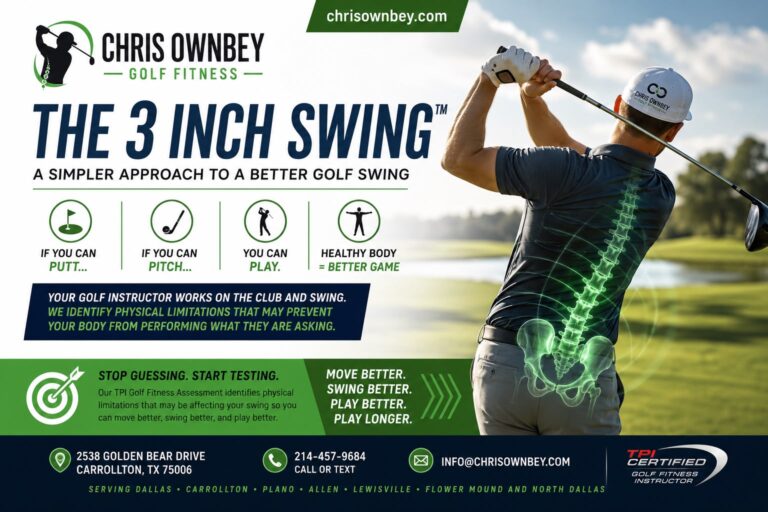
A TPI Golf Fitness Assessment can help identify physical limitations that may affect your golf swing.
At Chris Ownbey Golf Fitness, the goal of the assessment is to evaluate how your body moves.
Areas may include:
Hip mobility
Thoracic rotation
Shoulder mobility
Core stability
Balance
Lower-body strength
Rotational movement
Posture
Golf-specific movement quality
This is not a medical diagnosis.
It does not replace your physician or your golf instructor.
It gives us information about your physical abilities.
Once we know where your limitations are, we can build the right system around them.
That is much more effective than guessing.
What Should Golfers Over 50 Train?
Golfers over 50 should focus on five major physical qualities:
Strength. Mobility. Stability. Balance. Power.
These qualities work together.
Mobility helps you get into the positions you need.
Strength helps you produce force.
Stability helps you control movement.
Balance helps you manage force.
Power helps you produce force quickly.
Leaving one area out can limit the entire system.
That does not mean every golfer needs the same amount of each.
Some golfers need more mobility.
Some need more strength.
Some may already be strong but need more speed and power.
That is why individualized programming matters.
Strength Training for Golfers Over 50
Do not be afraid to get stronger.
Strength training can be one of the most valuable things you do for both golf and long-term function.
Good golf strength training can include movements such as:
Squats
Hip hinges
Rows
Presses
Carries
Lunges
Core stability exercises
Rotational resistance exercises
The exact exercise is not the most important part.
The important part is choosing exercises appropriate for your body and progressing them safely.
You do not need to destroy yourself in the gym.
Consistency is more important than exhaustion.
The goal is to become stronger while still being able to practice and play golf.
Mobility Training Should Be Specific
Many golfers believe they simply need to stretch more.
Stretching can help, but mobility training should be specific to your limitations.
If your hips are restricted, focus on your hips.
If your thoracic spine is limited, address rotational mobility.
If your shoulders are restricted, determine what needs to improve.
Do not spend 30 minutes stretching areas that are not limiting you.
The goal is not to become as flexible as possible.
The goal is to create enough usable mobility for your golf swing.
Power Training Can Help Restore Athleticism
Once you have a foundation of strength and mobility, power training may become valuable.
Golf is explosive.
The club moves quickly.
Your body needs to create force quickly.
Appropriate power training may include:
Medicine-ball throws
Rotational throws
Explosive cable movements
Speed-focused resistance training
Controlled jump variations when appropriate
Golf-specific speed training
Power training should be based on quality, not fatigue.
You want fast, controlled movement.
Not sloppy reps because you are exhausted.
Cardio Matters More Than Many Golfers Think
Cardiovascular fitness does not directly create clubhead speed, but it can help you maintain your performance throughout the round.
Fatigue changes movement.
If your legs and core are exhausted on the back nine, your swing may become less efficient.
That is why cardiovascular fitness should be part of golf fitness.
Walking, biking and other low-impact cardiovascular exercise can help build the endurance needed to play and practice consistently.
You do not need to train like a marathon runner.
You simply need enough conditioning to support your golf.
Golf Fitness Does Not Replace Your Golf Instructor
Your golf instructor and golf fitness trainer solve different problems.
Your instructor focuses on technique.
Golf fitness focuses on physical ability.
The two should complement one another.
If your instructor wants more hip turn and you do not have enough hip mobility, golf fitness can help address the physical limitation.
If you want more speed and your mechanics are already solid, golf fitness can evaluate whether strength and power are missing.
If you struggle with posture, we can evaluate balance, stability and strength.
The goal is to help your body support the swing your instructor is trying to build.
Do Not Let Your Age Decide Your Golf Game
Turning 50 does not mean you have to accept getting weaker.
It does not mean you have to accept becoming stiff.
It does not mean you cannot train for speed.
What it does mean is that your training needs to become smarter.
Your body at 55 is not the same as your body at 25.
That is okay.
You do not need to train like you are 25.
You need to train for the golfer you are today and the golfer you want to be in the future.
That means building strength.
Maintaining mobility.
Improving balance.
Developing power.
Supporting recovery.
And training consistently.
The goal is not only to play better golf right now.
The goal is to build a body capable of playing golf for decades.
Build a Stronger Body for More Distance
If you have lost distance after 50, do not automatically assume your golf swing is broken.
Do not immediately buy another driver.
Do not simply swing harder.
Look at the entire physical system behind the swing.
Your mobility.
Your strength.
Your stability.
Your balance.
Your power.
Your endurance.
All of these qualities influence how efficiently your body can produce a golf swing.
Your golf club is important.
Your technique is important.
But neither one can replace the body holding the club.
Your golf instructor works on your swing.
Your equipment helps optimize performance.
Golf fitness works on the body producing the swing.
That is why improving the body can be such an important part of improving the game.
Ready to Find Out What May Be Costing You Distance?
If you are a golfer over 50 who is losing distance, swing speed, mobility or strength, the first step is finding out what your body may be struggling to do.
A TPI Golf Fitness Assessment can help identify golf-specific limitations in mobility, strength, balance and stability.
From there, we can build the right system around your body, your golf game and your goals.
Hit the Ball Farther. Move Better. Play Golf Longer.
Call or fill out the form today to schedule your TPI Golf Fitness Assessment with Chris Ownbey Golf Fitness.
Serving golfers throughout Dallas, Carrollton, Plano, Frisco, Lewisville, Castle Hills and North Dallas.
Chris Ownbey Golf Fitness
214-457-9684
ChrisOwnbey.com
TPI Level 1 & Level 2 Golf Fitness Professional
TPI Certified Since 2006
Other related topics:
- Is Your Body Limiting Your Golf Swing? Golf Fitness Dallas
- Why Your Back Hurts After Playing Golf: The Hidden Cause Most Golfers Never Address
- Why Strength Matters for Golfers Over 50
- Straddle Stretch for Golfers | Dallas Golf Fitness
- Golf Fitness in Dallas – How to Increase Speed, power, and Distance While Preventing Injuries
- How to cure your golf slice in the golf fitness studio
- If you are suffering from lower back pain. Try this stretch.